CM Himanta credits Modi decade for 49.6 cr lifted from poverty
Synopsis
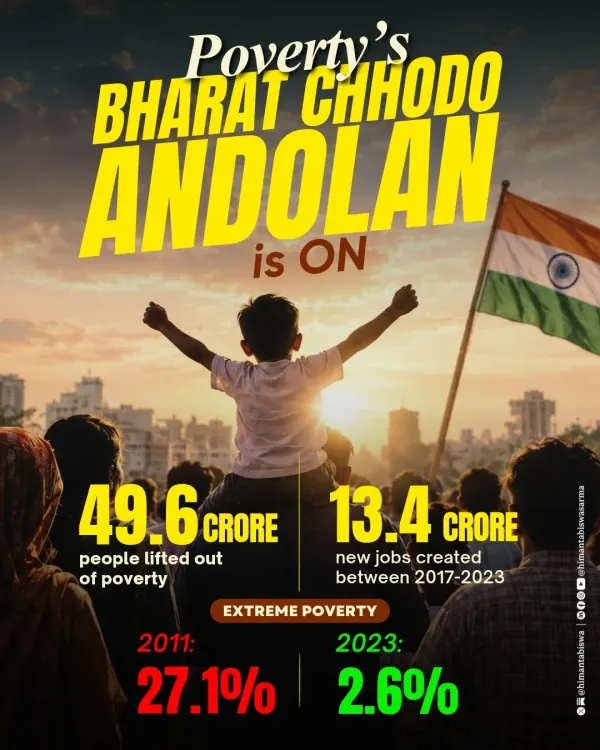
Assam CM Himanta Biswa Sarma declared on 31 October 2026 that the Modi government's decade of welfare delivery lifted 49.6 crore people from poverty and created 14.6 crore jobs — framing it as the mandate for 2029.
Key Takeaways
Assam CM Himanta Biswa Sarma posted on 31 October 2026 that the past decade constitutes the biggest andolan against poverty in India's history.
He cited 49.6 crore people lifted out of poverty and 14.6 crore new job opportunities created — figures NationPress could not independently verify against a single published official dataset.
NITI Aayog's Multidimensional Poverty Index reports from 2023 and 2024 do confirm a significant cumulative decline in multidimensional poverty since the 2015-16 baseline.
Flagship schemes underpinning the claim include PM Awas Yojana (2015) , PM Ujjwala Yojana (2016) , and Ayushman Bharat (2018) .
Sarma explicitly framed the outcomes as the mandate Indians voted for in 2014, 2019 , and 2024 , projecting continued support in 2029 .
The next Periodic Labour Force Survey report and an updated NITI Aayog MPI release will be critical reference points for evaluating the specific figures cited.
A decade of welfare delivery, Assam Chief Minister Himanta Biswa Sarma argued on Saturday, 31 October 2026, has produced what he called the biggest andolan (movement) against poverty in India's history — one that pulled 49.6 crore people out of deprivation and created 14.6 crore new job opportunities.
The numbers behind the claim
Sarma's post frames the figures as the defining record of three consecutive BJP electoral mandates — 2014, 2019, and 2024 — and projects the momentum forward to 2029. The headline statistics — 49.6 crore people lifted from poverty and 14.6 crore jobs created — have not been directly matched to a single, widely published official report; NationPress could not independently verify these precise figures against pre-existing public datasets.
The broader trajectory, however, is documented. NITI Aayog's Multidimensional Poverty Index reports, released in 2023 and 2024, do record a substantial cumulative decline in multidimensional poverty in India since the 2015-16 baseline — one of the steepest reductions tracked among large economies in that window.
The welfare architecture underpinning the argument
The policy scaffolding Sarma points to is real and well-documented. Prime Minister Narendra Modi's government rolled out a suite of flagship schemes in rapid succession: PM Awas Yojana (affordable housing, 2015), PM Ujjwala Yojana (clean cooking fuel for below-poverty-line households, 2016), and Ayushman Bharat (health insurance cover for the poorest families, 2018). Together, these programmes targeted the structural underpinnings of rural deprivation — shelter, energy access, healthcare costs — simultaneously.
That layered approach is precisely what NITI Aayog's MPI methodology captures: not just income, but the composite weight of overlapping deprivations. When multiple schemes land together on the same household, the index needle moves fast. That is the statistical story the BJP has consistently cited as evidence of intentional, rather than incidental, poverty reduction.
Electoral framing and the 2029 horizon
Sarma's post is explicitly electoral in its close. Framing welfare outcomes as a democratic verdict — 'the new India people voted for in 2014, 2019 and 2024 and will again vote for in 2029' — turns a development argument into a prospectus. It is a pattern recognisable across the party's state-level leadership: amplify central scheme outcomes to pre-load the narrative well before a campaign cycle opens.
The 2029 general election reference is a forward projection, not a scheduled announcement — but as a messaging signal, it is unambiguous. Sarma, as convenor of the North-East Democratic Alliance (NEDA), carries the welfare-delivery argument across a region where scheme penetration has historically been patchy and where such claims carry particular electoral weight.
The next Periodic Labour Force Survey annual report and an updated NITI Aayog MPI release will be the real referees of whether the specific figures in the post hold up to independent scrutiny — and both sides of the political debate will be watching closely.
Point of View
14.6 crore jobs — exceed what has been publicly anchored in a single official dataset, which leaves them open to opposition challenge on methodology. Yet the underlying NITI Aayog MPI trend is genuine and well-documented, giving the broader argument a defensible empirical floor. For a NEDA convenor operating in the northeast, where welfare penetration is both a policy imperative and an electoral multiplier, tying regional scheme delivery to national outcome data is a calculated and durable messaging strategy.
NationPress
31 Oct 2026
Frequently Asked Questions
How many people has India lifted out of poverty under the Modi government according to Himanta Sarma?
According to Assam CM Himanta Biswa Sarma's post on 31 October 2026, the Modi government lifted 49.6 crore (approximately 496 million) people out of poverty over the past decade, though this specific figure has not been matched to a single widely published official report.
What does NITI Aayog's Multidimensional Poverty Index say about India's poverty reduction?
NITI Aayog's MPI reports from 2023 and 2024 document a substantial cumulative decline in multidimensional poverty in India since the 2015-16 baseline, recording one of the steepest reductions among large economies in that period.
Which welfare schemes did the Modi government launch to reduce poverty?
Key flagship schemes include PM Awas Yojana (affordable housing, 2015), PM Ujjwala Yojana (clean cooking fuel for BPL households, 2016), and Ayushman Bharat (health insurance for the poorest families, 2018).
Why is Himanta Biswa Sarma already talking about the 2029 election?
As a senior BJP leader and NEDA convenor, Sarma is using welfare-delivery data to reinforce the party's electoral narrative well ahead of the 2029 general election — a common pre-cycle messaging strategy for state-level BJP leaders.
What is NEDA and what is Himanta Sarma's role in it?
The North-East Democratic Alliance (NEDA) is a BJP-led political alliance of parties in India's northeastern states. Himanta Biswa Sarma serves as its convenor, making him a key figure in projecting the party's regional electoral strategy.