49.6 crore lifted out of poverty, 14.6 crore jobs in a decade: Himanta Sarma

Synopsis
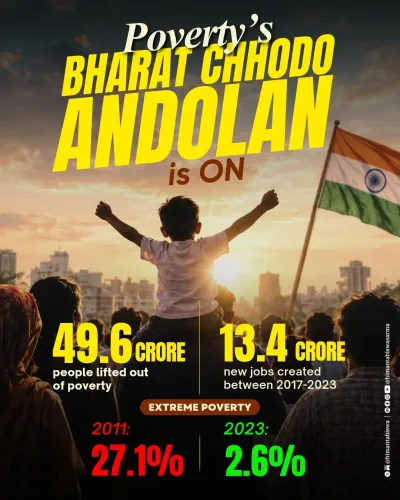
Assam CM Himanta Biswa Sarma has put a striking number on the table — 49.6 crore people out of poverty and 14.6 crore new jobs in ten years — framing it as India's biggest-ever anti-poverty drive. With the 2029 election signal already embedded in his post, the BJP is evidently moving to lock in its development record as the defining pitch for the next national vote.
Key Takeaways
Assam Chief Minister Himanta Biswa Sarma claimed on 31 October 2026 that 49.6 crore people have been lifted out of poverty over the last decade.
14.6 crore new job opportunities were reportedly created during the same period, according to Sarma.
Sarma credited the achievements to Prime Minister Narendra Modi 's leadership since 2014 .
He said people voted for the BJP -led government in 2014 , 2019 , and 2024 , and would do so again in 2029 .
Independent methodologies for measuring poverty vary, and the exact figures remain a subject of ongoing policy debate.
Assam Chief Minister Himanta Biswa Sarma on Saturday, 31 October 2026, claimed that 49.6 crore people have been lifted out of poverty and 14.6 crore new job opportunities created over the last decade, describing it as the largest anti-poverty movement in India's history. Sarma attributed both milestones to the country's transformation under Prime Minister Narendra Modi since 2014.
What Sarma Said
Posting on X, Sarma framed the figures as proof of a decade-long 'andolan' — a movement — against poverty. 'The biggest andolan against poverty has been waged in India in the last decade and the results?' he wrote, before citing the poverty reduction and employment generation numbers.
He further linked the achievements to the electoral mandate the Bharatiya Janata Party (BJP)-led government received in the 2014, 2019, and 2024 Lok Sabha elections, arguing that voters backed a development-first political vision each time.
The 2029 Election Signal
Sarma's remarks carry an explicit forward-looking dimension. He expressed confidence that the same political vision would secure public backing in the 2029 general elections, positioning the development narrative as the ruling party's central electoral pitch well ahead of the next national poll.
This comes amid continuing political discourse over poverty alleviation, employment generation, and the pace of economic progress under the Modi government — themes that opposition parties, including the Indian National Congress, have consistently contested with alternative data and assessments.
Context: BJP's Development Narrative
The Centre has consistently highlighted welfare initiatives — including financial inclusion programmes, direct benefit transfers, rural infrastructure development, and employment-linked schemes — as contributors to poverty reduction. The BJP has made these figures a cornerstone of its broader development argument across successive election cycles.
Notably, independent assessments of poverty data in India vary depending on the methodology used — whether multidimensional poverty indices, consumption-based surveys, or income thresholds. The figures cited by Sarma reportedly draw from government and multilateral datasets, though independent verification of the exact numbers remains a subject of ongoing academic and policy debate.
What It Means for India's Political Landscape
Sarma's statement, made from Guwahati, reflects the ruling party's confidence in carrying its decade-long development record into the next electoral cycle. For a party that came to power in 2014 on a promise of inclusive growth, the ability to credibly claim mass poverty reduction and job creation remains strategically vital — particularly as opposition voices sharpen their scrutiny of employment quality, wage levels, and the reliability of poverty metrics ahead of 2029.
Point of View
Consumption surveys, or income benchmarks, and no single set of numbers is universally accepted. The claim of 14.6 crore jobs is equally contested: critics distinguish between formal employment creation and informal or gig-economy participation, where income volatility remains high. What is clear is that the BJP is already road-testing its 2029 pitch, and poverty alleviation will be its anchor argument. The opposition's counter-narrative — which centres on jobless growth and wage stagnation — will need equally granular data to dent it.
NationPress
31 Oct 2026
Frequently Asked Questions
What did Assam CM Himanta Biswa Sarma claim about poverty reduction in India?
Sarma claimed that 49.6 crore people have been lifted out of poverty in India over the last decade, describing it as the biggest anti-poverty movement in the country's history. He attributed the achievement to Prime Minister Narendra Modi's government since 2014.
How many jobs does Sarma say were created in the last decade?
Sarma claimed that 14.6 crore new job opportunities were created over the last decade under the Modi government. This figure covers the period from 2014 to the present, though independent assessments of employment data vary by methodology.
Why did Sarma make these remarks on 31 October 2026?
The remarks came amid continuing national discourse on poverty alleviation and employment generation, and also serve as an early signal of the BJP's development-centric narrative for the 2029 general elections . Sarma explicitly expressed confidence that voters would back the same political vision again in 2029.
Are the poverty reduction figures independently verified?
The figures cited by Sarma reportedly draw from government and multilateral datasets, but independent verification of the exact numbers is subject to ongoing academic and policy debate. Different poverty measurement methodologies — multidimensional indices, consumption surveys, income thresholds — can produce varying results.
What is the BJP's broader development narrative on poverty and jobs?
The BJP has consistently highlighted welfare initiatives including direct benefit transfers, financial inclusion, rural infrastructure, and employment-linked schemes as contributors to poverty reduction. These achievements have been central to the party's electoral pitch across the 2014, 2019, and 2024 Lok Sabha elections.