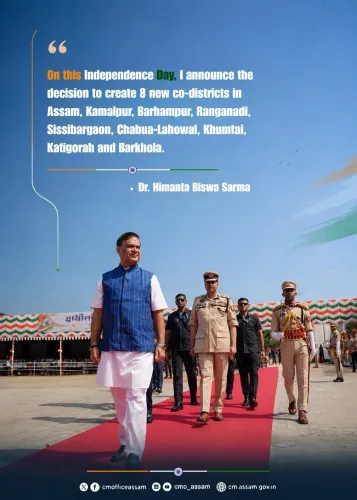
CM Himanta expands Assam's Co-district model with 8 new units

Synopsis
Assam CM Himanta Biswa Sarma announced 8 new Co-districts on August 18, 2026, taking the state's decentralisation experiment to 47 units and deepening administrative access for citizens across Assam's diverse geography.
Key Takeaways
8 new Co-districts will be created in Assam, taking the total to 47 .
39 Co-districts are already operational under the Sarma government's governance model.
The Co-district framework is designed to bring administrative services closer to citizens, reducing dependence on a single district headquarters.
CM Sarma framed the expansion under the #EaseOfGovernance banner, mirroring Centre-level ease-of-living frameworks.
Assam has 35 official districts , many geographically vast or seasonally inaccessible, making decentralisation a structural necessity.
Eight new administrative units are coming to Assam — and they signal a quiet but deliberate rewiring of how the state delivers governance to its citizens. Assam Chief Minister Himanta Biswa Sarma announced on Tuesday, August 18, 2026 that his government will add 8 more Co-districts to the existing 39, expanding a decentralisation model he has positioned as the backbone of his administration's 'Ease of Governance' agenda.
What the Co-district model actually does
The Co-district framework is designed to reduce the distance — literal and bureaucratic — between a citizen and the nearest seat of government authority. Rather than requiring residents of remote or large districts to travel to a single district headquarters for administrative services, Co-districts create additional sub-district-level nodes that carry meaningful administrative powers. With 39 Co-districts already operational across Assam, the model has moved well past the pilot stage.
CM Sarma framed the expansion in direct terms: 'Good governance begins when the Government comes closer to the people.' The addition of 8 new Co-districts will bring the total to 47, spreading that administrative reach further into the state's diverse geography — which spans the Brahmaputra valley, the Barak valley, and a string of hill districts with historically thin government presence.
Assam's geography and the governance gap it creates
Assam's administrative challenge is structural. The state has 35 districts, several of which are vast, flood-prone, or cut off seasonally — making a single district headquarters a distant and often inaccessible destination for large swathes of the population. The Co-district model is a direct answer to that friction: bring the paperwork, the certificates, the grievance redressal, and the official stamp closer to where people actually live.
The Sarma government has consistently used the phrase #EaseOfGovernance to brand this push — a deliberate echo of the Centre's 'Ease of Living' and 'Ease of Doing Business' frameworks, applied to the mechanics of everyday administration.
47 Co-districts and what comes next for Assam
The announcement does not yet name which regions will receive the 8 new Co-districts, leaving the specifics of geography and jurisdiction for a formal order. But the direction is clear: Sarma is doubling down on administrative decentralisation as a signature governance bet — one that, if it delivers measurable service improvements, could become a model other states in the North-East look to replicate.
Forty-seven Co-districts across one state is not a footnote. It is an architecture.
Point of View
Accessible government. With 47 Co-districts eventually in place across a state of roughly 35 million people, Assam would have one of the densest sub-district administrative networks in the North-East. The move also pre-empts a familiar critique of BJP-led state governments — that development stays concentrated in urban centres — by pushing the apparatus of the state into peripheral geographies. Whether the Co-districts are staffed, funded, and empowered adequately will determine if the model delivers real 'Ease of Governance' or just a new layer of bureaucracy.
NationPress
18 Aug 2026
Frequently Asked Questions
What is the Co-district model in Assam?
The Co-district model creates additional sub-district-level administrative units in Assam, allowing citizens to access government services closer to where they live rather than travelling to a single district headquarters. Assam already has 39 Co-districts operational as of August 2026.
How many Co-districts will Assam have after the new announcement?
After CM Himanta Biswa Sarma's announcement of 8 new Co-districts on August 18, 2026, Assam will have a total of 47 Co-districts .
Why is Assam creating more Co-districts?
Assam's geography — spanning large, flood-prone, and seasonally inaccessible areas — makes a single district headquarters difficult to reach for many residents. The Co-district model is designed to bring administration closer to citizens, reducing bureaucratic distance.
What is Ease of Governance in Assam?
Ease of Governance is a framework championed by CM Himanta Biswa Sarma to streamline and decentralise administrative services in Assam, making government more accessible to ordinary citizens — particularly in remote and underserved regions.
How many districts does Assam have?
Assam has 35 official districts . The Co-district model supplements these by creating additional administrative nodes within or alongside existing districts to improve service delivery.