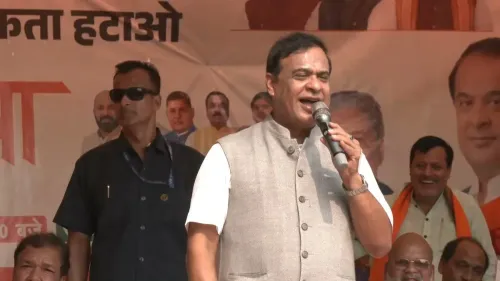
CM Himanta fires back: EVM, CBI, ED are Congress creations

Synopsis
Assam CM Himanta Biswa Sarma turned the Congress party's institutional-misuse allegations back on itself on 20 November 2026, noting that the CBI, ED, and EVMs were all built under Congress governments — framing the complaints as an indictment of Congress-era governance.
Key Takeaways
Assam CM Himanta Biswa Sarma posted on 20 November 2026 that EVMs, CBI, and ED were created by Congress governments.
The Enforcement Directorate was constituted in 1956 and the CBI in 1963 , both under Congress-led administrations.
Electronic Voting Machines were first used in Indian elections in 1982 under a Congress government in a Kerala bypoll.
Sarma argued that Congress-era governance was so weak it left these institutions vulnerable to the misuse the party now alleges.
The post is part of a broader BJP counter-narrative as ED and CBI cases involving opposition figures have intensified through the 2020s.
As NEDA convenor, Sarma's framing signals a coordinated national BJP talking point ahead of potential legislative debates.
Who built the machinery, and who now cries foul about it? Assam Chief Minister Himanta Biswa Sarma sharpened that question on Friday, 20 November 2026, posting a pointed Hindi-language challenge at the Congress party over its complaints about the misuse of central institutions.
Sarma's post, in Hindi, translates directly: 'EVM, CBI, ED sab Congress sarkaaron ka prakalp hain. Aur ab ye ro rahe hain ki sab misuse ho raha hai.' — 'EVMs, the CBI, and the ED are all projects of Congress governments. And now they are crying that everything is being misused. Their governance was so weak that the very institutions they built are all being misused?'
The institutions Congress built — and the row they sparked
The targets of Sarma's post have concrete founding histories. The Enforcement Directorate was constituted in 1956 under the Ministry of Finance to administer foreign exchange laws, with its mandate later expanding to money-laundering cases. The Central Bureau of Investigation came into being in 1963 under the Delhi Special Police Establishment Act framework — both during Congress-led central governments. Electronic Voting Machines entered Indian elections as early as 1982, first deployed in a Kerala bypoll under a Congress administration, before being scaled nationally over subsequent decades.
Sarma's argument is a compressed, two-part jab: Congress authored these institutions, and Congress-era governance was so deficient that it left them structurally vulnerable to the very abuse the party now protests. It is a rhetorical inversion the BJP has deployed with increasing regularity as ED and CBI cases involving opposition figures have multiplied through the 2020s.
A longer war over institutional independence
The dispute over whether central agencies are tools of the ruling party or independent bodies has shadowed Indian politics for decades — but it has grown louder and more personal in recent years. The Congress and other opposition parties have consistently accused the current central government of weaponising the ED and CBI against political opponents, pointing to the timing of raids and arrests ahead of state elections. The BJP's counter — crystallised here by Sarma — is that the architecture of these agencies was laid by Congress, making the complaints structurally ironic.
The EVM angle adds another layer. Congress and several regional parties have called repeatedly for a return to paper ballots, alleging that electronic voting is susceptible to manipulation. Sarma's grouping of EVMs alongside CBI and ED in a single sentence frames electoral-technology scepticism as an admission of Congress-era institutional fragility rather than a credible reform demand.
As a senior BJP voice and convenor of the North-East Democratic Alliance (NEDA), Sarma's broadsides carry weight beyond Assam — they signal a coordinated national talking point. Expect Congress spokespersons to respond, and watch for any parliamentary floor time on proposed changes to ED and CBI functioning.
Point of View
The ED, and the CBI into a single historical indictment, he collapses three distinct debates (electoral integrity, law enforcement autonomy, and anti-corruption architecture) into one political liability for Congress. The move is tactically effective because it is factually grounded: the founding dates are real. But it sidesteps the substantive question of whether inherited institutions have been used differently under successive governments. As national and state polls approach, this framing will likely harden into a standard BJP rebuttal whenever institutional misuse is raised.
NationPress
20 Nov 2026
Frequently Asked Questions
Who created the CBI in India?
The Central Bureau of Investigation was established in 1963 under the Delhi Special Police Establishment Act framework during a Congress-led central government.
When was the Enforcement Directorate set up?
The Enforcement Directorate was constituted in 1956 under the Ministry of Finance to administer foreign exchange laws, also during Congress rule.
When were EVMs first used in Indian elections?
Electronic Voting Machines were first deployed in a 1982 Kerala bypoll under a Congress-led administration and were later scaled to national elections.
What did Himanta Biswa Sarma say about Congress and central institutions?
Sarma posted that EVMs, CBI, and ED were all created by Congress governments, arguing that Congress-era governance was so weak it left these institutions open to the misuse the party now alleges.
Why does the BJP-Congress row over CBI and ED matter?
The dispute goes to the heart of institutional independence in India — opposition parties allege agencies are deployed against political rivals, while the BJP argues the agencies' founding under Congress undermines those complaints.