CM Himanta flags Japan-India Summit: 150+ firms, $12.5 bn security push
Synopsis
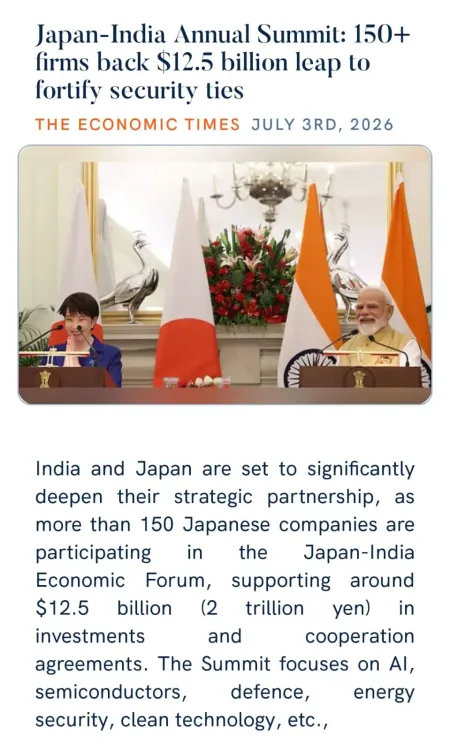
Assam Chief Minister Himanta Biswa Sarma flagged the Japan-India Annual Summit on 4 July 2026, noting that over 150 firms are backing a $12.5 billion commitment to deepen bilateral security and economic ties, building on a partnership formalised since 2006.
Key Takeaways
Assam CM Himanta Biswa Sarma shared details of the Japan-India Annual Summit on 4 July 2026 .
More than 150 firms are backing a $12.5 billion investment to fortify Japan-India security ties.
The bilateral partnership dates to the India-Japan Strategic and Global Partnership of 2006 , deepened by a 2008 defence pact and a 2011 trade agreement.
Japan joined India's Act East Policy in 2017 via the India-Japan Act East Forum , directing investments toward Assam and the Northeast .
Private-sector participation at this scale signals a maturing of the public-private model within the Indo-Pacific strategic framework.
Follow-up project execution in Northeast India and new defence or technology-transfer pacts are the key near-term milestones to watch.
Assam Chief Minister Himanta Biswa Sarma on Saturday, 4 July 2026, shared details of the Japan-India Annual Summit, highlighting that more than 150 firms are backing a $12.5 billion investment aimed at fortifying bilateral security ties between the two nations.
Context
The Japan-India Annual Summit is an institutionalised high-level dialogue that has served as the cornerstone of bilateral engagement since the India-Japan Strategic and Global Partnership was formalised in 2006. The two countries deepened their framework through a 2008 defence cooperation agreement and the Comprehensive Economic Partnership Agreement, which came into force in 2011. CM Sarma has consistently spotlighted this partnership, given that Japanese official development assistance and corporate investment have targeted road, power, and industrial corridors in Assam and the broader Northeast since the mid-2010s.
Policy Backdrop
Prime Minister Narendra Modi has prioritised annual summits and strategic agreements with Japan since 2014, embedding economic instruments within the security cooperation architecture. A pivotal moment came in 2017 when Japan joined India's Act East Policy through the India-Japan Act East Forum, directly targeting connectivity projects in Assam and other northeastern states. This convergence of private-sector capital with government-to-government mechanisms — including the 2+2 dialogue and regular joint military exercises — has defined the current phase of the relationship.
The participation of more than 150 firms in the latest summit signals a maturing of that public-private model, where corporate commitments are being woven into the strategic fabric of the Indo-Pacific framework. The $12.5 billion figure, as shared by CM Sarma, underscores the scale at which economic engagement is now being deployed to reinforce defence and security objectives.
Stakeholders and Impact
Japanese firms, India's defence and infrastructure sectors, and the Northeast states — particularly Assam — stand as the primary stakeholders in this expanded partnership. For Assam, Japanese investment has historically translated into tangible infrastructure upgrades: road corridors, power projects, and industrial zones that carry both economic and strategic significance given the state's proximity to international borders. CM Sarma's role as convenor of the North-East Democratic Alliance (NEDA) amplifies his interest in ensuring that summit-level commitments cascade down to ground-level project execution in the region.
The Indian defence sector, meanwhile, stands to benefit from technology-transfer and co-production arrangements that have grown alongside the government-to-government security dialogue. Broader private-sector participation could accelerate timelines for projects that have historically moved slowly through bureaucratic channels.
What's Next
Observers will watch for follow-up announcements on specific project execution in Assam and the broader Northeast, as well as any parliamentary or cabinet approvals for new defence or technology-transfer pacts emerging from the summit. The scale of corporate backing — 150+ firms and $12.5 billion — sets a high benchmark, and the speed at which these commitments are converted into signed agreements and on-ground activity will determine the summit's lasting impact. For Northeast India, the stakes are particularly high: deeper Japan-India economic integration could reshape connectivity and industrial development across the region for the next decade.
Point of View
He is reinforcing a narrative that BJP-governed frontier states are central to India's foreign policy dividends. The $12.5 billion figure, if it translates into committed projects, would mark a qualitative shift from ODA-driven to market-led Japanese engagement in the region. This also strengthens Sarma's standing as the Northeast's principal interlocutor on national security and economic diplomacy.
NationPress
4 Jul 2026
Frequently Asked Questions
What is the Japan-India Annual Summit?
The Japan-India Annual Summit is an institutionalised high-level dialogue between the two governments, held yearly to review progress on security, economic, and technology cooperation under the India-Japan Strategic and Global Partnership established in 2006.
What is the $12.5 billion Japan-India investment about?
According to the post shared by Assam CM Himanta Biswa Sarma, more than 150 firms are backing a $12.5 billion commitment aimed at fortifying security and economic ties between Japan and India at the 2026 Annual Summit.
How does the Japan-India partnership affect Northeast India?
Japan joined India's Act East Policy through the India-Japan Act East Forum in 2017, directing investments into road, power, and industrial corridors in Assam and other Northeast states, giving the region strategic and economic significance in the bilateral relationship.
Why did CM Himanta Biswa Sarma share this Japan-India summit post?
As Assam Chief Minister and NEDA convenor, Sarma has a direct stake in Japan-India economic cooperation, since Japanese ODA and corporate investments have historically targeted infrastructure projects in Assam and the Northeast.
What is India's Act East Policy and Japan's role in it?
Act East Policy is India's outreach initiative launched in 2014 to deepen engagement with Southeast and East Asian nations. Japan formally joined through the India-Japan Act East Forum in 2017, co-funding connectivity and infrastructure projects in India's northeastern states.