CM Himanta Flags Off Somnath Yatra 2026 From Guwahati

Synopsis
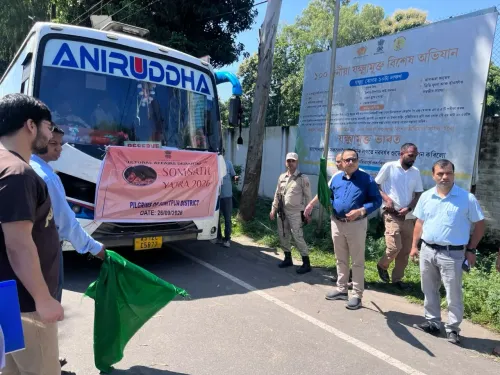
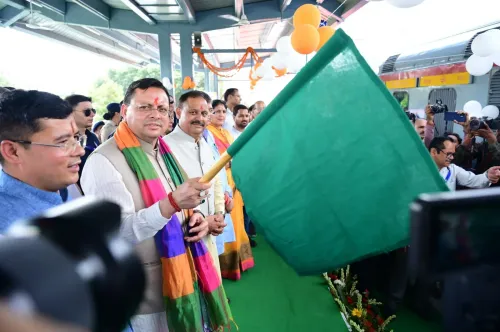
The Assam Chief Minister's Office flagged off the historic SomnathYatra2026 from Kamakhya Railway Station, Guwahati, on September 26, 2026, with 1,042 pilgrims heading to the sacred Jyotirlinga shrine of Somnath Dham in Gujarat. CM Himanta Biswa Sarma extended his blessings for a safe journey.
Key Takeaways
1,042 pilgrims from Assam were flagged off on the SomnathYatra2026 on September 26, 2026 .
The yatra departed from Kamakhya Railway Station, Guwahati , adjacent to the revered Kamakhya Shakti Peeth.
The destination is Shri Somnath Dham , the first of the twelve Jyotirlinga shrines, located in Prabhas Patan, Gujarat .
Himanta Biswa Sarma extended personal best wishes for a safe journey and a blessed darshan of Mahadev.
The initiative reflects the Assam government's push to organise state-sponsored pilgrimages connecting northeastern devotees with major sacred sites across India.
1,042 pilgrims from Assam boarded their train at Kamakhya Railway Station, Guwahati, on Saturday, September 26, 2026, setting off on a journey that spans the length of India — from the sacred foothills of Kamakhya in the east to the ancient Jyotirlinga of Somnath Dham on Gujarat's western coast. The historic #SomnathYatra2026 was formally flagged off by the Chief Minister's Office of Assam, with Chief Minister Dr. Himanta Biswa Sarma extending his personal best wishes for a safe journey and a blessed darshan of Mahadev.
Kamakhya to Somnath: A Journey Between Two Sacred Poles
The yatra's departure point is itself laden with meaning. Kamakhya Railway Station sits adjacent to the Kamakhya Temple, one of the most revered Shakti Peethas in the country — making the send-off a symbolic passage from one axis of Hindu sacred geography to another. The destination, Shri Somnath Dham in Prabhas Patan, Gujarat, is the first and arguably the most storied of the twelve Jyotirlinga shrines dedicated to Lord Shiva, rebuilt in its present form in the 1950s after centuries of destruction and reconstruction.
For devout pilgrims from the northeast, reaching Somnath has historically meant navigating vast distances independently. An organised state-facilitated yatra compresses that barrier — offering safety in numbers, logistical support, and the collective energy of over a thousand fellow devotees on the same sacred mission.
Assam's Organised Pilgrimage Push Under Dr. Himanta
Dr. Himanta Biswa Sarma, who has served as Chief Minister of Assam since May 2021 under the BJP, has made state-sponsored cultural and religious connectivity a visible strand of his governance agenda. State governments across India periodically organise group pilgrimages to major Jyotirlinga and other sacred sites, with the twin goal of deepening cultural bonds between distant regions and making spiritually significant travel accessible to those who might otherwise lack the resources or logistics to undertake it alone.
The northeast's geographic distance from the great pilgrimage centres of western and central India has long been a practical obstacle for devotees. Rail-based group yatras — especially when flagged off with state-level ceremony — signal institutional commitment to closing that gap.
What the Pilgrims Carry Home
Beyond the personal dimension of darshan, organised yatras like this one quietly serve as threads in a larger national-cultural weave — weaving together communities from Assam with the shared devotional landscape that stretches from Rameswaram to Kedarnath, from Kamakhya to Somnath. 1,042 pilgrims will return to Assam carrying not only blessings from Mahadev but lived experience of India's extraordinary geographic and spiritual breadth.
Watch for announcements on subsequent phases of the yatra — or extensions to other Jyotirlinga shrines — as the Assam government signals whether this becomes a recurring programme on the state's religious-tourism calendar.
Point of View
Reinforcing Assam's civilisational ties with the broader Hindu sacred geography at a time when northeastern states are being more visibly integrated into India's national mainstream. Organised pilgrimages serve the BJP's broader ideological grammar of cultural nationalism while delivering tangible benefit to ordinary devotees who face real geographic and financial barriers. The choice of Somnath — India's most symbolically resonant Jyotirlinga, rebuilt after Partition as an assertion of civilisational continuity — amplifies the political subtext. If the programme is institutionalised as an annual or multi-phase yatra, it could become a durable pillar of Assam's religious-tourism policy.
NationPress
26 Sept 2026
Frequently Asked Questions
What is the SomnathYatra2026 from Assam?
The SomnathYatra2026 is a state-organised pilgrimage in which 1,042 pilgrims from Assam departed Kamakhya Railway Station, Guwahati on September 26, 2026, to visit the Jyotirlinga shrine of Shri Somnath Dham in Prabhas Patan, Gujarat.
Who flagged off the Somnath Yatra 2026?
The yatra was flagged off by the Chief Minister's Office of Assam. Chief Minister Dr. Himanta Biswa Sarma extended his best wishes to all 1,042 pilgrims for a safe journey and a blessed darshan of Mahadev.
Where is Somnath Dham located?
Somnath Dham is located in Prabhas Patan, Gujarat. It is the first of the twelve Jyotirlinga shrines dedicated to Lord Shiva and was rebuilt in its current form in the 1950s.
Why does Assam organise group pilgrimages to Somnath?
The northeast is geographically distant from major pilgrimage centres in western India. State-organised group yatras provide logistical support and make sacred travel accessible to devotees who might otherwise struggle to make the journey independently.
How many pilgrims travelled on the Somnath Yatra 2026 from Assam?
A total of 1,042 pilgrims from Assam participated in the SomnathYatra2026, departing from Kamakhya Railway Station in Guwahati.