CM Himanta Hails Anti-Cheating Bill Passed in Lok Sabha

Synopsis
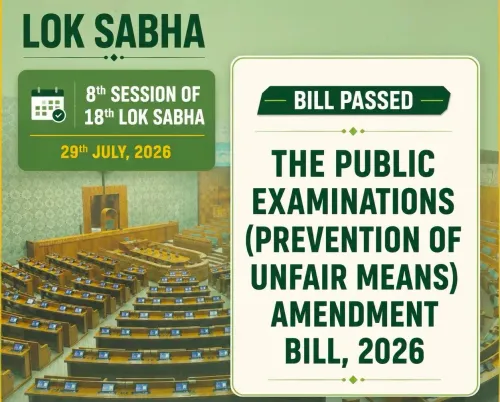
The Lok Sabha passed the Public Examinations (Prevention of Unfair Means) Amendment Bill, 2026 on July 29, introducing strict punishments, Special Fast Track Courts, and time-bound investigations to combat examination fraud. Assam CM Himanta Biswa Sarma welcomed the passage, calling it a step toward integrity and fairness for India's students.
Key Takeaways
The Lok Sabha passed the Public Examinations (Prevention of Unfair Means) Amendment Bill, 2026 on July 29, 2026 .
The bill mandates strict punishments for examination misconduct and guarantees time-bound investigations .
Special Fast Track Courts will be established to adjudicate cases of examination fraud.
The original anti-cheating legislation was first introduced in Parliament in 2024 , targeting malpractices including paper leaks in national exams.
Assam CM Himanta Biswa Sarma praised the bill as a step toward a fair, transparent examination system under PM Narendra Modi's leadership.
The bill must still clear the Rajya Sabha before it becomes law; state-level court infrastructure will then need to be established.
A legislative push to clean up India's examination system cleared a major hurdle on Wednesday, July 29, 2026, as the Lok Sabha passed the Public Examinations (Prevention of Unfair Means) Amendment Bill, 2026 — drawing congratulations from Assam Chief Minister Himanta Biswa Sarma, who called it a landmark step toward a fair and transparent future for students across the country.
What the Amendment Bill Puts on the Table
The bill, as described by CM Sarma, moves well beyond a symbolic gesture. It mandates strict punishments for examination misconduct, establishes Special Fast Track Courts to hear such cases, and guarantees time-bound investigations — a direct answer to the slow, opaque processes that have allowed examination fraud to fester in the past. 'This bill will strengthen the examination process in India, maintain its integrity and provide students a fair and transparent system,' Sarma wrote on X.
The original Public Examinations (Prevention of Unfair Means) Bill was first introduced in Parliament in 2024, targeting malpractices such as paper leaks in national-level examinations. The 2026 Amendment builds on that foundation, sharpening its enforcement teeth.
The Paper-Leak Shadow This Bill Is Meant to Erase
The legislation does not emerge in a vacuum. India's competitive examination ecosystem — anchored by high-stakes tests like NEET and JEE — has been rocked in recent years by controversies over leaked question papers and systemic irregularities. Each scandal eroded student confidence and sparked nationwide protests, placing enormous pressure on the central government to act structurally rather than reactively. The creation of dedicated Special Fast Track Courts signals precisely that shift: from ad hoc damage control to institutionalised accountability.
The bill's passage through the Lok Sabha is a significant milestone, but the full legislative journey is not yet complete. Its progress in the Rajya Sabha, and the subsequent groundwork of setting up the fast-track court infrastructure at both central and state levels, will determine how quickly its protections reach the students it promises to serve.
Modi Government's Commitment — and What Comes Next
CM Sarma credited the momentum to Prime Minister Narendra Modi, stating that 'under the leadership of Adarniya Modi ji, the Central Govt remains committed to a better future for our students.' For BJP-governed states like Assam, the bill also creates a state-level implementation obligation — standing up investigation mechanisms and court infrastructure that can actually deliver on the law's promise. The real test begins after the Rajya Sabha vote.
Point of View
The legislation attempts to close the accountability gap that allowed past paper-leak scandals to drag through slow legal processes with little deterrence. For the BJP, the bill also carries political utility: framing the party as the guarantor of meritocracy ahead of future electoral cycles where youth disillusionment over exam fraud has proven to be a mobilising issue. The real measure of success, however, will be implementation speed — how quickly the courts are constituted and whether state governments translate the central mandate into functioning infrastructure.
NationPress
30 Jul 2026
Frequently Asked Questions
What is the Public Examinations (Prevention of Unfair Means) Amendment Bill, 2026?
It is a bill passed by the Lok Sabha on July 29, 2026, that strengthens India's examination laws by introducing strict punishments for misconduct, establishing Special Fast Track Courts, and ensuring time-bound investigations into examination fraud such as paper leaks.
What are Special Fast Track Courts under the exam anti-cheating bill?
Special Fast Track Courts are dedicated judicial bodies proposed under the bill to hear and resolve examination misconduct cases quickly, reducing the delays that previously allowed such cases to linger without consequence.
Why was an anti-cheating exam law needed in India?
India's high-stakes national examinations, including NEET and JEE, have faced repeated controversies over question paper leaks and irregularities, eroding student trust and triggering widespread protests, making stronger legislative action necessary.
Has the anti-exam-fraud bill become law yet?
Not yet. The bill passed the Lok Sabha on July 29, 2026, but must still be approved by the Rajya Sabha before it can be enacted into law.
Why did Assam CM Himanta Biswa Sarma comment on the exam bill?
As a senior BJP leader and Chief Minister of Assam, Himanta Biswa Sarma welcomed the bill's passage, congratulating students nationwide and crediting Prime Minister Narendra Modi's government for the legislative push toward examination integrity.