Kishan Reddy Hails Lok Sabha Nod to Exam Anti-Cheating Bill

Synopsis
The Lok Sabha passed the Public Examinations (Prevention of Unfair Means) Amendment Bill-2026 on 29 July, introducing fast-track courts, special prosecutors, and time-bound probes against paper-leak syndicates. Union Minister G. Kishan Reddy hailed the vote as a historic safeguard for millions of exam aspirants.
Key Takeaways
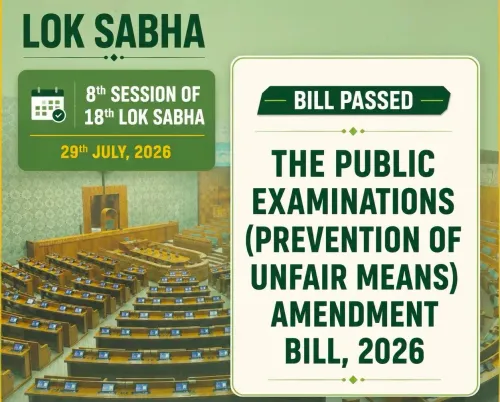
Lok Sabha passed the Public Examinations (Prevention of Unfair Means) Amendment Bill-2026 on 29 July 2026 .
The bill mandates fast-track courts and special public prosecutors for examination fraud cases.
It amends the parent Public Examinations (Prevention of Unfair Means) Act, 2024 , enacted after multiple paper leak scandals.
Jitendra Singh , Minister of State (IC) for Science and Technology, introduced and steered the bill on the floor.
Kishan Reddy credited cross-party support for the bill's passage.
The bill now heads to the Rajya Sabha for final approval before it can become law.
A bill that could reshape the future of millions of exam aspirants cleared the Lok Sabha on Wednesday, 29 July 2026 — and Union Coal and Mines Minister G. Kishan Reddy called it a moment of historic reckoning for India's battered public examination system.
Posting in Telugu, Kishan Reddy described the passage of the Public Examinations (Prevention of Unfair Means) Amendment Bill-2026 as 'ఎంతో సంతోషకరం' — 'a matter of immense joy' — and framed the legislation as a shield for the 'lakhs of youth who study day and night.' The post reflects the broader anxiety gripping a generation of aspirants who have watched hard-earned preparation unravel because of organised paper-leak networks.
What the Amendment Actually Does
The 2026 bill builds on the foundational Public Examinations (Prevention of Unfair Means) Act, 2024, which was itself a legislative reaction to a string of high-profile paper leak scandals — including those that shook confidence in national-level medical and state recruitment tests. The amendment sharpens the teeth of that law with a set of procedural reinforcements: fast-track courts dedicated to examination fraud cases, special public prosecutors, and mandatory time-bound investigations that prevent cases from dying quietly in overcrowded dockets.
Together, these provisions target the organised syndicates — the 'gangs,' as Kishan Reddy put it — that treat question papers as a commodity. Speed and specialisation are the twin bets: fast-track courts remove the delay that has historically let accused networks regroup, while dedicated prosecutors ensure the state is not outgunned in complex conspiracy cases.
Dr. Jitendra Singh's Role on the Floor
Dr. Jitendra Singh, Minister of State (Independent Charge) for Science and Technology and Earth Sciences, piloted the bill through the lower house. Kishan Reddy singled him out for 'effectively introducing the bill and resolving members' doubts' — a nod to what appears to have been a cross-party floor debate that the minister navigated successfully. Kishan Reddy also thanked members from all political parties who backed the bill, framing the vote as a rare moment of parliamentary consensus on governance reform.
The Leak Epidemic That Made This Necessary
India's recurring paper-leak crisis is not a new story — it is a systemic wound. From state police recruitment drives to national entrance tests, leaked question papers have repeatedly forced mass cancellations, re-examinations, and prolonged court battles, each cycle eroding the trust of a younger generation already navigating fierce competition for limited government posts. The 2024 parent act was a first legislative salvo; the 2026 amendment is the follow-through, tightening the institutional machinery that converts a law on paper into consequences in a courtroom.
The bill now moves to the Rajya Sabha, where its passage will determine how soon fast-track courts can be constituted and special prosecutors notified. That is where the reform's real test begins.
Point of View
It attempts to close the gap between legislative intent and courtroom reality that has plagued India's anti-cheating framework since 2024. The cross-party support Kishan Reddy highlighted is politically significant: it signals that exam integrity has become a rare consensus issue in a polarised Parliament, likely because the aspirant vote cuts across every constituency. Whether the amendment's promise holds will depend entirely on how quickly the executive notifies rules and funds the new court infrastructure — the Rajya Sabha passage is the next milestone, but implementation is the real verdict.
NationPress
28 Oct 2026
Frequently Asked Questions
What is the Public Examinations Amendment Bill 2026?
The Public Examinations (Prevention of Unfair Means) Amendment Bill-2026 is legislation passed by the Lok Sabha on 29 July 2026 that strengthens India's existing 2024 anti-cheating law by adding fast-track courts, special public prosecutors, and time-bound investigation mandates to tackle paper leak syndicates in government recruitment and entrance exams.
Who introduced the exam anti-cheating bill in Lok Sabha?
Dr. Jitendra Singh, Minister of State (Independent Charge) for Science and Technology and Earth Sciences, introduced and piloted the Public Examinations Amendment Bill-2026 on the floor of the Lok Sabha.
What is the difference between the 2024 act and the 2026 amendment?
The Public Examinations (Prevention of Unfair Means) Act, 2024 established the foundational legal framework against exam malpractice. The 2026 amendment adds procedural muscle — fast-track courts, special prosecutors, and mandatory time-bound probes — to make enforcement faster and more effective.
Has the exam anti-leak bill become law yet?
Not yet. The bill passed the Lok Sabha on 29 July 2026 and must clear the Rajya Sabha before it can receive presidential assent and become law.
Why is India passing laws against paper leaks in exams?
Recurring paper leak scandals in exams — including national entrance tests and state recruitment drives — have forced mass cancellations and re-examinations, undermining the trust of millions of aspirants. Legislative responses with stricter penalties and faster courts are aimed at restoring credibility in the selection process.