Kishan Reddy Hails Lok Sabha Passage of Anti-Exam Fraud Bill
Synopsis
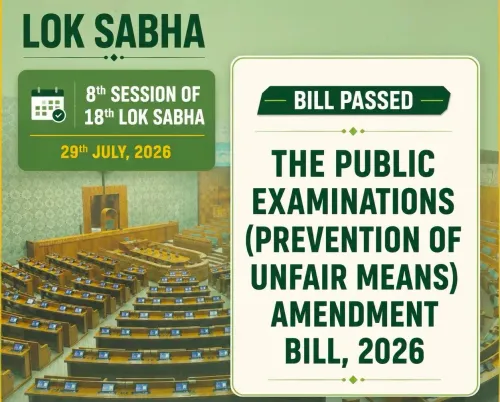
The Lok Sabha passed the Public Examinations (Prevention of Unfair Means) Amendment Bill, 2026, on 29 July, tightening the 2024 anti-fraud law with Fast Track Courts, Special Prosecutors, and stricter penalties. Union Minister G. Kishan Reddy welcomed the cross-party passage.
Key Takeaways
The Lok Sabha passed the Public Examinations (Prevention of Unfair Means) Amendment Bill, 2026 on 29 July 2026 .
The bill amends the Public Examinations (Prevention of Unfair Means) Act, 2024 , which was India's first dedicated anti-exam-fraud legislation.
Key provisions include dedicated Fast Track Courts , Special Public Prosecutors , stricter punishments, time-bound investigations, and a streamlined appeals process.
Union Minister of State Dr.
Jitendra Singh presented the bill and steered the Lok Sabha debate.
The bill received cross-party support in the lower house, reflecting broad political consensus on combating examination malpractice.
The bill must now pass the Rajya Sabha before it can be notified into law and its institutional machinery operationalised.
Millions of young Indians who sit gruelling competitive examinations — only to watch their futures derailed by paper leaks and organised fraud — got a legislative answer on Wednesday, 29 July 2026, when the Lok Sabha passed the Public Examinations (Prevention of Unfair Means) Amendment Bill, 2026. Union Coal and Mines Minister G. Kishan Reddy welcomed the development, calling it a reform that 'further strengthens the legal framework for safeguarding the sanctity of public examinations.'
What the Amendment Actually Does
The bill is not a fresh start — it is a sharpening of a blade already forged. The Public Examinations (Prevention of Unfair Means) Act, 2024 was Parliament's first dedicated response to the wave of malpractice that had rocked high-stakes exams conducted by bodies including UPSC, SSC, and NTA. The 2026 amendment now goes further: stricter punishments, dedicated Fast Track Courts, time-bound investigations, Special Public Prosecutors, and a streamlined appeals process. Each provision targets a specific gap that fraudsters have historically exploited — slow trials, diffuse prosecution, and penalties too light to deter organised syndicates.Cross-Party Consensus in the Lower House
Rarely does a governance bill clear the Lok Sabha without friction. This one did. Kishan Reddy explicitly thanked 'all Members of Parliament and political parties who came together in support of this important legislation' — a signal that the cross-party consensus reflects how politically toxic examination fraud has become across every constituency in India. The bill was presented by Union Minister of State Dr. Jitendra Singh, who holds independent charge of Science and Technology and Earth Sciences, and also serves as MoS in the Prime Minister's Office, DoPT, Atomic Energy, and Space. Kishan Reddy praised Singh for his 'clear and comprehensive presentation' and for 'effectively addressing the concerns and suggestions raised by Members during the debate.'The Road the Bill Still Has to Travel
Lok Sabha passage is a milestone, not a finish line. The bill must now clear the Rajya Sabha before it can be notified into law. After that, the government will need to operationalise the institutional machinery the amendment envisions — designating Fast Track Courts, appointing Special Public Prosecutors, and framing rules for time-bound investigations. How quickly that machinery is assembled will determine whether the law becomes a genuine deterrent or another statute that aspirants read about but never feel. For the lakhs of students who prepare for years only to face a compromised question paper, the clock is already running.Point of View
Class, and region. The real test, however, is institutional: Fast Track Courts and Special Prosecutors exist on paper in several domains yet remain understaffed in practice. Whether this bill becomes a credible deterrent or a well-worded statute depends almost entirely on how fast the executive builds the machinery behind it.
NationPress
13 Sept 2026
Frequently Asked Questions
What is the Public Examinations (Prevention of Unfair Means) Amendment Bill, 2026?
It is a 2026 amendment to the Public Examinations (Prevention of Unfair Means) Act, 2024, introducing stricter punishments, Fast Track Courts, time-bound investigations, Special Public Prosecutors, and a streamlined appeals process to combat paper leaks and organised examination fraud in India.
Has the exam fraud bill been passed in Parliament?
The Lok Sabha passed the bill on 29 July 2026 . It still needs to clear the Rajya Sabha before it becomes law.
Who presented the Public Examinations Amendment Bill in Lok Sabha?
Union Minister of State Dr. Jitendra Singh, who holds independent charge of Science and Technology and Earth Sciences and is also MoS in the Prime Minister's Office and DoPT, presented the bill and led the debate.
What were the paper leak cases that led to this law?
Repeated incidents of question-paper leaks in exams conducted by bodies such as UPSC, SSC, and NTA prompted Parliament to first enact the 2024 Act and subsequently strengthen it through the 2026 amendment.
What are Fast Track Courts under the exam fraud bill?
The amendment provides for dedicated Fast Track Courts to ensure speedy trial of examination fraud cases, paired with Special Public Prosecutors and time-bound investigation norms to close the loopholes that allowed cases to drag on for years.