CM Himanta Salutes Bordoloni's Wildlife-Coexistence Legacy
Synopsis
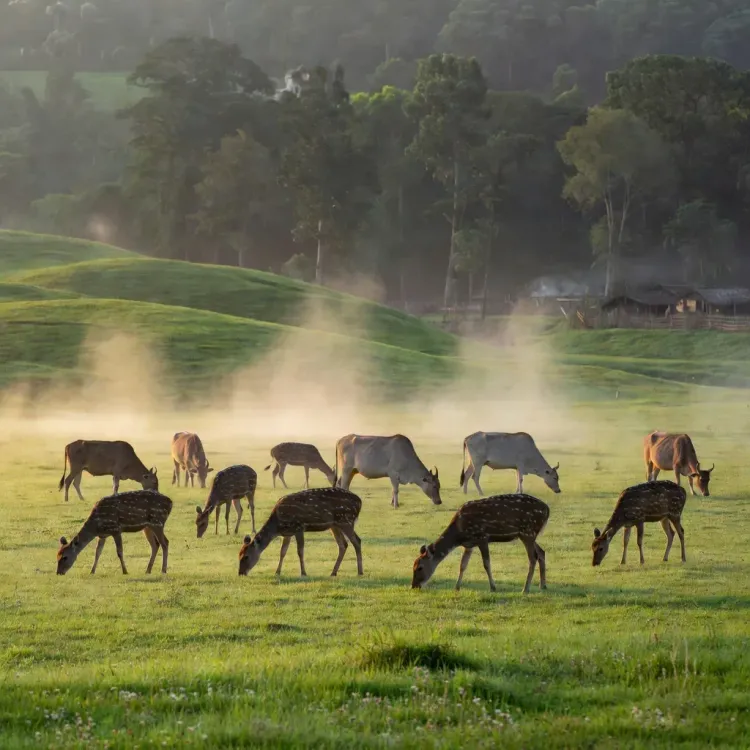
Assam Chief Minister Himanta Biswa Sarma publicly praised the people of Bordoloni for sustaining Maghuahola as a multigenerational haven where deer and wildlife coexist peacefully alongside domestic cattle — spotlighting community-led conservation in the Northeast.
Key Takeaways
Assam CM Himanta Biswa Sarma praised the community of Bordoloni on 10 October 2026 for their conservation efforts.
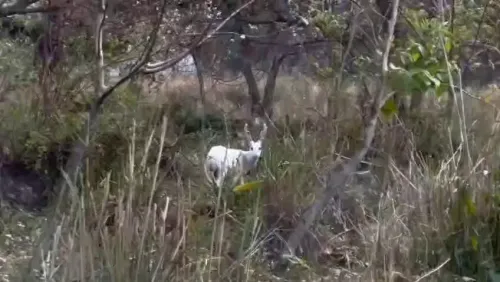
The site Maghuahola is described as a haven where deer and other wildlife coexist with cattle across generations.
The acknowledgement highlights community-led, voluntary wildlife coexistence as a model distinct from formal protected areas.
Northeast India's biodiversity depends heavily on such community conservation zones outside official forest boundaries.
State-level public recognition by the Chief Minister signals policy-level appreciation for grassroots conservation compacts.
In a corner of Assam where cattle and deer share the same grassland, a community has quietly been doing what conservation policy often struggles to achieve. Assam Chief Minister Himanta Biswa Sarma on Saturday, 10 October 2026, praised the people of Bordoloni for turning Maghuahola into a living sanctuary — one built not on fences and forest officers, but on generations of collective will.
Sarma wrote: 'When communities come together, nature thrives. For generations, Bordoloni's people have made Maghuahola a haven where deer and other wildlife live alongside their cattle. My heartfelt appreciation to the community for nurturing this beautiful bond with nature.'
Maghuahola: Where Deer Graze Beside Cattle
The site of Maghuahola, as described by the Chief Minister, represents a model of community-led coexistence that conservationists call one of the hardest outcomes to engineer top-down. Deer — animals that typically retreat from human settlement — sharing grazing land with domestic cattle signals an unusually deep, long-standing truce between the village and the wild. The fact that this has held across generations speaks to a cultural compact, not a seasonal truce.
Bordoloni's Quiet Conservation Compact
Community conservation areas across Assam and the broader Northeast have increasingly drawn attention as buffers between protected forests and human habitation. Villages that voluntarily restrict hunting, discourage encroachment, and tolerate wildlife on farmland perform a function that formal wildlife corridors cannot always replicate. Bordoloni's Maghuahola appears to be exactly this kind of unsung node in the region's ecological web.
Sarma's public acknowledgement does more than offer praise — it signals state-level recognition of a practice that often goes unrewarded and unrecorded. In a political climate where land-use and forest-rights tensions frequently dominate headlines in the Northeast, a Chief Minister spotlighting voluntary coexistence sends a pointed message about which model of conservation the state finds worth celebrating.
Why This Moment Matters Beyond One Village
Northeast India sits within one of the world's most significant biodiversity hotspots. Assam alone is home to the Kaziranga National Park, a UNESCO World Heritage Site, and several elephant and tiger reserves. Yet much of the region's wildlife survives outside formal protected areas — in community forests, village commons, and agricultural fringes exactly like Maghuahola. The long-term health of that wildlife depends almost entirely on whether communities choose coexistence or conflict.
When a state's Chief Minister takes a moment to name a village, name a place, and say 'thank you' — that is soft policy in action. It costs nothing and can shift everything.
Bordoloni's story is a reminder that the most durable conservation victories are rarely announced with a press release — they are simply lived, quietly, for generations.
Point of View
High-signal political gesture: by naming a specific village and a specific site, he frames community conservation as a BJP-aligned governance value in Assam without invoking any legislation or budget. In the Northeast, where forest-rights disputes and ethnic land tensions are perennial flashpoints, celebrating voluntary coexistence is a deliberate counter-narrative. It also positions Assam's model of community-state partnership in biodiversity management as something worth replicating — a soft pitch to both voters in rural Assam and to a national audience watching the state's environmental record.
NationPress
10 Oct 2026
Frequently Asked Questions
Where is Maghuahola located?
Maghuahola is located in or near Bordoloni in Assam , India. Assam CM Himanta Biswa Sarma described it as a community-protected haven where deer and wildlife coexist with cattle.
Why did Himanta Biswa Sarma praise Bordoloni?
Sarma praised Bordoloni's community for maintaining Maghuahola as a multigenerational wildlife coexistence zone where deer and other animals live peacefully alongside domestic cattle — an example of voluntary, community-led conservation.
What is community conservation in Assam?
Community conservation in Assam refers to villages voluntarily protecting wildlife and forests outside formal protected areas. Sites like Maghuahola, where locals restrict hunting and tolerate wildlife on shared land, are key examples.
What wildlife is found at Maghuahola?
According to CM Sarma's post, deer and other wildlife are found at Maghuahola, coexisting with the cattle of Bordoloni's residents.
Why does community wildlife coexistence matter in Northeast India?
Northeast India is a global biodiversity hotspot. Much of its wildlife survives outside formal sanctuaries, making community goodwill and voluntary coexistence — as seen in Bordoloni — critical to long-term conservation across the region.