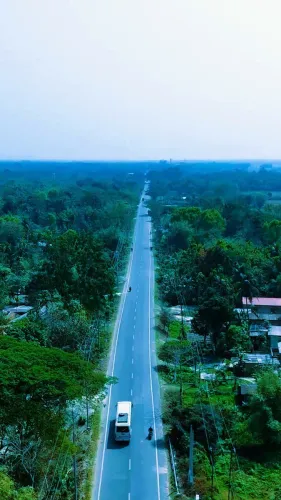
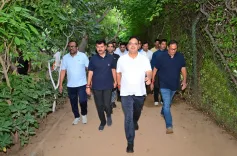
CM Himanta heads to Tinsukia, reflects on eastern Assam's transformation
Synopsis
Assam Chief Minister Himanta Biswa Sarma travelled to Tinsukia on October 28, 2026, sharing public reflections on the easternmost district's transformation — signalling continued political focus on border-district development under the BJP-led state government.
Key Takeaways
Assam CM Himanta Biswa Sarma visited Tinsukia , one of the state's easternmost districts, on October 28, 2026 .
Tinsukia borders Arunachal Pradesh and sits near Myanmar , with economic significance in tea, oil, and cross-border trade.
The Chief Minister publicly shared reflections on the region's transformation while in transit, continuing a pattern of high-visibility district visits.
Eastern Assam has been a focus of the BJP-led state government since 2016 , with investments in road connectivity and trade facilitation.
Specific project announcements or policy outcomes from this visit are expected in follow-up official communications.
From the far eastern edge of India's map, Assam Chief Minister Himanta Biswa Sarma is making a point — and making the journey to prove it. On Wednesday, October 28, 2026, as he travelled toward Tinsukia, one of the state's easternmost districts, the Chief Minister shared reflections on the region's development arc, posting his thoughts publicly on X.
Why Tinsukia commands attention
Tinsukia is not a routine stop on any political circuit. Nestled against the borders of Arunachal Pradesh and within striking distance of Myanmar, the district anchors Assam's eastern frontier — economically significant for its tea estates, oil production, and potential as a cross-border trade corridor. For decades, its distance from Guwahati translated directly into distance from development.
That calculus has been shifting. Since the BJP-led state government came to power in 2016, eastern and border districts have been drawn into a broader push for infrastructure and connectivity. Road linkages, trade facilitation, and resource-based economic growth have gradually brought Tinsukia closer to the mainstream — at least on policy maps.
A Chief Minister who governs on the road
Sarma's practice of travelling to outlying districts — and flagging the visits publicly — has become a signature of his administrative style. The act of 'jotting down thoughts' en route signals something deliberate: governance as a continuous, visible exercise rather than a desk-bound one. The public post invites scrutiny and builds a narrative of personal investment in peripheral regions.
Eastern Assam residents and local businesses in Tinsukia represent the direct audience for whatever specific projects or announcements follow from this visit. The broader audience is the state's voters, who have watched successive governments promise connectivity to border districts and deliver unevenly.
The integration imperative for border districts
Tinsukia's geography is both its challenge and its opportunity. Border districts in India's Northeast carry strategic weight — they are where national connectivity policy meets ground-level reality. Under the current administration, the integration of remote areas into mainstream development has been framed not just as welfare but as strategic necessity. A prosperous, well-connected Tinsukia is a more stable Tinsukia.
The specific thoughts Sarma referenced in his post — and any project announcements likely to follow — will be the real measure of this visit's significance. Until those details emerge, the journey itself is the signal: the Chief Minister is watching the eastern edge closely.
Point of View
Keeping border districts in the public eye serves both developmental and electoral logic. The real test will be whether this visit produces concrete, measurable outcomes in connectivity or economic uplift that local residents and businesses can actually point to.
NationPress
28 Oct 2026
Frequently Asked Questions
Why did Assam CM Himanta Biswa Sarma visit Tinsukia?
CM Himanta Biswa Sarma travelled to Tinsukia on October 28, 2026, and shared reflections on the district's development transformation, continuing his practice of visiting Assam's outlying border districts to highlight governance progress.
Where is Tinsukia located in Assam?
Tinsukia is one of Assam's easternmost districts, bordering Arunachal Pradesh and situated near Myanmar, making it economically significant for tea production, oil resources, and cross-border trade.
What development work has been done in eastern Assam under CM Himanta?
Since the BJP-led government came to power in Assam in 2016, eastern and border districts including Tinsukia have received investment in road connectivity, trade facilitation, and resource-based economic development to reduce regional disparities.
What is the strategic importance of Tinsukia for Assam?
Tinsukia's proximity to Arunachal Pradesh and Myanmar gives it strategic significance as a frontier trade corridor, while its tea estates and oil production make it one of eastern Assam's most economically important districts.
How does CM Himanta engage with remote districts of Assam?
CM Himanta Biswa Sarma regularly visits outlying and border districts and shares his observations publicly on social media, a practice that has become a visible part of his administrative style and political communication.