CM Himanta pays tribute to Mising scholar Taburam Taid on Punyatithi
Synopsis
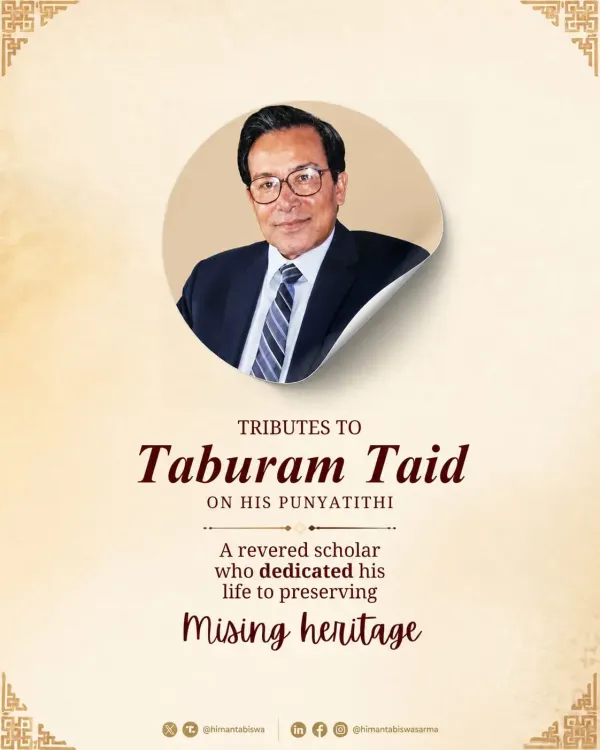
Assam Chief Minister Himanta Biswa Sarma remembered scholar Taburam Taid on his Punyatithi, honouring Taid's lifelong contributions to preserving the Mising language, literature, and cultural heritage — a community central to Assam's tribal identity.
Key Takeaways
Assam CM Himanta Biswa Sarma paid tribute to Taburam Taid on his Punyatithi on 17 August 2026 .
Taid is recognised for lifelong work in preserving and enriching the Mising language, literature, and cultural heritage .
The Mising are one of Assam's largest plains tribal communities, with a Tibeto-Burman linguistic tradition.
Assam political leaders regularly issue public tributes to scholars from indigenous communities as part of the state's cultural acknowledgment practice.
No new policy announcement accompanied the tribute; it forms part of routine commemorative recognition.
On the Punyatithi of Taburam Taid, Assam Chief Minister Himanta Biswa Sarma paused to honour a scholar whose life's work was devoted to keeping the Mising language and its literary traditions alive — a quiet but consequential act of cultural stewardship that the state is now formally acknowledging.
Sarma described Taid as an 'eminent scholar' whose 'lifelong work in preserving and enriching the Mising language, literature and cultural heritage remains an invaluable contribution to Assam.' The tribute, posted on 17 August 2026, underscores the continued visibility that indigenous linguistic figures command in Assam's public discourse.
Who the Mising are — and why their language matters
The Mising are one of Assam's largest plains tribal communities, primarily settled along the banks of the Brahmaputra and its tributaries in districts such as Dhemaji and Lakhimpur. Their language, also called Mising, belongs to the Tibeto-Burman family and carries an oral literary tradition of considerable depth — one that remains vulnerable in an era of rapid linguistic homogenisation.
Scholars like Taid occupy a rare position: part linguist, part archivist, part cultural anchor. Their work — documenting oral poetry, codifying grammar, producing literature — forms the institutional memory of a community whose language has no large commercial publishing ecosystem behind it.
Assam's tradition of honouring indigenous cultural figures
Tributes of this kind are a recurring feature of Assam's political calendar. State leaders periodically mark the death anniversaries of scholars, poets, and cultural workers from the state's tribal and indigenous communities — a practice that reflects both genuine cultural plurality and the political salience of community recognition in a state with over 30 scheduled tribes.
For the Mising community, such public acknowledgment from the Chief Minister carries symbolic weight, signalling that their linguistic heritage is part of Assam's mainstream identity — not a footnote to it.
Point of View
Recognition from the Chief Minister elevates their cultural figures into the mainstream narrative of Assam's identity. Whether such commemorations translate into sustained institutional support for endangered languages — dedicated curricula, publishing grants, digital archiving — remains the sharper question these tributes invariably raise but rarely answer.
NationPress
1 Oct 2026
Frequently Asked Questions
Who was Taburam Taid?
Taburam Taid was an eminent scholar known for his lifelong work in preserving and enriching the Mising language, literature, and cultural heritage of Assam. Specific biographical details beyond his scholarly contributions are not publicly documented in available records.
Who are the Mising people of Assam?
The Mising are one of Assam's largest plains tribal communities, primarily living along the Brahmaputra river belt in districts like Dhemaji and Lakhimpur. They speak the Mising language, a Tibeto-Burman tongue with a rich oral literary tradition.
Why did CM Himanta Biswa Sarma pay tribute to Taburam Taid?
CM Sarma paid tribute on Taid's Punyatithi to honour his invaluable contributions to the Mising language and cultural heritage, reflecting Assam's practice of publicly recognising scholars from indigenous communities.
What is the significance of Mising language preservation in Assam?
The Mising language belongs to the Tibeto-Burman family and lacks a large commercial publishing ecosystem, making scholarly preservation work critical to preventing linguistic erosion. Assam's recognition of such efforts signals the state's commitment to its tribal linguistic diversity.