CM Himanta Pays Tribute to Anandaram Dhekial Phukan
Synopsis
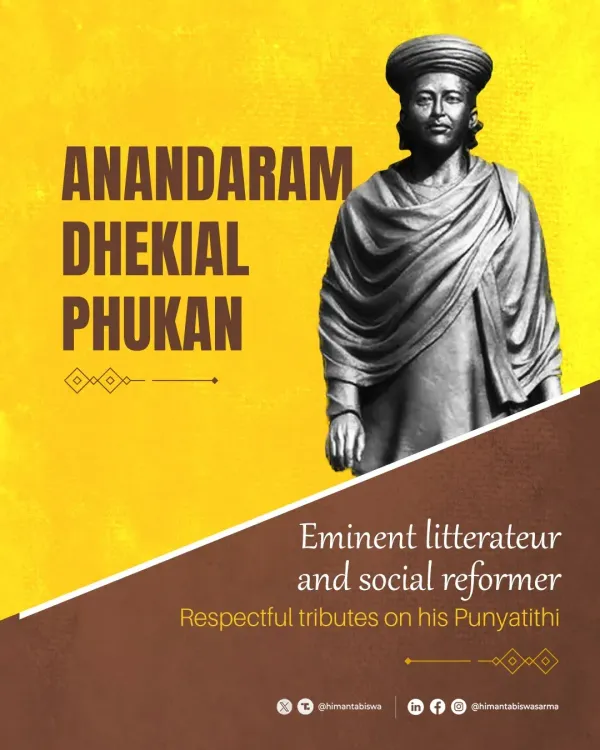
Assam Chief Minister Himanta Biswa Sarma on June 16, 2026, remembered Anandaram Dhekial Phukan on his Punyatithi, calling the 19th-century scholar and social reformer a defining force in modern Assamese literary thought whose legacy endures in the state's culture and language.
Key Takeaways
Himanta Biswa Sarma paid tribute to Anandaram Dhekial Phukan on his Punyatithi on June 16, 2026 .
Anandaram Dhekial Phukan (1829–1859) was a pioneering Assamese litterateur and social reformer who championed Assamese as the language of education and administration.
He opposed the colonial imposition of Bengali in Assam and also campaigned against opium addiction in Assamese society.
His advocacy is seen as a forerunner to the Assam Official Language Act, 1960 , which formally recognised Assamese as the state's official language.
The tribute reflects a broader pattern of the Assam government invoking pre-independence regional intellectuals to reinforce the state's distinct linguistic and cultural identity.
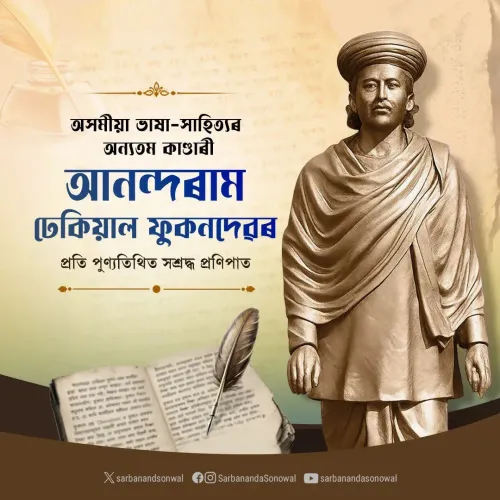
Assam Chief Minister Himanta Biswa Sarma on Tuesday, June 16, 2026, paid tribute to Anandaram Dhekial Phukan on his Punyatithi, honouring the 19th-century Assamese scholar and social reformer as a 'pioneering litterateur' whose legacy continues to shape the state's literary and cultural identity.
Context
Anandaram Dhekial Phukan (1829–1859) was among the most consequential voices of the 19th-century Assamese literary renaissance. In a short life of just thirty years, he championed the use of Assamese as the medium of instruction in schools and as the language of administration — at a time when Bengali had been imposed on the region by colonial authorities. His reformist writings also took direct aim at the social ill of opium addiction, which had taken a severe toll on Assamese society under British rule.
Chief Minister Sarma described him as having 'played a defining role in shaping modern Assamese literary thought,' adding that 'his writings and reformist ideas continue to enrich Assam's literary and cultural legacy.'
Policy Backdrop
Dhekial Phukan's advocacy for the Assamese language laid an intellectual foundation that would take formal shape more than a century later with the Assam Official Language Act, 1960, which recognised Assamese as the state's official language. His push for Assamese in education and courts is now seen as an early pillar of the broader language-rights movement in the Northeast.
The current state government has maintained an active interest in promoting Assamese in schools and public administration, even as it navigates the region's complex multilingual demographics. Periodic public commemorations of pre-independence intellectuals form part of this broader cultural policy posture.
Stakeholders and Impact
The tribute resonates most directly with Assam's literary community, language educators, and cultural organisations that have long sought greater institutional recognition for regional literary heritage. Dhekial Phukan is regarded as a founding figure in modern Assamese prose, and his Punyatithi is observed by scholars and cultural bodies across the state.
For a government that has repeatedly invoked regional identity as a pillar of its governance narrative, commemorating figures like Dhekial Phukan also serves to reinforce the state's distinct cultural consciousness within the broader Northeast India framework.
What's Next
Anniversaries around June associated with 19th-century Assamese reformers often prompt state-level announcements on literary awards, heritage events, or curriculum initiatives. Whether the government follows this tribute with any formal programme — such as a new literary prize, textbook inclusion, or archival project — remains to be seen. The broader pattern of such commemorations suggests they frequently serve as preludes to cultural policy announcements tied to regional identity.
Point of View
The CM signals continuity between historical language advocacy and present-day governance priorities. This is not merely ceremonial: such tributes often precede or accompany state-level cultural policy moves, from curriculum revisions to literary awards. In a multilingual Northeast where identity questions remain politically charged, the choice of whom to remember — and when — carries weight beyond sentiment.
NationPress
18 Sept 2026
Frequently Asked Questions
Who was Anandaram Dhekial Phukan?
Anandaram Dhekial Phukan (1829–1859) was a pioneering 19th-century Assamese scholar, litterateur, and social reformer who advocated for Assamese as the medium of instruction and administration, and campaigned against opium addiction in Assamese society.
Why is Anandaram Dhekial Phukan important to Assam?
He is considered a founding figure of modern Assamese prose and a key voice in the movement to restore Assamese as the language of education and courts during British colonial rule, laying groundwork for the Assam Official Language Act of 1960.
Why did CM Himanta Biswa Sarma pay tribute to Anandaram Dhekial Phukan?
Chief Minister Himanta Biswa Sarma paid tribute on Dhekial Phukan's Punyatithi on June 16, 2026, honouring his role as a pioneering litterateur and social reformer who shaped modern Assamese literary thought.
What is the Assam Official Language Act 1960?
The Assam Official Language Act, 1960 recognised Assamese as the official language of Assam, reflecting the language-rights advocacy that 19th-century reformers like Anandaram Dhekial Phukan had championed more than a century earlier.