CM Himanta Links Navratri's Brahmacharini to Nijut Moina Scheme
Synopsis
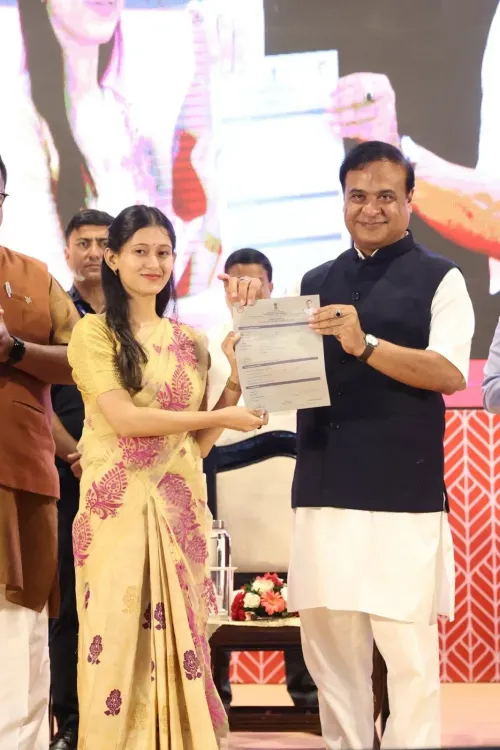
On Navratri Day Two, Assam CM Himanta Biswa Sarma linked the goddess Brahmacharini's spirit of tapasya to the Nijut Moina scheme, which provides girl students monthly stipends of ₹1,000 to ₹2,500 to fight dropout and child marriage.
Key Takeaways
CM Himanta Biswa Sarma highlighted Mukhya Mantrir Nijut Moina on the second day of Navratri, 12 October 2026 .
Girl students at Higher Secondary level receive ₹1,000/month ; graduation students receive ₹1,250/month ; post-graduate students receive ₹2,500/month .
Stipends are paid across ten months per academic year at government and government-aided institutions in Assam .
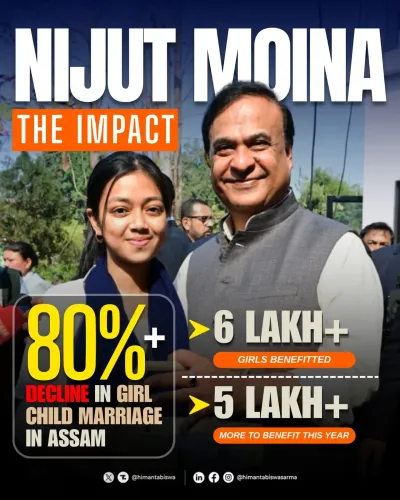
The scheme explicitly targets reduction of child marriage and early school dropout among girls.
CM Sarma framed a girl choosing education over early marriage as her own act of tapasya (spiritual discipline), mirroring the day's deity Maa Brahmacharini.
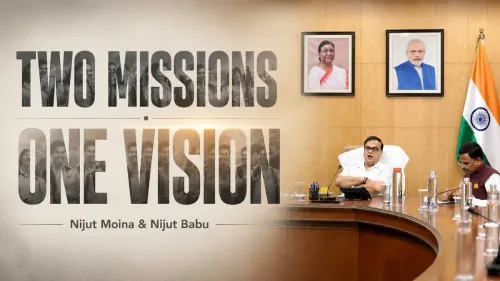
On the second day of Navratri, Assam Chief Minister Himanta Biswa Sarma wove together the spirit of Maa Brahmacharini — goddess of tapasya and disciplined learning — with the State's flagship girl-education scheme, Mukhya Mantrir Nijut Moina, framing monthly stipends for girl students as a modern act of devotion.
What Nijut Moina promises — and to whom
The scheme reaches girl students enrolled in government and government-aided institutions across three levels of study. Students at the Higher Secondary stage receive ₹1,000 per month; those at the graduation level receive ₹1,250 per month; and post-graduate students receive ₹2,500 per month — all disbursed across ten months in an academic year.
CM Sarma was explicit about the scheme's dual purpose: 'This is not just a scholarship. It is a firm stand against child marriage and early dropout.' The framing positions financial support not as charity but as a structural signal — telling families that a daughter's continued education is an investment the State is prepared to co-fund.
Tapasya as metaphor — and as policy argument
Invoking Maa Brahmacharini — depicted carrying a rosary and a kamandal, symbols of sustained discipline — CM Sarma drew a deliberate parallel: 'When a girl chooses her books over an early marriage, she is performing her own tapasya.' The religious occasion gave the policy argument an unusually intimate register, speaking to families for whom the Navratri narrative carries cultural weight.
Assam has historically recorded some of the highest rates of child marriage in India, making schemes that create direct financial incentives for keeping girls in school a live policy priority. By attaching the stipend to institutional enrolment, Nijut Moina ties the benefit to continued attendance rather than a one-time grant.
Why the Navratri timing is deliberate
Each of the nine nights of Navratri is associated with a different form of the goddess Durga. Day Two belongs to Brahmacharini — the form associated with knowledge, penance, and the pursuit of wisdom. Announcing or amplifying an education-for-girls scheme on this specific day is a calculated act of alignment: the goddess's attributes mirror the policy's stated goals almost point for point.
The Chief Minister closed with a blessing: 'May Maa Brahmacharini bless every Nijut Moina with focus, wisdom and the courage to dream without limits.' It is the language of a benediction — but behind it sits a structured welfare programme with three distinct stipend tiers and a statewide institutional footprint.
For the girls of Assam enrolled under Nijut Moina, the goddess's lesson is now also a monthly bank transfer.
Point of View
Widening its emotional reach beyond policy audiences. Assam's persistent child-marriage challenge gives Nijut Moina genuine political salience, and repeated seasonal messaging keeps it in public conversation without requiring fresh legislation. The move reflects a broader BJP-governed-state pattern of embedding welfare schemes within Hindu calendrical moments to build constituent ownership.
NationPress
12 Oct 2026
Frequently Asked Questions
What is Mukhya Mantrir Nijut Moina scheme?
Mukhya Mantrir Nijut Moina is an Assam government scheme that provides monthly financial support to girl students enrolled in government and government-aided institutions — ₹1,000 at Higher Secondary level, ₹1,250 at graduation level, and ₹2,500 at post-graduation level, paid over ten months a year.
Who is eligible for Nijut Moina scholarship in Assam?
Girl students studying at Higher Secondary, graduation, and post-graduation levels in government or government-aided institutions in Assam are eligible for the Nijut Moina monthly stipend.
How much money do students get under Nijut Moina?
Eligible students receive ₹1,000 per month at the Higher Secondary stage, ₹1,250 per month at the degree level, and ₹2,500 per month at the post-graduate level, for ten months each academic year.
Why did Himanta Biswa Sarma post about Nijut Moina on Navratri?
CM Sarma connected the scheme to Day Two of Navratri, dedicated to Maa Brahmacharini — goddess of tapasya and knowledge — drawing a parallel between the goddess's attributes and the goal of keeping girls in education rather than early marriage.
What is the aim of Nijut Moina — is it only a scholarship?
CM Sarma described it as more than a scholarship — it is explicitly positioned as a tool to combat child marriage and school dropout by giving families a financial reason to keep daughters enrolled in higher education.