CM Himanta links Vajpayee's legacy to Modi's three mandates
Synopsis
Assam Chief Minister Himanta Biswa Sarma linked Atal Bihari Vajpayee's governance legacy to Narendra Modi's three consecutive mandates since 2014, calling it a remarkable chapter in Bharat's democratic journey reflecting sustained public trust.
Key Takeaways
Assam CM Himanta Biswa Sarma posted a tribute on 7 October 2026 connecting Vajpayee's governance legacy to PM Modi's leadership.
Sarma described Modi's three consecutive mandates since 2014 as 'a remarkable chapter in Bharat's democratic journey.' Former PM Atal Bihari Vajpayee led the NDA government from 1998 to 2004 and passed away on 16 August 2018 .
Sarma frames the BJP's current dominance as an ideological extension of the Vajpayee era, not a departure from it.
As NEDA convenor , Sarma is a key BJP voice across North-East India, giving his national tributes added coalition significance.
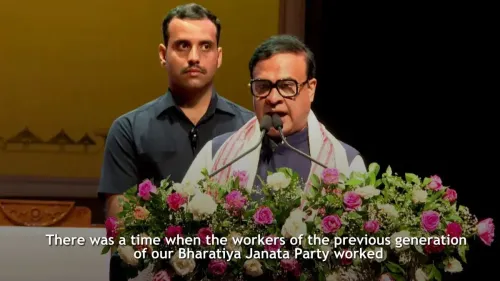
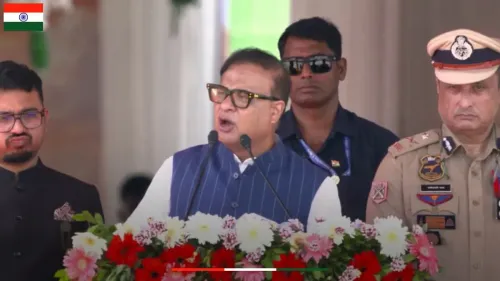
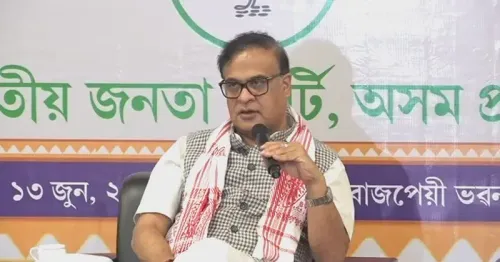
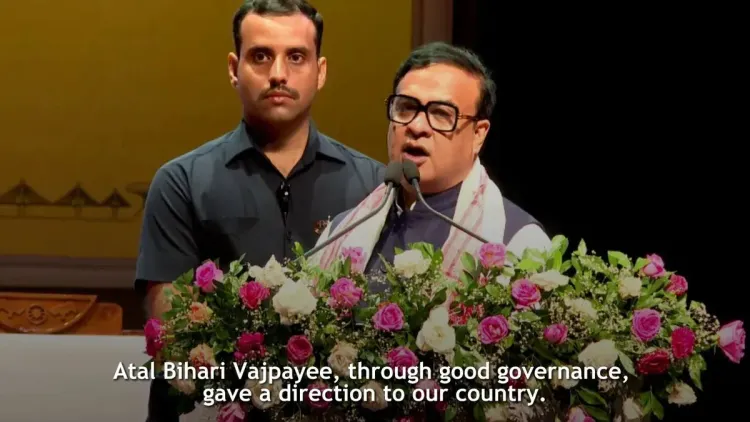
A thread connecting two eras of BJP governance — and the public trust that stitched them together — is at the heart of a tribute posted by Assam Chief Minister Himanta Biswa Sarma on Wednesday, 7 October 2026. Invoking the memory of former Prime Minister Atal Bihari Vajpayee, Sarma argued that the ideals of good governance Vajpayee embodied have found fresh momentum under Prime Minister Narendra Modi.
Sarma's post frames Modi's three consecutive electoral mandates since 2014 as a democratic continuum rooted in the Vajpayee tradition. 'The legacy of good governance left by Shraddheya Atal Bihari Vajpayee Ji continues to find new momentum under Adarniya Narendra Modi Ji,' he wrote, describing the run of mandates as 'a remarkable chapter in Bharat's democratic journey' sustained by public trust.
Vajpayee to Modi: the governance lineage Sarma is drawing
Atal Bihari Vajpayee led the BJP-anchored National Democratic Alliance government from 1998 to 2004, a tenure remembered for economic liberalisation, landmark infrastructure programmes, and a foreign-policy pivot that included the 1999 Lahore Declaration and the Kargil conflict. His rhetorical elegance and cross-party respect gave him an almost singular stature in Indian politics. He passed away on 16 August 2018.
By invoking that legacy, Sarma is doing something deliberate: positioning the Modi era not as a break from BJP's founding idealism but as its organic extension — a line of ideological succession that the electorate has ratified three times over. It is a framing the party has consistently used to ground its current dominance in a longer historical arc.
Why 'three consecutive mandates' carries weight in this framing
No party or coalition had won three back-to-back Lok Sabha majorities in modern Indian political history with the same leader at the helm across all three cycles before this run. Sarma's invocation of that sequence is a pointed reminder of electoral durability — the kind of sustained public endorsement that, in his telling, validates the governance model rather than just the politician.
As NEDA convenor, Sarma is also one of the BJP's most active voices in the North-East, a region where the party has expanded significantly since 2014. His tributes to national leaders carry a dual register: they are simultaneously personal conviction and coalition signalling.
The torch Vajpayee lit, Sarma is saying, has not dimmed — it has simply passed to a steadier hand. Whether that argument lands beyond the party faithful is the question Indian democracy will keep answering at every election.
Point of View
Asserting instead that repeated public endorsement is itself proof of governance quality. For Sarma personally, such posts reinforce his identity as one of the BJP's most articulate national spokespersons operating from the periphery. The Vajpayee-to-Modi arc is likely to be deployed with increasing frequency as the party manages questions of succession and ideological continuity in the years ahead.
NationPress
7 Oct 2026
Frequently Asked Questions
Why did Himanta Biswa Sarma invoke Atal Bihari Vajpayee in his post about Modi?
Sarma used Vajpayee's legacy of good governance as a historical reference point to argue that PM Modi's three mandates since 2014 represent a continuation of that tradition, framing BJP's current dominance as ideologically rooted rather than accidental.
How many times has Narendra Modi won a Lok Sabha mandate?
According to Sarma's post, Modi has won three consecutive mandates since 2014 , a run the Assam CM describes as a 'remarkable chapter' in India's democratic journey.
When did Atal Bihari Vajpayee serve as Prime Minister?
Atal Bihari Vajpayee served as Prime Minister under the NDA government from 1998 to 2004 . He passed away on 16 August 2018 .
What is Himanta Biswa Sarma's role beyond being Assam Chief Minister?
Beyond leading Assam, Sarma serves as the convenor of the North-East Democratic Alliance (NEDA) , making him one of the BJP's most prominent political managers across all North-Eastern states.
What does 'Shraddheya' mean in Sarma's post about Vajpayee?
'Shraddheya' is a Sanskrit-rooted honorific meaning 'venerable' or 'deeply revered,' commonly used in Indian political discourse to pay tribute to a respected elder or departed leader.