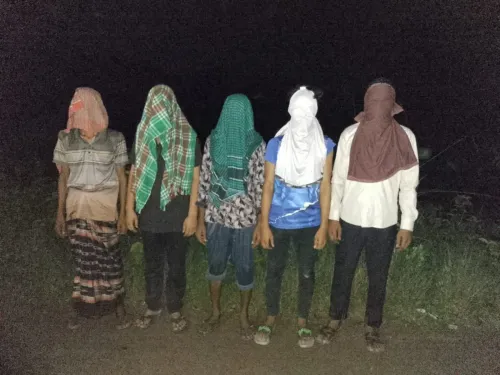
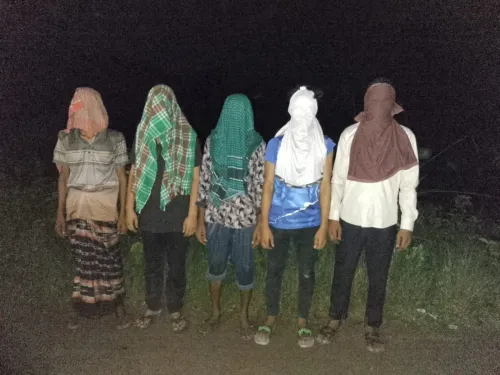
CM Himanta Orders Crackdown, 36 Held Near Dhubri Border

Synopsis
Assam Chief Minister Himanta Biswa Sarma announced that 36 individuals were caught attempting illegal border crossing near Dhubri as state teams targeted infiltrators, brokers, and facilitators in a sweeping anti-infiltration operation.
Key Takeaways
36 individuals were apprehended near Dhubri , western Assam, while allegedly attempting an illegal border crossing.
CM Himanta Biswa Sarma stated the crackdown targets not just crossers but also brokers and facilitators of the infiltration network.
Dhubri district borders Bangladesh along a riverine stretch historically flagged as a high-risk corridor for illegal movement.
The operation fits a long-standing Assam governance priority rooted in the Assam Accord of 1985 and the 2019 NRC update .
Legal proceedings — deportation or Foreigners Tribunal referral — for the detained individuals remain the key follow-up to watch.
Thirty-six individuals were apprehended near Dhubri in western Assam while allegedly attempting to cross the border illegally — and Assam Chief Minister Himanta Biswa Sarma made clear on Friday, October 30, 2026 that the operation was far from a one-off raid. It was a strike at the entire ecosystem keeping illegal infiltration alive.
Targeting the whole chain — not just the crossers
What makes the CM Sarma's statement noteworthy is the explicit width of the target. 'Infiltrators, brokers, facilitators — all are being targeted,' he wrote, describing the operation as an effort to dismantle an 'anti-India modus operandi' root and branch. The framing is deliberate: this is not a headcount exercise but a network-disruption strategy.
Dhubri district sits at the southwestern tip of Assam, separated from Bangladesh by the Brahmaputra and a porous riverine boundary — making it one of the state's most sensitive transit corridors. Border security forces and state police have historically flagged the district as a pressure point for cross-border movement, both of people and of criminal networks.
Assam's long war on illegal immigration
The political and administrative backdrop stretches back decades. The Assam Accord of 1985 first codified the state's anxiety over demographic change, setting a legal cut-off date for identifying foreigners. The National Register of Citizens (NRC), whose Assam update concluded in 2019, was the most recent large-scale administrative attempt to separate legal residents from illegal ones — a process that generated enormous legal and humanitarian debate even as it remained BJP policy.
Since taking office in 2021, CM Sarma — also the convenor of the North-East Democratic Alliance (NEDA) — has repeatedly framed anti-infiltration drives as a non-negotiable pillar of governance in the Northeast. Assam's border communities, who have lived with the pressures of demographic change for two generations, watch each such operation closely for both its security signal and its political one.
What happens to the 36 now
The immediate legal trajectory of the 36 detained individuals — whether they face deportation proceedings, detention under the Foreigners Act, or referral to Foreigners Tribunals — will be the real test of operational follow-through. Drives that yield arrests but stall in legal limbo have been a recurring criticism of past crackdowns. CM Sarma's emphatic close — 'NO compromise on national security' — sets a high-visibility benchmark his own administration will now be measured against.
The question is not whether the arrests happened. The question is what comes next — and whether the brokers and facilitators named alongside the crossers actually face prosecution.
Point of View
His administration claims a higher-order law-enforcement ambition that goes beyond optics. However, Assam's history of high-profile drives that later stall in overburdened Foreigners Tribunals means the credibility of this crackdown will ultimately rest on prosecutorial follow-through, not arrest numbers. For NEDA's broader Northeast coalition, the message doubles as a reminder of BJP's ideological consistency on border identity — a theme that continues to animate voter blocs across the region.
NationPress
31 Oct 2026
Frequently Asked Questions
Who were the 36 people apprehended near Dhubri in Assam?
According to CM Himanta Biswa Sarma, the 36 individuals were illegal infiltrators identified and caught while attempting to cross the border near Dhubri in western Assam. Specific identities and nationalities have not been officially disclosed.
Where is Dhubri and why is it significant for border security?
Dhubri is a district in western Assam that shares a riverine boundary with Bangladesh along the Brahmaputra. Its geography makes it one of the most sensitive and frequently used corridors for illegal cross-border movement in the Northeast.
What is Assam's legal framework for dealing with illegal immigrants?
Assam uses the Foreigners Act and refers cases to Foreigners Tribunals, a quasi-judicial mechanism. The 1985 Assam Accord set the legal cut-off date for detecting foreigners, and the 2019 NRC update was the most recent administrative process to identify illegal residents.
What did CM Himanta Biswa Sarma say about the Dhubri operation?
CM Sarma stated that state teams are 'striking at the core of the illegal infiltration nexus,' targeting infiltrators, brokers, and facilitators together. He confirmed 36 people were apprehended near Dhubri and declared 'NO compromise on national security.'
What happens next to the people detained at Dhubri?
The detained individuals are expected to face legal proceedings under the Foreigners Act, which could include detention, referral to Foreigners Tribunals, or deportation proceedings. The outcome of those legal processes will be the key indicator of the operation's long-term impact.