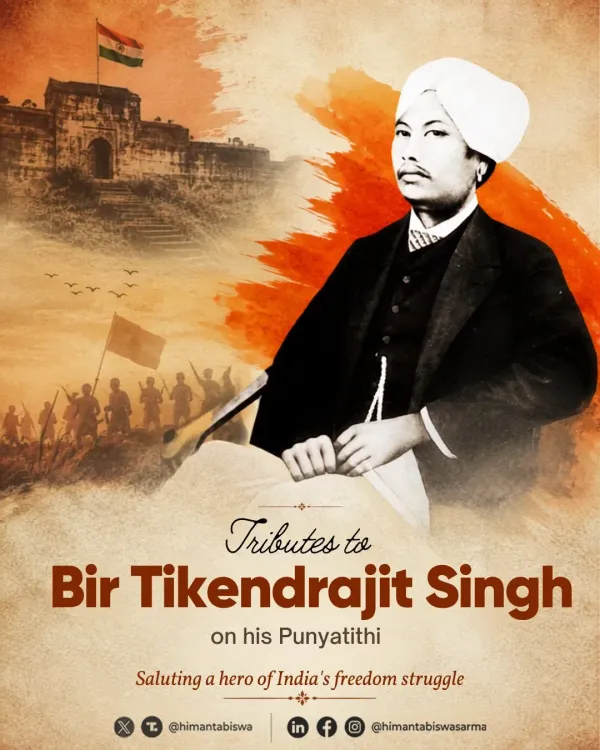
CM Himanta pays tribute to Bir Tikendrajit Singh on Punyatithi
Synopsis
Assam CM Himanta Biswa Sarma marked the 133rd punyatithi of Bir Tikendrajit Singh, the Manipuri prince executed by British forces on 13 August 1891 after the Anglo-Manipur War, calling him a fearless patriot and 'great son of Manipur'.
Key Takeaways
Assam CM Himanta Biswa Sarma paid tribute to Bir Tikendrajit Singh on his punyatithi, 13 August .
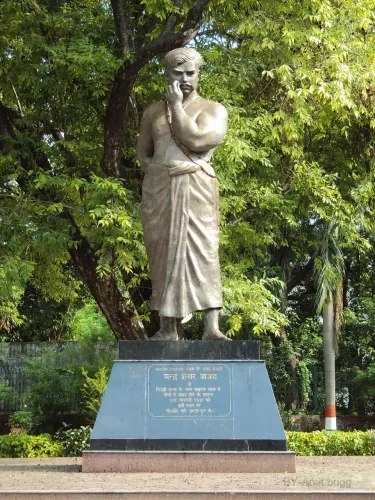
Tikendrajit Singh was the Senapati of the Kingdom of Manipur , executed by British authorities on 13 August 1891 following the Anglo-Manipur War .
Imphal International Airport is named after Tikendrajit Singh, reflecting his enduring legacy in Manipur.
The tribute falls two days before Independence Day , amplifying its symbolic resonance.
Northeast BJP leaders regularly invoke regional anti-colonial figures to connect state histories to India's broader freedom struggle.
On the 133rd anniversary of his execution, Assam Chief Minister Himanta Biswa Sarma paid solemn tribute to Bir Tikendrajit Singh, the Manipuri prince who defied British colonial power until his last breath on 13 August 1891.
The man who said no to empire
Bir Tikendrajit Singh was the Senapati — commander-in-chief — of the Kingdom of Manipur, a princely state that resisted British annexation long after much of the subcontinent had been absorbed into colonial administration. The Anglo-Manipur War of 1891 brought that resistance to a violent head. British forces moved to assert control; Tikendrajit led the defence. When the kingdom fell, colonial authorities tried and executed him publicly in Imphal — a calculated act of imperial deterrence that, over the following century, only deepened his stature as a martyr. He is remembered in Manipur not merely as a freedom fighter but as the defining symbol of the state's sovereign identity before colonial absorption. Imphal International Airport bears his name — a daily, living reminder of who he was.Northeast BJP's deliberate memory politics
CM Sarma's tribute is part of a consistent pattern among Northeast BJP leaders: publicly honouring regional anti-colonial figures to weave state-level histories into the broader tapestry of India's independence struggle. For Manipur — a state that has faced prolonged internal conflict — invoking Tikendrajit's legacy carries particular resonance. It signals both cultural solidarity and political continuity with the region's deep-rooted resistance tradition. Sarma, as convenor of the North-East Democratic Alliance (NEDA), routinely anchors Northeast political messaging. A tribute on this date is not incidental — 13 August falls two days before Independence Day, amplifying the symbolic weight of every remembrance in that window. The courage of one prince, executed on a colonial gallows over a century ago, still shapes how a region remembers itself — and how its leaders choose to be seen.Point of View
Not just a mainland political force. Paying homage to a Manipuri martyr two days before Independence Day places a state-specific hero inside the national freedom narrative, which serves both cultural and electoral purposes in a region where identity politics runs deep. For a party governing Assam and allied with the Manipur government, this kind of symbolic outreach is low-cost but high-signal. It is political memory management — and in the Northeast, that is serious politics.
NationPress
13 Aug 2026
Frequently Asked Questions
Who was Bir Tikendrajit Singh?
Bir Tikendrajit Singh was the Senapati, or commander-in-chief, of the Kingdom of Manipur. He led resistance against British forces during the Anglo-Manipur War of 1891 and was executed by colonial authorities on 13 August 1891, making him one of the earliest martyrs of the Northeast's resistance to British rule.
Why is 13 August significant for Manipur?
13 August marks the punyatithi — death anniversary — of Bir Tikendrajit Singh, who was publicly executed by British authorities on that date in 1891. The day is observed as a solemn remembrance in Manipur, and Imphal International Airport is named in his honour.
What was the Anglo-Manipur War of 1891?
The Anglo-Manipur War of 1891 was a brief but significant conflict in which British imperial forces moved to assert control over the Kingdom of Manipur. Bir Tikendrajit Singh led the Manipuri defence. After the kingdom's defeat, British authorities tried and executed key leaders, including Tikendrajit.
Why did Himanta Biswa Sarma pay tribute to a Manipuri figure?
As convenor of the North-East Democratic Alliance (NEDA) and a senior BJP leader in the Northeast, CM Sarma regularly honours regional historical figures. Such tributes are part of a broader political effort to connect Northeast state histories to India's national independence narrative.
Is Bir Tikendrajit Singh officially recognised as a freedom fighter?
Bir Tikendrajit Singh is widely celebrated in Manipur as a symbol of anti-colonial resistance. Imphal International Airport bears his name, reflecting official recognition of his legacy within the state.