CM Himanta pays tribute to Dhemaji attack victims on Independence Day
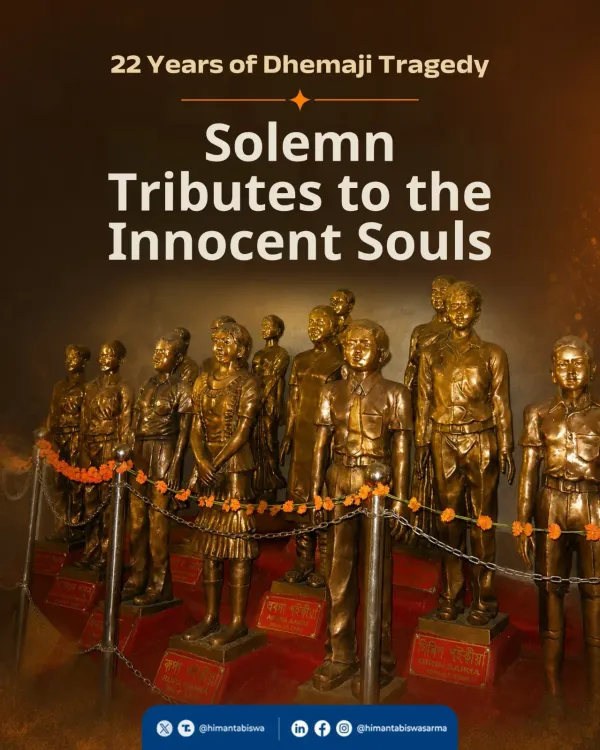
Synopsis
Assam Chief Minister Himanta Biswa Sarma marked Independence Day by paying tribute to the 13 people — mostly schoolchildren and teachers — killed in the ULFA bomb blast at Dhemaji on 15 August 2004, linking the memory to Assam's hard-won peace.
Key Takeaways
Assam CM Himanta Biswa Sarma paid tribute to victims of the Dhemaji terror attack on 15 August 2026 , the 22nd anniversary of the blast.
The 15 August 2004 bomb blast at Dhemaji college field , attributed to ULFA militants, killed 13 people , many of them schoolchildren and teachers during Independence Day celebrations.
Sarma described the Dhemaji tragedy as 'one of the starkest reminders of the devastating human cost of violence and insurgency.' Assam signed a peace accord with the pro-talks faction of ULFA in 2020 , part of a broader decline in insurgency-related violence since the mid-2000s.
Sarma reaffirmed the state's commitment to ensuring 'such a tragedy never recurs,' framing the tribute within Assam's transition to lasting peace.
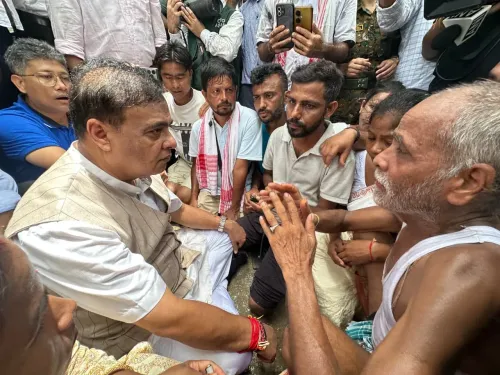
Twenty-two years after a bomb tore through an Independence Day gathering in Dhemaji, Assam Chief Minister Himanta Biswa Sarma paused on 15 August 2026 to remember the children, teachers, and bystanders who never made it home. The tribute, posted on the morning of Independence Day, carried the weight of one of the darkest chapters in Assam's insurgency era.
The day a celebration turned to carnage
On 15 August 2004, a crowd had gathered at the Dhemaji college field for Independence Day festivities — schoolchildren in uniform, teachers, families. A bomb, attributed to ULFA militants, detonated in the middle of the celebration, killing 13 people, many of them young students. The images of that morning — a tricolour still flying over a scene of grief — became a defining symbol of what unchecked insurgency costs ordinary people.
Sarma called it 'one of the starkest reminders of the devastating human cost of violence and insurgency.' That framing is deliberate: the Dhemaji attack did not target soldiers or government buildings. It targeted children on a national holiday.
From peak militancy to peace accords
Assam endured its worst insurgency-related violence through the 1990s and early 2000s, with ULFA and NDFB cadres behind a sustained campaign of bombings, abductions, and extortion across the Brahmaputra valley. The 2004 Dhemaji blast came near the peak of that violence. What followed was a long, uneven turn toward dialogue — ceasefires, surrender packages, rehabilitation schemes — that slowly drained the operational capacity of the major groups.
A significant milestone came in 2020, when the Assam government formalised a peace accord with the pro-talks faction of ULFA, building on years of back-channel engagement. Sarma, who has championed that peace architecture as Chief Minister and as convenor of the North-East Democratic Alliance (NEDA), framed today's tribute within that arc: 'Today, as Assam has emerged into an era of lasting peace, every child has the opportunity to learn, dream and build a secure future.'
Independence Day, memory, and a promise
The choice to post this tribute on Independence Day — the same date as the original attack — is not incidental. It turns a national celebration into an annual reckoning. Sarma closed with a direct pledge: 'We remain steadfast in ensuring that such a tragedy never recurs.' For the families of Dhemaji's 13 victims, that sentence is both comfort and demand — a promise the state must keep renewing, year after year, flag after flag.
Point of View
Lending moral weight to the ULFA accord of 2020. By invoking children killed on the same date, he frames security not as a law-and-order metric but as a condition for childhood itself — a framing that resonates in Upper Assam districts still carrying the memory. The tribute also signals continuity: as NEDA convenor, Sarma has staked regional credibility on the North-East's insurgency-to-investment story, and Dhemaji is its starkest proof-of-cost.
NationPress
15 Aug 2026
Frequently Asked Questions
What was the Dhemaji terror attack of 2004?
On 15 August 2004 , a bomb exploded at the Dhemaji college field in Assam during Independence Day celebrations, killing 13 people — mostly schoolchildren and teachers. The attack was attributed to ULFA militants and remains one of the deadliest strikes on civilians in Assam's insurgency history.
Who carried out the Dhemaji bomb blast?
The blast was attributed to cadres of the United Liberation Front of Asom (ULFA) , which was engaged in an armed insurgency against the Indian state in Assam through the 1990s and 2000s.
How many people died in the Dhemaji attack?
13 people were killed in the Dhemaji blast, many of them schoolchildren and teachers who had gathered for Independence Day festivities.
Has Assam made peace with ULFA since the 2004 attack?
Yes. The Assam government signed a peace accord with the pro-talks faction of ULFA in 2020 , building on earlier ceasefires. Large-scale militant violence has significantly declined since the mid-2000s.
Why does Himanta Biswa Sarma pay tribute to Dhemaji victims on Independence Day?
The Dhemaji blast occurred on 15 August 2004 — Independence Day — making the anniversary a natural moment for remembrance. CM Sarma uses the occasion to honour the victims and reaffirm the state's commitment to lasting peace in Assam.