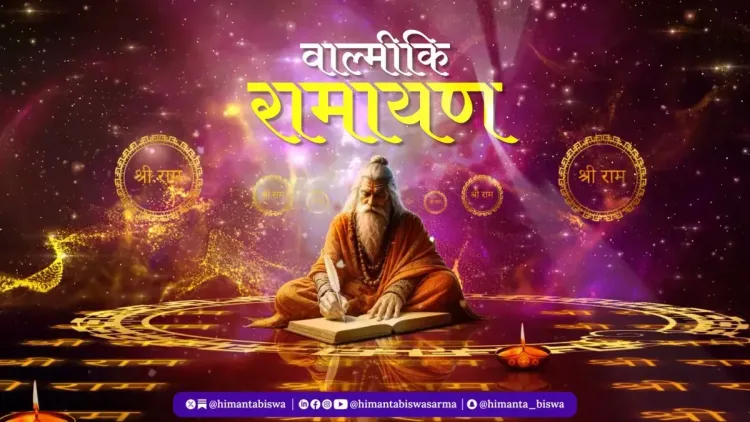
CM Himanta shares Valmiki Ramayana shloka in Assamese
Synopsis
Assam Chief Minister Himanta Biswa Sarma posted a precise citation from the Valmiki Ramayana — Balakanda, Sarga 38, Shloka 21 — in both Assamese and Hindi scripts on November 11, 2026, without additional commentary, letting the ancient verse speak for itself.
Key Takeaways
Assam CM Himanta Biswa Sarma shared a Valmiki Ramayana shloka on X on November 11, 2026 .
The citation is precise: Balakanda, Sarga 38, Shloka 21 — a chapter associated with the descent of the river Ganga.
The post was written in both Assamese script and Devanagari (Hindi) , reflecting dual linguistic identity.
No political commentary or policy context accompanied the verse — the citation stood alone alongside an attached video.
BJP leaders periodically invoke specific Ramayana shlokas as part of a broader cultural outreach tradition in Indian politics.
Assam under Sarma has promoted Sanskrit scholarship and regional linguistic heritage as part of state cultural policy.
A verse from one of Hinduism's most ancient epics surfaced on Wednesday, November 11, 2026, when Assam Chief Minister Himanta Biswa Sarma shared a shloka from the Valmiki Ramayana — citing it precisely as Balakanda, Sarga 38, Shloka 21 — in both Assamese and Hindi scripts on X.
The post is notably sparse on explanation: no commentary, no political hook, no accompanying note. The citation stands on its own — Assamese script leading, Devanagari following — presenting the verse as the message itself. The video attached to the post is the centrepiece the text frames.
Balakanda, Sarga 38 — what the chapter holds
The Balakanda is the first of seven books of the Valmiki Ramayana, traditionally attributed to the sage Valmiki, widely regarded as the original composer of the Sanskrit epic. Sarga 38 falls within a section of the Balakanda that narrates the descent of the river Ganga from the heavens — one of the most celebrated cosmological episodes in the entire text. Shloka 21 of that chapter is embedded in this sacred narrative, lending the citation a tone of reverence rather than political argument.
The choice to render the reference first in Assamese, then in Hindi, is itself telling. It places regional linguistic identity — Assam's own script and literary heritage — alongside the pan-Indian Devanagari tradition, a pairing that reflects the dual cultural register Sarma routinely inhabits as both a regional leader and a national BJP figure.
BJP leaders and the Ramayana as public text
Indian political leaders aligned with the Bharatiya Janata Party have periodically quoted specific shlokas from the Ramayana and Mahabharata in public communications — a practice that blends cultural assertion with identity signalling. Assam under Sarma has also seen state-level promotion of Sanskrit scholarship and indigenous linguistic traditions, making a bilingual Ramayana citation consistent with an established pattern of cultural programming from the Chief Minister's office.
What makes this post stand apart is its austerity. No hashtag. No call to action. Just a precise scholarly citation — book, chapter, verse — offered to followers as though pinning a page in a shared text. Whether a formal cultural programme or government initiative follows remains to be watched.
An ancient verse, two scripts, one message: for Himanta Biswa Sarma, the Ramayana is not subtext — it is the headline.
Point of View
Two scripts, no gloss — fits a recognisable BJP pattern of using classical Hindu texts as cultural markers rather than political arguments. The bilingual Assamese-Hindi framing is deliberate: it roots national epic tradition in regional identity, reinforcing Sarma's simultaneous role as Assam's custodian and a pan-Indian BJP voice. The austerity of the post — no hashtag, no explanation — may itself be the signal, projecting scholarly gravity over populist messaging. Watch for whether a formal government cultural programme or public address follows to anchor the verse in a specific initiative.
NationPress
11 Nov 2026
Frequently Asked Questions
Which shloka did Himanta Biswa Sarma post from the Ramayana?
He cited Valmiki Ramayana, Balakanda, Sarga 38, Shloka 21 — a verse from the chapter describing the celestial descent of the river Ganga.
Why did Assam CM post a Ramayana shloka in Assamese?
The post reflects Himanta Biswa Sarma's practice of connecting Assam's regional linguistic heritage with pan-Indian Hindu cultural traditions. No explicit reason was stated in the post.
What is Balakanda in the Valmiki Ramayana?
Balakanda is the first of seven books of the Valmiki Ramayana, covering the early life of Lord Rama and including celebrated episodes such as the descent of the river Ganga.
Do BJP leaders often quote Ramayana shlokas publicly?
Yes. Leaders aligned with the Bharatiya Janata Party periodically quote specific verses from the Ramayana and Mahabharata as part of cultural outreach, identity signalling, and public communication.
What language did Himanta Biswa Sarma use for the Ramayana post?
The post was written in two scripts: Assamese first, followed by Devanagari (Hindi) , giving the citation both a regional and a national register.