CM Himanta: Political protest gets a political answer
Synopsis
Assam Chief Minister Himanta Biswa Sarma declared on October 16, 2026 that political protests will be answered politically — not administratively — signalling his government's intent to counter dissent through party mobilisation and public narrative rather than state machinery.
Key Takeaways
Assam CM Himanta Biswa Sarma stated on October 16, 2026 that political protests will be met with a political response.
The statement was made in Hindi , emphasising the word rajnaitik (political) as opposed to administrative or legal action.
Sarma has governed Assam under the BJP since 2021 and is also convenor of the North-East Democratic Alliance (NEDA) .
The posture signals counter-mobilisation via party machinery rather than state enforcement against opposition demonstrators.
Opposition parties in Assam and NEDA allies are likely to face a coordinated political counter-campaign in response to any street protests.
Assam Chief Minister Himanta Biswa Sarma drew a sharp line on Friday, October 16, 2026 — political protest, he declared, will be met with a political response, not an administrative one. The statement is brief, but in India's Northeast, where the line between governance and political management is perpetually contested, it lands with unmistakable weight.
In Hindi, Sarma posted: 'Rajnaitik protest ka jawab rajnaitik tarike se hi diya jayega' — 'A political protest will be answered in a political way only.' The choice of words is deliberate. By framing the response as rajnaitik (political) rather than prashासanिक (administrative) or legal, the Chief Minister signals that his government intends to fight dissent on the terrain of public opinion and party mobilisation — not through state machinery.
What 'political response' means in Assam's context
Assam has been governed by the BJP since 2016, and Sarma — who took over as Chief Minister in 2021 — has built a reputation for aggressive political counter-mobilisation whenever the opposition moves against his administration. As convenor of the North-East Democratic Alliance (NEDA), he coordinates BJP-aligned politics across multiple northeastern states, giving him a vast party apparatus to deploy in response to any organised dissent.
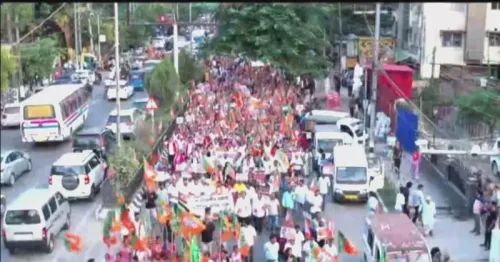
The implication is clear: opposition street protests will be countered not with lathis or legal notices, but with rival rallies, narrative battles, and electoral arithmetic. It is a posture that acknowledges the legitimacy of protest as a political tool — while promising to outmanoeuvre it on the same field.
Opposition and NEDA allies now on notice
The statement puts both Assam's opposition parties and NEDA allies on notice. Opposition groups mounting street pressure can expect a coordinated, well-resourced party-level response. The framing also carries an implicit warning: the government will not be drawn into defensive, reactive governance — it intends to set the political agenda.
Whether this translates into a specific counter-campaign or remains a statement of governing philosophy will depend on how the current wave of political protest in the state develops. What is certain is that Sarma has chosen to answer loudly — and entirely in the language of politics.
Point of View
He pre-empts criticism that his government suppresses dissent through state power, while simultaneously telegraphing that the BJP's organisational machinery in the Northeast is ready to be deployed. It fits a broader pattern in BJP-governed states of treating electoral and narrative dominance as the primary instrument of political management. The statement also reinforces Sarma's role as NEDA convenor: it is a message not just to Assam's opposition, but to the wider northeastern political ecosystem about how organised dissent will be handled. The real test will come in whether 'political response' means genuine engagement with grievances or simply louder counter-messaging.
NationPress
16 Oct 2026
Frequently Asked Questions
What did Himanta Biswa Sarma say about political protests?
Assam Chief Minister Himanta Biswa Sarma stated on October 16, 2026, that political protests will be answered in a political way — meaning through party-level counter-mobilisation and public narrative rather than administrative or legal action.
What is Himanta Biswa Sarma's role in Northeast India politics?
Himanta Biswa Sarma is the Chief Minister of Assam and the convenor of the North-East Democratic Alliance (NEDA), which coordinates BJP-aligned political activity across multiple northeastern states.
How long has BJP governed Assam?
The BJP has governed Assam since 2016. Himanta Biswa Sarma became Chief Minister in 2021 and has since led the state government.
What does 'political response to protest' mean in BJP-governed states?
In practice, a 'political response' typically means counter-rallies, narrative campaigns, and electoral outreach rather than using police or administrative machinery against protesters.
Which opposition parties are likely affected by Sarma's statement?
The statement is directed at opposition parties currently mounting protests in Assam. Specific parties were not named in the post, but the phrasing puts all groups engaged in political demonstration on notice of an organised BJP counter-response.