Smriti Irani Defends 90 Crore Voters' Mandate Against 'Regime Change' Talk
Synopsis
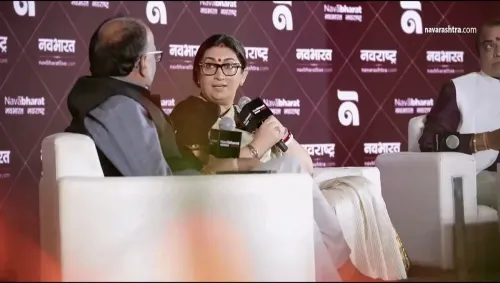
BJP leader Smriti Irani invoked the democratic mandate of 90 crore Indian voters on October 16, 2026, sharply rejecting calls for regime change as an illegitimate override of the people's electoral will.
Key Takeaways
BJP leader Smriti Irani posted on X on October 16, 2026 defending the democratic rights of 90 crore Indians .
She rejected calls for 'regime change', framing them as a single individual's declaration against a collective electoral mandate.
The post invokes India's vast registered voter base as the ultimate source of governmental legitimacy.
The rhetorical contrast — 'someone' vs '90 crore Indians' — positions opposition to the government as a fringe, undemocratic impulse.
The specific event or statement that triggered the post has not been independently confirmed.
Opposition responses and any parliamentary follow-up are the key developments to watch.
A single line — and it landed like a gavel. BJP leader and former Union Minister Smriti Irani fired a sharp salvo on X on Friday, October 16, 2026, declaring that the democratic rights of 90 crore Indians cannot be stripped away simply because someone woke up and decided they wanted a 'regime change.'
The 90-Crore Number and What It Signals
The figure is not rhetorical decoration — it points directly at India's registered voter base, the electorate whose verdict Irani is invoking as an untouchable democratic mandate. Her post reads: 'You cannot take away the rights of 90 crore Indians because someone woke up and declared, "I want a regime change."' The framing is deliberate: it casts any push for unseating the current government not as legitimate political opposition, but as a unilateral, illegitimate declaration by a single will against a collective democratic choice.
A Recurring Battleground in Indian Electoral Politics
This rhetorical move — anchoring the ruling party's legitimacy in the sheer weight of the voter mandate — is a well-worn but effective instrument in Indian political discourse. When critics question the direction of a government, the counter-argument almost invariably returns to the ballot box: crores of voters made this choice, and no editorial, protest, or foreign pressure can override that arithmetic. Irani's post compresses that entire argument into a single combative sentence.
The language also sets up a contrast between the collective ('90 crore Indians') and the singular ('someone'), painting the call for regime change as a fringe or elite impulse disconnected from the mass of ordinary voters. It is a framing that resonates in a country where the scale of democratic participation — India routinely conducts the largest elections in human history — is itself a source of national pride.
Opposition Responses and What Comes Next
The specific trigger behind the post — whether it was a speech, a debate, or a foreign commentary — has not been confirmed. But the tone signals that this is not a passing remark; it is a staking of ground. Watch for opposition leaders to respond by challenging what 'rights' means in the context Irani is invoking, or by reframing 'regime change' as an ordinary aspiration of electoral democracy rather than a subversive act.
In the world's largest democracy, the fight over who speaks for the voter — and who is accused of undermining them — never really stops. Irani's post is the latest round.
Point of View
It shifts the debate from governance to democratic legitimacy itself. This is a high-stakes framing choice: it forces critics to either contest the election result directly or argue on terrain the ruling party controls. In the run-up to any electoral cycle, such statements also serve as mobilisation signals, reminding the base that the mandate is under threat and must be defended.
NationPress
16 Oct 2026
Frequently Asked Questions
What did Smriti Irani say about regime change?
Smriti Irani posted on X on October 16, 2026, stating that the rights of 90 crore Indians cannot be taken away simply because someone declared they want a regime change, defending the democratic electoral mandate against such calls.
Who are the 90 crore Indians Smriti Irani referred to?
The 90 crore figure refers to India's registered voter base — the electorate whose collective democratic choice Irani was invoking as the foundation of the current government's legitimacy.
Why is 'regime change' a politically sensitive term in India?
In Indian political discourse, 'regime change' is often used by ruling party leaders to characterise opposition efforts as illegitimate attempts to override the people's electoral verdict, rather than normal democratic competition.
What was the trigger for Smriti Irani's post on October 16, 2026?
The specific event or statement that prompted the post has not been confirmed. Irani did not name a person or incident directly in her message.
How has the BJP used the voter mandate argument in the past?
BJP leaders have repeatedly invoked the scale of their electoral victories — framing large vote counts and seat tallies as a democratic shield against criticism — particularly when facing questions about the government's direction or legitimacy.