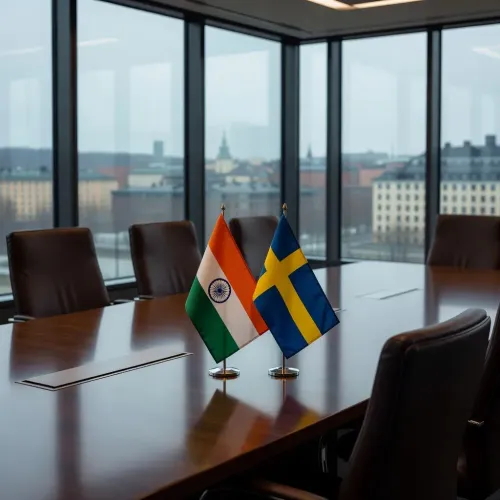
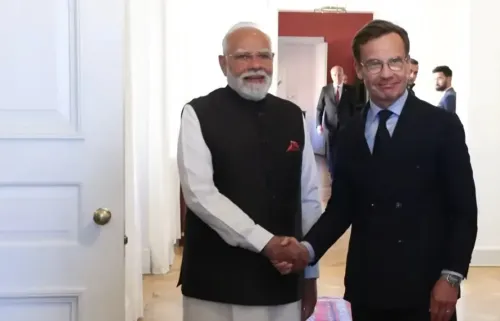
Haryana CMO: India, Sweden target trade doubling in 5 years

Synopsis
India and Sweden have pledged to double bilateral trade and investment over five years, with Haryana's Chief Minister's Office amplifying the announcement — pointing to potential state-level investment opportunities in clean tech, defence and digital sectors.
Key Takeaways
India and Sweden have set a target to double bilateral trade and investment within five years .
The announcement was made by the Chief Minister's Office of Haryana on 16 October 2026 .
Sweden's strengths in clean energy, defence technology and digital innovation align with India's industrial priorities.
Haryana , with its major industrial corridors near Gurugram and Manesar, is positioned as a key beneficiary of Swedish investment inflows.
India has been systematically expanding Nordic and European trade partnerships as part of broader economic diplomacy.
Concrete follow-through — sector-specific MoUs, joint commission meetings and updated trade data — will determine whether the five-year goal translates into policy.
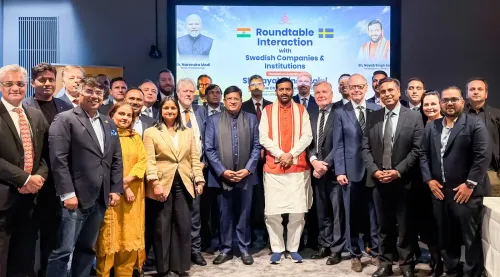
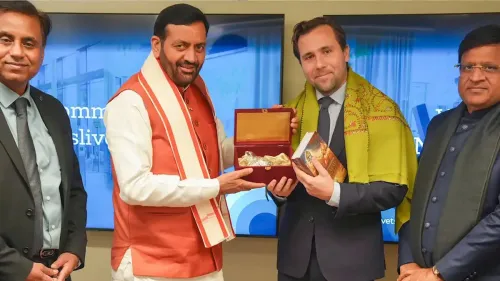
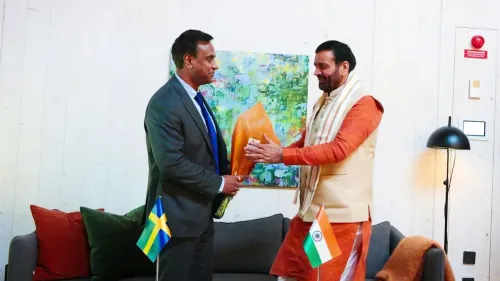
A concrete ambition now sits on the table: India and Sweden have set their sights on doubling bilateral trade and investment over the next five years, a target announced Friday, 16 October 2026 by the Chief Minister's Office of Haryana on X — signalling that this economic push carries a clear state-level dimension.
What the five-year doubling goal actually means
Doubling trade in half a decade is an ambitious but familiar benchmark in Indian economic diplomacy — it demands sustained annual growth well above typical trade-expansion rates. Sweden brings to the table its strengths in clean technology, defence manufacturing, digital innovation and sustainable infrastructure, sectors that map neatly onto India's own industrial priorities. For Indian exporters and Swedish investors alike, a formalised target creates the scaffolding for sector-specific MoUs, joint commissions and investment facilitation mechanisms.
India has been systematically deepening ties with Nordic and European nations as part of a broader strategy to diversify trade partnerships beyond its largest multilateral relationships. Sweden, as a technology-forward economy within the European Union, represents a particularly high-value partner in that arc.
Haryana's stake in the India-Sweden push
The statement's origin in the Haryana Chief Minister's Office is itself a signal. Haryana is home to some of India's most significant industrial corridors — from automotive clusters around Gurugram and Manesar to emerging logistics and technology hubs along the Delhi-Mumbai Industrial Corridor. Swedish multinationals with manufacturing and R&D interests in India have historically found north India's industrial belt attractive. A state-level amplification of this bilateral target suggests Haryana may be positioning itself as a preferred destination for Swedish investment inflows.
What comes next for trade watchers
The concrete test of this ambition lies in follow-through: updated bilateral trade data from India's commerce ministry, scheduled sittings of any India-Sweden Joint Commission, and — critically — whether specific sectoral agreements materialise to give the five-year target measurable milestones. Aspirational language hardens into policy only when timelines and accountability mechanisms are attached.
A doubling target without a baseline is half a promise. The numbers India's commerce ministry puts on the table next will tell the real story.
Point of View
Which suggests the state is actively competing for a share of whatever Swedish investment pipeline emerges. Sweden's industrial profile — clean tech, precision manufacturing, defence — aligns unusually well with both national and state-level priorities under India's 'Make in India' and green transition pushes. The real measure of success will be whether the commerce ministry and state government convert this headline into a structured joint commission roadmap with verifiable milestones.
NationPress
16 Oct 2026
Frequently Asked Questions
What is the India-Sweden trade doubling target?
India and Sweden have announced a goal to double their bilateral trade and investment within the next five years, as stated by the Chief Minister's Office of Haryana on 16 October 2026.
Why is Haryana involved in an India-Sweden trade announcement?
The Haryana Chief Minister's Office amplified the announcement, reflecting the state's interest in attracting Swedish investment to its industrial corridors around Gurugram, Manesar and the Delhi-Mumbai Industrial Corridor.
What sectors are key to India-Sweden bilateral trade?
Sweden brings expertise in clean technology, sustainable infrastructure, defence manufacturing and digital innovation — areas that closely align with India's current industrial and green-transition priorities.
How significant is Sweden as a trade partner for India?
Sweden is a technology-forward EU economy and part of India's broader strategy to diversify trade with Nordic and European nations, prioritising high-value sectors over volume-driven commodity trade.
What are the next steps after India and Sweden set this trade target?
Key milestones to watch include updated bilateral trade data from India's commerce ministry, scheduled India-Sweden Joint Commission meetings, and specific sectoral MoUs that give the five-year target measurable accountability.