CM Himanta Warns Drug Cartels as Assam Vows Ruthless Anti-Narcotics Drive
Synopsis
The Chief Minister's Office of Assam issued a blunt warning to drug cartels on 13 July 2026, vowing a 'ruthless' crackdown on narcotics. CM Himanta Biswa Sarma's government is intensifying enforcement in a state whose borders with Myanmar and Bangladesh make it a key trafficking corridor in northeast India.
Key Takeaways
The Chief Minister's Office of Assam declared on 13 July 2026 that the state will be 'ruthless' in its fight against drug cartels.
Chief Minister Himanta Biswa Sarma has led Assam since May 2021 , with security and anti-narcotics enforcement as recurring priorities.
Assam shares porous borders with Myanmar and Bangladesh , making it a significant corridor for drug trafficking into mainland India .
The NDPS Act (1985, amended 2014) and the Narcotics Control Bureau (est.
1986) form the legal and institutional backbone of enforcement action.
Similar state-level anti-narcotics campaigns have been conducted in Punjab and Manipur , reflecting a nationwide pattern of intensified enforcement in high-risk states.
Upcoming Assam Police seizure data and potential rehabilitation programme announcements will be key indicators of the campaign's depth and reach.
The Chief Minister's Office of Assam issued a stark warning to drug cartels on Monday, 13 July 2026, declaring that the state will be 'ruthless' in its fight against narcotics. The announcement signals an intensification of Assam's ongoing enforcement campaign targeting drug trafficking networks operating through the northeastern region.
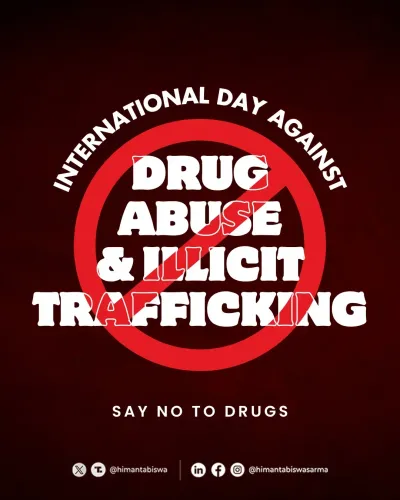
The post from the official CMO account stated plainly: 'A clear warning to drug cartels: Assam will be ruthless in its fight against narcotics.' The language is unambiguous — the state government under Chief Minister Himanta Biswa Sarma is positioning this not as a routine enforcement update but as a direct political and administrative declaration of intent.
Context
Assam occupies a strategically sensitive position in India's northeast, sharing porous borders with Myanmar and Bangladesh — two major nodes in regional drug trafficking corridors. Synthetic drugs, heroin, and opioids have historically moved through these routes into the state and onward into the Indian mainland. The state's border communities and youth have been among the most affected demographics, making narcotics enforcement both a law-and-order and a public health priority. Chief Minister Himanta Biswa Sarma, who has helmed the state since May 2021, has consistently framed security and governance as flagship concerns of his administration. Anti-narcotics operations have featured repeatedly in the government's public communications over this period.Policy Backdrop
India's primary legal framework for narcotics enforcement remains the Narcotic Drugs and Psychotropic Substances (NDPS) Act, enacted in 1985 and significantly amended in 2014 to impose stricter penalties on trafficking and cartel operations. The Narcotics Control Bureau (NCB), established in 1986, coordinates enforcement across states including Assam, working alongside state police forces. Assam Police conducted multiple anti-narcotics operations and awareness drives between 2016 and 2021, targeting both synthetic drug supply chains and heroin transit routes. The current declaration appears to build on that institutional foundation while signalling a sharper, more aggressive posture under the present administration.Stakeholders and Impact
The groups most directly affected by this announcement span several layers. Law enforcement agencies — state police, the NCB, and border security forces — will bear the operational weight of any intensified campaign. Border communities in districts adjoining Myanmar and Bangladesh stand to see heightened surveillance and checkpoint activity. For Assam's youth, who represent the primary target of rehabilitation and de-addiction outreach alongside enforcement, the announcement carries both a protective and a deterrent signal. Assam's approach mirrors broader state-level campaigns seen in Punjab and Manipur, where governments have combined police action with central agency coordination and cross-border intelligence sharing to address opioid and synthetic drug crises.What's Next
The immediate question is operational detail: whether the declaration will be followed by specific task-force formations, fresh legislative or administrative measures, or enhanced coordination with the NCB and central security agencies. Analysts and civil society groups will watch for Assam Police seizure and arrest data in subsequent quarters as a concrete measure of the campaign's reach. Announcements on state-level rehabilitation infrastructure or de-addiction programme expansion would indicate whether the government is pairing its enforcement posture with a demand-reduction strategy — a combination that public health experts consider essential for durable impact. If the administration follows through with measurable operational outcomes, Assam could emerge as a reference model for narcotics enforcement in India's northeastern states.Point of View
Combative language — 'ruthless' directed squarely at 'cartels' — is a deliberate rhetorical escalation, not routine policy communication. It positions CM Himanta Biswa Sarma as a decisive law-and-order executive ahead of what could be a high-visibility enforcement phase. The framing fits a broader BJP-governed-state pattern of projecting muscular governance on security issues, particularly in border regions where trafficking carries both criminal and national-security dimensions. Whether the declaration translates into sustained, measurable enforcement or remains primarily a political signal will depend on the operational follow-through that emerges in the coming weeks.
NationPress
13 Jul 2026
Frequently Asked Questions
What did the Assam CM office announce about drug cartels?
The Chief Minister's Office of Assam issued a direct warning to drug cartels on 13 July 2026, stating that the state will be 'ruthless' in its fight against narcotics.
Why is Assam a major drug trafficking corridor?
Assam shares long, porous borders with Myanmar and Bangladesh, both significant nodes in regional drug supply chains, making it a transit and destination point for heroin, synthetic drugs, and opioids.
Who is the Chief Minister of Assam?
Himanta Biswa Sarma has been the Chief Minister of Assam since May 2021 and is a senior BJP leader who has prioritised security and anti-narcotics enforcement.
What law governs narcotics enforcement in India?
The Narcotic Drugs and Psychotropic Substances (NDPS) Act, enacted in 1985 and amended in 2014, is India's primary law on narcotics, with the Narcotics Control Bureau coordinating enforcement across states.
Which other Indian states have run similar anti-drug campaigns?
Punjab and Manipur have conducted comparable state-level anti-narcotics campaigns focusing on opioids and synthetic drugs, often combining police action with central agency coordination.