CM Pema Khandu urges Itanagar to lead on cleanliness this Gandhi Jayanti
Synopsis
On Gandhi Jayanti 2026, Arunachal Pradesh CM Pema Khandu called Itanagar the public face of the state and urged every citizen to take personal ownership of cleanliness, reinforcing the national Swachh Bharat Mission with a video post.
Key Takeaways
Chief Minister Pema Khandu posted a Gandhi Jayanti cleanliness appeal on 2 October 2026 .
He described Itanagar as 'the face of Arunachal Pradesh' and called its upkeep a collective civic duty.
The post was tagged #SwachhataAbhiyan , #GandhiJayanti , and #SwachhBharat , aligning with the national Swachh Bharat Mission.
A video was attached, indicating a participatory, demonstrative intent beyond a text-only pledge.
The message explicitly placed responsibility on individual citizens — 'Swachhata begins with each one of us' — rather than on state agencies alone.
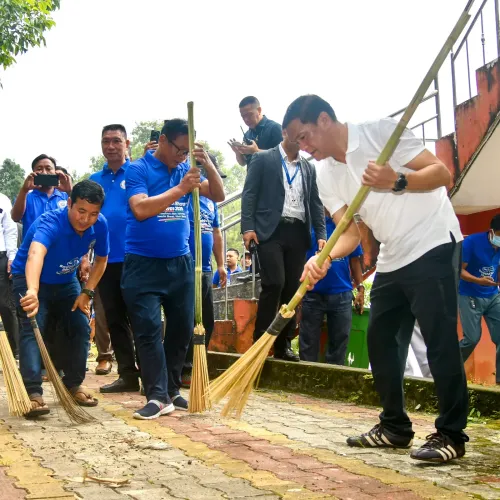
On Gandhi Jayanti, 2 October 2026, Arunachal Pradesh Chief Minister Pema Khandu turned the national occasion into a direct call to civic action, reminding citizens that Itanagar — as the state capital and its public face — carries a collective responsibility to stay clean.
Posting on X, the Chief Minister wrote: 'Itanagar is the face of Arunachal Pradesh, and it is our collective duty to keep that face clean. On this Gandhi Jayanti, let us always remind ourselves that Swachhata begins with each one of us.' The message, tagged with #SwachhataAbhiyan, #GandhiJayanti, and #SwachhBharat, was accompanied by a video — a deliberate choice to move beyond words into visible demonstration.
Itanagar as Arunachal's mirror
The framing matters. By naming Itanagar specifically — not Arunachal Pradesh in the abstract — Khandu anchors the message in the lived reality of the capital's streets, markets, and public spaces. A state capital is where first impressions are made: by visiting officials, tourists, and the state's own residents arriving from districts across the Eastern Himalayas. Its cleanliness, or the lack of it, speaks for the entire state.
Gandhi Jayanti and the Swachh Bharat link
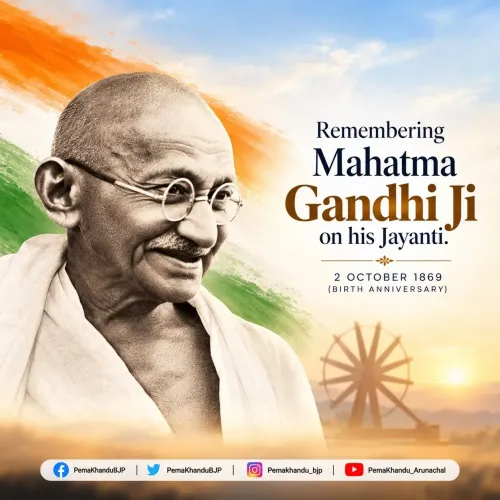
2 October is not an arbitrary date for this message. Gandhi Jayanti — the birth anniversary of Mahatma Gandhi — was chosen by the central government in 2014 as the launch date for the Swachh Bharat Mission, deliberately tying sanitation to Gandhi's own lifelong emphasis on cleanliness and self-reliance. Every year since, the date serves as the Mission's symbolic renewal across the country. Khandu's post fits squarely into that national rhythm, reinforcing the campaign at the state level with a personal, first-person appeal rather than a bureaucratic directive.
Individual duty, not just government policy
The sharpest phrase in the post is also the simplest: 'Swachhata begins with each one of us.' It deflects no responsibility onto agencies or contractors. In a border state where administrative reach can be uneven and civic infrastructure is still growing, a Chief Minister publicly owning that duty — and asking citizens to own it too — carries weight beyond the ceremonial. The video attached to the post suggests a participatory intent: showing, not just telling.
As India marks another Gandhi Jayanti with brooms and pledges, the question Khandu leaves in the air is the same one Gandhi always asked — not what the government will do, but what you will do today.
Point of View
Now in its twelfth year. By foregrounding individual responsibility rather than government delivery, it shifts the civic contract subtly: cleanliness becomes a citizen virtue, not just a policy output. For a BJP chief minister in a frontier state that frequently headlines national-security conversations, the gesture also signals a deliberate pivot toward developmental and civic identity-building. The choice of a video over a static image suggests the party's communication machinery is investing in shareable, emotive content for northeast India ahead of the electoral calendar.
NationPress
2 Oct 2026
Frequently Asked Questions
What did CM Pema Khandu say on Gandhi Jayanti 2026?
Pema Khandu called Itanagar 'the face of Arunachal Pradesh' and urged citizens to take personal responsibility for cleanliness, posting the message on X with a video on 2 October 2026.
Why is Gandhi Jayanti linked to the Swachh Bharat Mission?
The Swachh Bharat Mission was launched on 2 October 2014 — Gandhi's birth anniversary — to honour Gandhi's emphasis on sanitation, making the date an annual marker for cleanliness campaigns across India.
What is the significance of Itanagar in Arunachal Pradesh?
Itanagar is the state capital of Arunachal Pradesh and serves as its administrative and symbolic centre, making its public cleanliness a direct reflection of the state's civic standards.
What is the SwachhataAbhiyan hashtag used for?
#SwachhataAbhiyan is used across social media to aggregate posts related to India's cleanliness drives, particularly around the Swachh Bharat Mission and Gandhi Jayanti activities.