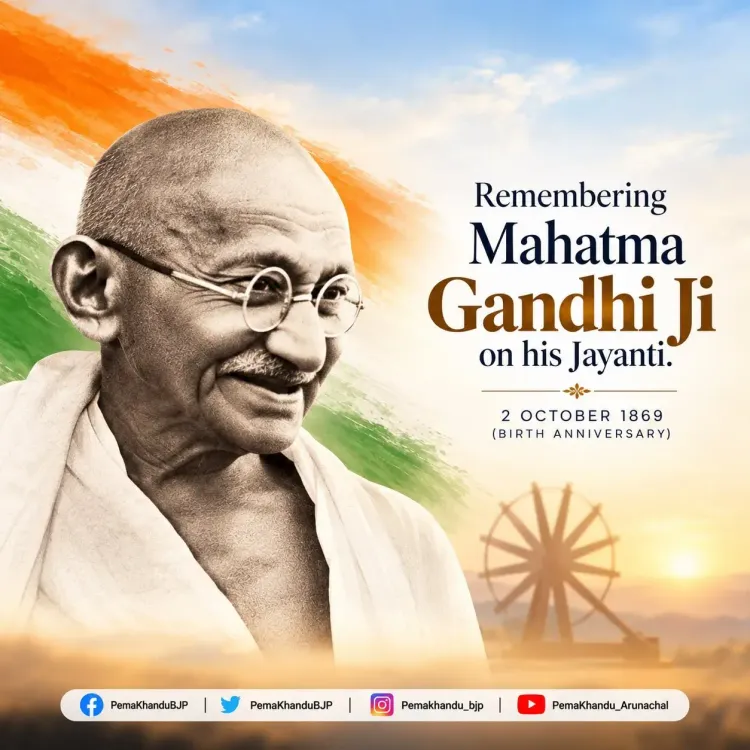
CM Pema Khandu marks Gandhi Jayanti with call for peace
Synopsis
On Gandhi Jayanti 2026, Arunachal Pradesh Chief Minister Pema Khandu called on citizens to honour Mahatma Gandhi's legacy of truth, non-violence, simplicity and service, and to strive for a more peaceful and just society.
Key Takeaways
CM Pema Khandu posted a Gandhi Jayanti tribute on 2 October 2026 , the 157th birth anniversary of Mahatma Gandhi.
He highlighted Gandhi's four core ideals: truth, non-violence, simplicity, and service .
2 October is both a national holiday in India and the UN International Day of Non-Violence , designated in 2007 .
Gandhi's principles of satyagraha and ahimsa have influenced global peace movements beyond India.
The message carries added context coming from the Chief Minister of Arunachal Pradesh , a state on India's sensitive northeastern frontier.
On the 150th-plus anniversary of one of history's most consequential moral voices, Arunachal Pradesh Chief Minister Pema Khandu paused on Gandhi Jayanti, 2 October 2026, to invoke the Mahatma's four enduring pillars — truth, non-violence, simplicity, and service.
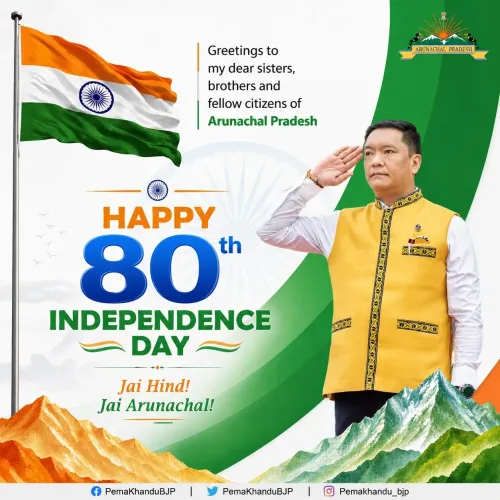
Posting on the morning of the national holiday, CM Khandu wrote: 'On Gandhi Jayanti, we remember Mahatma Gandhi and reflect on his enduring message of truth, non-violence, simplicity and service. May his ideals continue to inspire us to work for a more peaceful, compassionate and just society.'
Why these four words still carry weight
Mohandas Karamchand Gandhi, born 2 October 1869 in Porbandar, Gujarat, built a mass movement on exactly these four principles — not as abstractions, but as daily practice. Satyagraha (truth-force) and ahimsa (non-violence) became the twin engines of India's independence struggle, and later influenced movements from the American civil-rights movement to anti-apartheid activism in South Africa. Simplicity and service, embodied in the charkha and the ashram model, were Gandhi's rebuke to both colonial excess and post-colonial ambition.
On this date every year, India observes a national holiday. The United Nations designated 2 October as the International Day of Non-Violence in 2007, cementing Gandhi's philosophy as a globally recognised framework — not just an Indian memory.
Khandu's message from the frontier
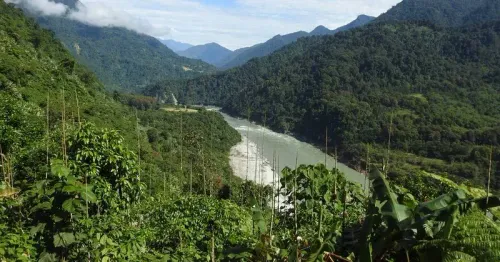
Arunachal Pradesh — India's easternmost state, sharing sensitive borders with China and Bhutan — carries its own resonance when its Chief Minister speaks of peace and a 'just society'. The state has long been at the intersection of national-security concerns and development aspirations for its diverse tribal communities. A call for compassion and non-violence from this particular corner of India is never merely ceremonial.
CM Khandu, a senior BJP leader and one of the longest-serving Chief Ministers in the state's recent history, has consistently framed governance in Arunachal around inclusion and connectivity. His Gandhi Jayanti message fits that broader register — a reminder that the ideals underpinning the republic are as relevant at its geographical edges as anywhere else.
Seventy-nine years after independence, the question Gandhi Jayanti poses is not merely one of remembrance — it is whether the principles that won a nation can still hold it together.
Point of View
But the geography of the messenger matters. A senior BJP leader in a border state invoking non-violence and a 'just society' signals that the party's eastern frontier managers are keen to frame governance in the language of national ideals, not just security imperatives. For Khandu personally, aligning with Gandhian values broadens his political register beyond the BJP's typical idiom. More broadly, the UN's 2007 designation of 2 October as the International Day of Non-Violence means these annual statements now carry a soft-power dimension that extends well beyond domestic politics.
NationPress
2 Oct 2026
Frequently Asked Questions
When is Gandhi Jayanti celebrated in India?
Gandhi Jayanti is celebrated every year on 2 October , the birth anniversary of Mahatma Gandhi , born in 1869 . It is a national holiday in India.
What did CM Pema Khandu say on Gandhi Jayanti 2026?
CM Pema Khandu called on citizens to remember Gandhi's message of truth, non-violence, simplicity and service, and expressed hope that these ideals would inspire a more peaceful, compassionate and just society.
What is the International Day of Non-Violence?
The International Day of Non-Violence is observed on 2 October every year. It was established by the United Nations General Assembly in 2007 in honour of Mahatma Gandhi's philosophy of non-violence.
Why is Gandhi's message significant for Arunachal Pradesh?
Arunachal Pradesh shares sensitive borders with China and Bhutan , making a call for peace and a just society from its Chief Minister particularly resonant beyond routine ceremonial tribute.