CM Pema Khandu joins BJP Padyatra, slams Congress rule
Synopsis
Chief Minister Pema Khandu joined a BJP 'Save Democracy, Remove Anarchy' padyatra on 18 November 2026, attacking Congress's six-decade rule, backing PM Modi's development record, and urging Arunachal's youth to reject politics of confusion.
Key Takeaways
CM Pema Khandu participated in a BJP Padyatra on 18 November 2026 under the slogan 'Loktantra Bachao, Arajakta Hatao' ('Save Democracy, Remove Anarchy').
Khandu cited nearly six decades of Congress rule as the backdrop for India's shift toward the BJP under PM Narendra Modi since 2014 .
He called for constructive opposition, rejecting what he described as 'politics of negativity and chaos.' The padyatra targeted Arunachal Pradesh's youth , urging them to focus on opportunities and progress rather than destabilising narratives.
Khandu himself switched from Congress to BJP in 2016 , enabling the party to govern Arunachal Pradesh and anchoring its northeastern strategy.
The event is part of a broader BJP mobilisation pattern ahead of future assembly or general elections across northeastern states.
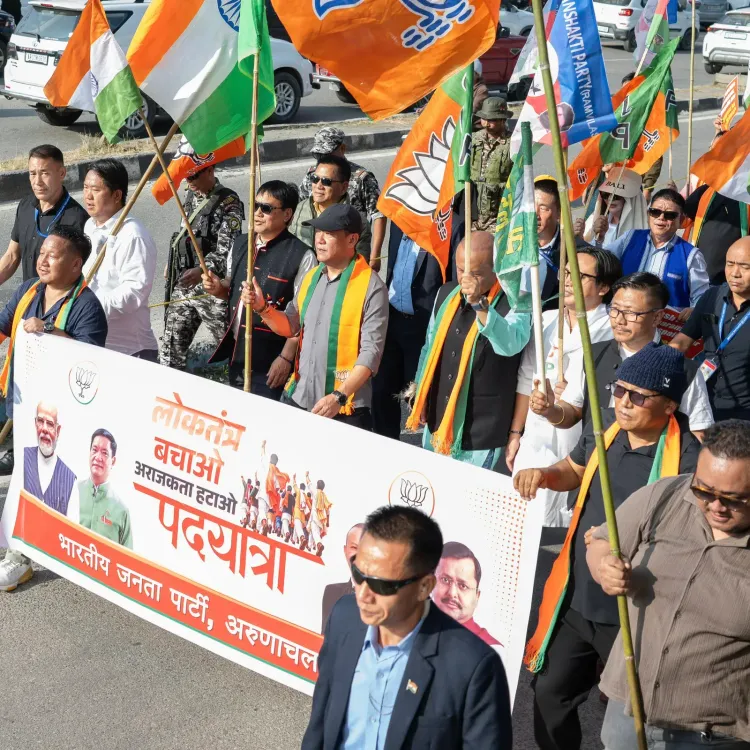
A padyatra through the streets — feet on the ground, slogan in the air — and Arunachal Pradesh Chief Minister Pema Khandu was right in the middle of it on Wednesday, 18 November 2026. The BJP's march under the banner 'Loktantra Bachao, Arajakta Hatao' ('Save Democracy, Remove Anarchy') drew Khandu out of Itanagar's corridors of power and into full campaign mode, taking direct aim at the Congress party's long dominance of Indian politics.
'Nearly six decades' — Khandu frames the Congress era as a closed chapter
Khandu's message was pointed and historically anchored. 'After giving Congress nearly six decades to govern, people chose a new direction,' he wrote, framing 2014 — the year Prime Minister Narendra Modi first came to power — as a civilisational turning point rather than a routine electoral shift. The language was deliberate: six decades maps almost exactly onto Congress's near-unbroken hold on the central government from independence through 2014.
The slogan itself signals the BJP's current political playbook — casting the opposition not merely as wrong on policy, but as a threat to democratic order itself. 'Democracy demands constructive opposition, not politics of negativity,' Khandu wrote, a line that doubles as both a reproach and a rallying cry.
Khandu's own journey: from Congress stronghold to BJP's northeastern anchor
Arunachal Pradesh was Congress territory for decades before Khandu's dramatic switch in 2016, when he moved his support to the BJP and enabled the party to form the state government — a tectonic shift in India's northeast. That backstory gives his padyatra participation a particular charge: he is not just a BJP campaigner, he is the living proof of the state-level version of the story he is now telling at a national scale.
Since then, the BJP has worked to consolidate its foothold across the northeastern states, using a mix of infrastructure investment, cultural outreach, and political mobilisation. Padyatras like this one are a standard tool in that effort — high-visibility, grassroots-signalling events designed to energise party workers and frame the electoral conversation ahead of future polls.
A message aimed squarely at Arunachal's youth
Khandu's sharpest line may have been the generational one: 'Our youth must be inspired by opportunities and progress, not misled by narratives that create confusion and unrest.' In a state with one of India's youngest demographic profiles, that appeal is strategically loaded. The BJP's pitch to young voters across the northeast has consistently centred on jobs, connectivity, and infrastructure — tangible deliverables against what the party frames as the Congress era's legacy of neglect.
Twenty images from the march accompanied the post, projecting scale and energy — a visual argument that the slogan has feet, not just words.
When a Chief Minister laces up his shoes for a padyatra, the message isn't just for the streets he walks — it's for every constituency watching whether the BJP's democratic narrative still has the power to move people.
Point of View
Elevating what could be routine campaigning into a values-based contrast with the opposition. By invoking six decades of Congress rule as an era of 'anarchy,' the BJP is attempting to fix a durable historical grievance in voters' minds rather than fight on individual policy points. In Arunachal Pradesh, where Congress once seemed unassailable, Khandu's own political biography is the party's most potent exhibit. The focus on youth signals the BJP's awareness that its northeastern advantage depends on retaining a generation of voters for whom 2014 is simply the world they grew up in.
NationPress
18 Nov 2026
Frequently Asked Questions
What is the BJP padyatra 'Loktantra Bachao, Arajakta Hatao'?
It is a BJP political march held under the slogan meaning 'Save Democracy, Remove Anarchy,' aimed at mobilising party workers and voters against what the BJP frames as the Congress party's negative and chaotic style of politics.
Why did Pema Khandu participate in the BJP padyatra?
As Arunachal Pradesh Chief Minister and senior BJP leader, Khandu joined the march to reinforce the party's development narrative under PM Modi and to contrast it with what he called decades of Congress misrule.
When did Pema Khandu join the BJP?
Pema Khandu switched from the Indian National Congress to the BJP in 2016, enabling the party to form the government in Arunachal Pradesh after decades of Congress dominance in the state.
What is the BJP's political strategy in northeastern states like Arunachal Pradesh?
The BJP has used a combination of infrastructure investment, cultural outreach, and grassroots mobilisation events like padyatras to consolidate its hold across northeastern states since coming to power at the centre in 2014.
What message did CM Khandu have for Arunachal Pradesh's youth?
Khandu urged young people to be inspired by opportunities and progress under PM Modi's governance rather than be misled by narratives that, in his words, 'create confusion and unrest.'