CM Majhi Backs Exam Reform Bill Passed in Lok Sabha
Synopsis
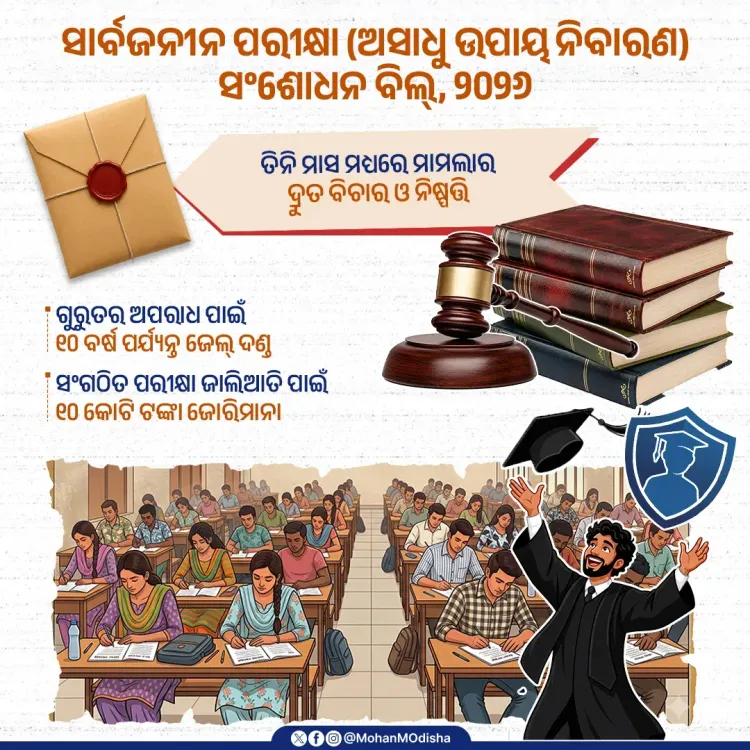
Odisha CM Mohan Charan Majhi has welcomed the passage of the Public Examinations (Amendment) Bill, 2026 in Lok Sabha, praising PM Modi's zero-tolerance approach to exam malpractice and calling the legislation a landmark step for youth justice and exam credibility.
Key Takeaways
The Public Examinations (Amendment) Bill, 2026 was passed in Lok Sabha and welcomed by Odisha CM Mohan Charan Majhi on 29 July 2026 .
The bill amends the Public Examinations (Prevention of Unfair Means) Act, 2024 , which was enacted to curb paper leaks and exam fraud.
Key additions include time-bound investigation and trial mandates and provisions for exemplary punishment for those who compromise exams.
CM Majhi described it as embodying the Modi government's 'zero tolerance' policy against individuals and organisations that exploit exam aspirants.
The bill must still pass Rajya Sabha before becoming enforceable law, with implementation rules to be framed by the Union Education Ministry .
Every student who has ever stayed up past midnight memorising formulas — only to wonder if the exam they are preparing for has already been sold — deserves better. Odisha Chief Minister Mohan Charan Majhi on Wednesday, 29 July 2026, welcomed the passage of the Public Examinations (Amendment) Bill, 2026 in Lok Sabha, calling it a decisive step toward protecting the future of India's meritorious youth.
Writing in Odia on X, CM Majhi said the bill — passed under the 'visionary leadership' of Prime Minister Narendra Modi — places the hopes, aspirations and futures of young India at the centre of good governance. He described the legislation as reinforcing transparency, impartiality and credibility in the examination system, and underlined its provisions for time-bound investigation and trial alongside exemplary punishment for offenders.
In his words: 'ଏହା ଯୁବପିଢ଼ିଙ୍କ ଭବିଷ୍ୟତ ସହ ଖେଳୁଥିବା ଅସାଧୁ ବ୍ୟକ୍ତି ଓ ସଂସ୍ଥାଙ୍କ ପ୍ରତି ମୋଦୀ ସରକାରଙ୍କ Zero Tolerance ନୀତି' — ('This reflects the Modi government's zero-tolerance policy toward dishonest individuals and organisations who play with the futures of the youth.')
The 2024 Law That Set the Stage
The amendment builds on the Public Examinations (Prevention of Unfair Means) Act, 2024, which Parliament enacted to crack down on paper leaks and malpractice in national-level competitive exams. That law emerged from a wave of public outrage after multiple reported irregularities in high-stakes recruitment and entrance tests rattled the confidence of millions of aspirants across India. The 2026 amendment now adds stricter procedural timelines — mandating that investigations and trials conclude within specified deadlines — and sharpens the penalty framework.
What the Bill Promises Exam Aspirants
CM Majhi framed the legislation as delivering three concrete guarantees to every exam-taker: swift justice, security, and greater accountability. The time-bound trial clause is particularly significant — it targets the long delays that have historically let accused paper-leak operators evade consequences. The bill situates itself squarely within the 'Viksit Bharat' (Developed India) vision, positioning a clean examination ecosystem as foundational to the country's human capital ambitions.
The bill still requires passage in Rajya Sabha before it can become law, and the Union Education Ministry will subsequently frame implementation rules. But for the crores of students preparing for competitive exams from UPSC to state-level recruitment boards, the message from Parliament is unambiguous: the era of impunity for exam fraud is under legislative siege.
Point of View
The Modi government is signalling that administrative circulars alone were insufficient deterrents. CM Majhi's public endorsement also reflects BJP's broader electoral calculus — youth unemployment and exam fraud have become potent political flashpoints in states like Odisha. The real test will come in implementation: whether investigation deadlines are actually enforced, and whether the Rajya Sabha passes the bill without dilution.
NationPress
28 Oct 2026
Frequently Asked Questions
What is the Public Examinations Amendment Bill 2026?
The Public Examinations (Amendment) Bill, 2026 is a proposed central law passed in Lok Sabha that amends the Public Examinations (Prevention of Unfair Means) Act, 2024, adding time-bound investigation and trial mandates and stricter penalties to combat exam malpractice such as paper leaks.
Why did Odisha CM Majhi comment on the exam amendment bill?
CM Mohan Charan Majhi welcomed the bill's passage in Lok Sabha, framing it as a reflection of PM Modi's zero-tolerance policy against exam fraud and a step toward protecting the futures of India's youth under the Viksit Bharat vision.
Has the Public Examinations Amendment Bill 2026 become law?
As of the Lok Sabha passage on 29 July 2026, the bill still needs to clear Rajya Sabha and receive Presidential assent before it becomes enforceable law.
What does the amendment add to the 2024 exam law?
According to CM Majhi's statement, the amendment introduces specific time limits for completing investigations and trials related to exam malpractice, along with provisions for exemplary punishment for offenders.
Which exams does the Public Examinations Act cover?
The Public Examinations (Prevention of Unfair Means) Act, 2024 covers national-level public examinations conducted by central recruitment and education bodies; the 2026 amendment seeks to strengthen enforcement across these exams.