CM Majhi: Food Processing Is Odisha's Path to Real Growth
Synopsis
Chief Minister Mohan Majhi declared on 7 August 2026 that only industrial growth tied to farmer and women's prosperity counts as real development, placing food processing at the centre of Odisha's economic agenda.
Key Takeaways
CM Mohan Majhi stated that industrial development linked to farmers and women is the only 'real development.' Odisha is giving special priority to the food processing sector as a vehicle for inclusive growth.
The policy targets small farmers and women entrepreneurs as primary beneficiaries of agro-industrial expansion.
The central government's Pradhan Mantri Kisan Sampada Yojana (2017) provides a national scaffold Odisha can align with.
Concrete food processing incentives are expected in upcoming Odisha assembly sessions and budget cycles.
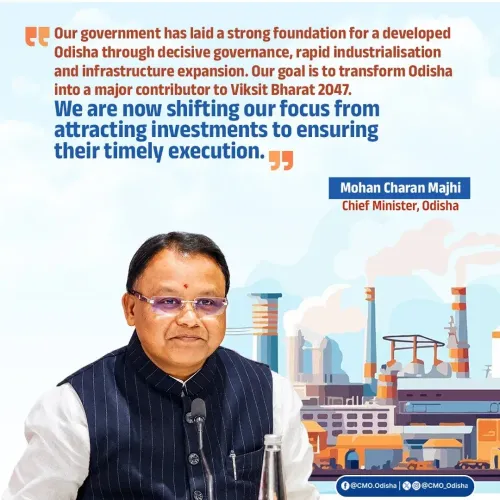
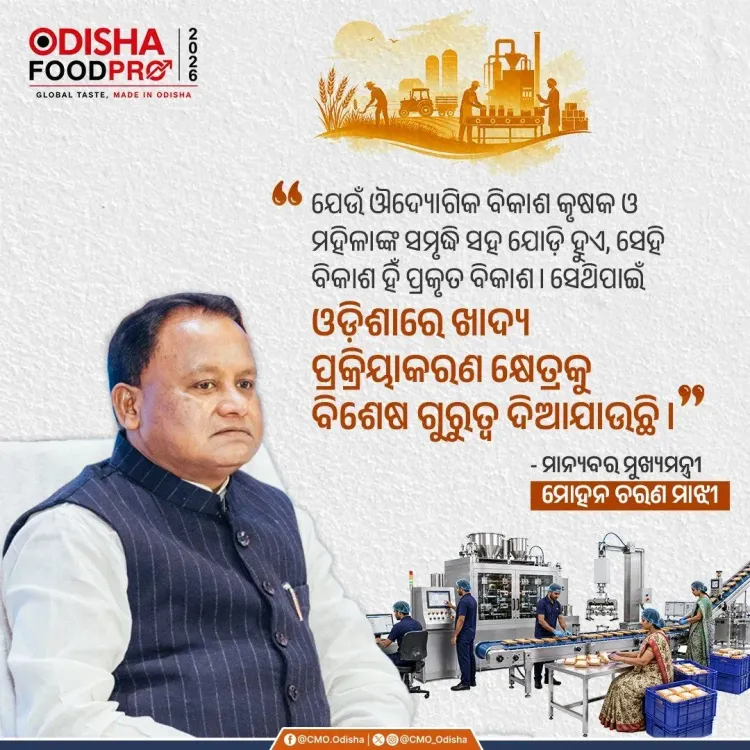
Industrial growth that leaves farmers and women behind is not growth at all — it is just noise. On Friday, 7 August 2026, the Chief Minister's Office of Odisha shared a pointed declaration from Chief Minister Mohan Majhi that reframes what the state counts as genuine development.
Speaking in Odia, CM Majhi said: 'Industrial development that is linked to the prosperity of farmers and women — that alone is real development. That is why the food processing sector in Odisha is being given special priority.' The statement is brief but deliberate, setting a clear ideological compass for the state's industrial agenda.
Why Food Processing, Why Now
Odisha sits on one of India's most productive agricultural bases — paddy, pulses, oilseeds, fruits, and fisheries — yet a large share of that produce has historically left the state as raw commodity, with value addition happening elsewhere. Food processing changes that equation: a tomato sold at the farm gate earns a fraction of what a packaged paste earns on a shelf. By anchoring processing units close to production clusters, the state can capture that margin locally and push it back to the farmer. The emphasis on women entrepreneurs is equally pointed. Self-help groups and micro food enterprises run by women are already a significant part of Odisha's rural economy. Formalising and scaling those units — through cold-chain access, credit linkages, and market connections — converts informal kitchen-scale work into bankable livelihoods.The National Scaffold Odisha Can Build On
The state does not have to start from scratch. The central government's Pradhan Mantri Kisan Sampada Yojana, launched in 2017, provides infrastructure support for food processing clusters, agro-processing parks, and backward-forward linkages — all of which Odisha is eligible to leverage. The scheme is designed precisely to close the gap between farm gate and consumer, and states that align their own incentives with it tend to attract private investment faster. CM Majhi, who has led Odisha's first BJP government since 2024, has consistently framed inclusive industrialisation as the administration's north star. This statement reinforces that framing and signals that upcoming budget cycles and assembly sessions may carry concrete food processing policy incentives — a space worth watching. The real test, as always, is translation from principle to project: how many processing units get sanctioned, how many women-led enterprises get linked to formal supply chains, and whether farm incomes in Odisha's interior districts actually move. The CM has drawn the line. The numbers will tell the story.Frequently Asked Questions
What did Odisha CM Mohan Majhi say about food processing?
CM Majhi said that industrial development linked to the prosperity of farmers and women is the only real development, and that food processing is therefore being given special priority in Odisha.
Why is Odisha focusing on food processing?
Odisha has a large agricultural base but much of its produce is sold raw, with value addition happening outside the state. Food processing allows the state to capture more economic value locally and raise farmer and women entrepreneur incomes.
How does Pradhan Mantri Kisan Sampada Yojana help Odisha?
The central scheme, launched in 2017, funds food processing infrastructure including agro-processing parks and supply-chain linkages, which Odisha can use to attract investment and build processing capacity near farming clusters.
Who benefits from Odisha's food processing push?
The primary beneficiaries are small farmers, who gain better prices for their produce, and women entrepreneurs, particularly those running self-help groups and micro food enterprises in rural areas.
What should we watch for next in Odisha's food processing policy?
Analysts are watching upcoming Odisha assembly sessions and state budget announcements for concrete incentives such as new processing unit sanctions, credit schemes for women-led enterprises, and cold-chain infrastructure investments.