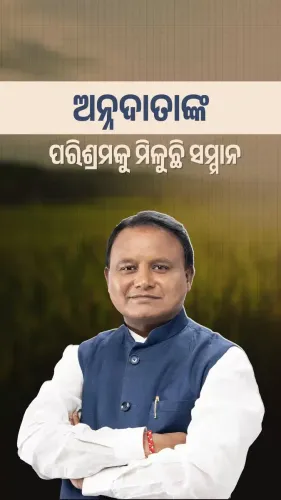
CM Majhi Vows Farmer-First Shift in Odisha's Agri Policy
Synopsis
Odisha Chief Minister Mohan Charan Majhi declared on 23 June 2026 that his BJP government has made farmer welfare its highest priority, contrasting past mandi deductions and payment delays with a new seed-to-market support framework that treats farmers as the state's foundational strength, not a vote bank.
Key Takeaways
CM Mohan Charan Majhi posted on 23 June 2026 reaffirming the BJP government's farmer-first agenda in Odisha .
He cited past grievances including arbitrary mandi deductions, distress sales, and delayed paddy payments under the previous administration.
The BJP came to power in Odisha in June 2024 , ending 24 years of BJD rule under Naveen Patnaik .
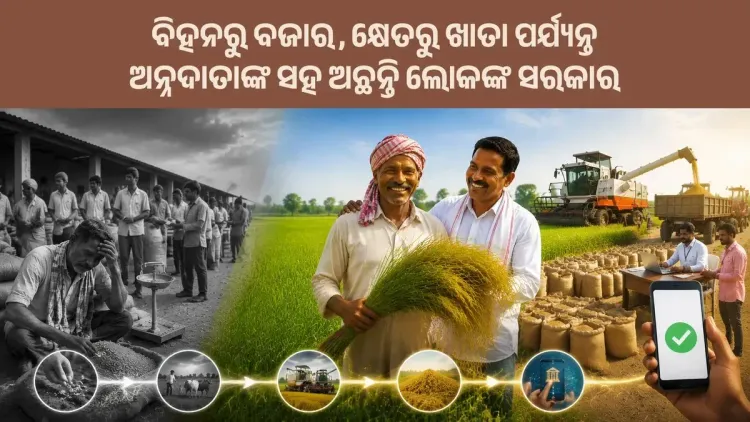
The government's stated approach covers the full agricultural chain — 'from seed to market, from field to account' .
The central PM-KISAN scheme provides Rs 6,000 per year to eligible farmer families, forming part of the broader support framework in the state.
Implementation outcomes for the 2026-27 paddy procurement season will be the key test of these commitments.
Odisha Chief Minister Mohan Charan Majhi on Tuesday, 23 June 2026, reaffirmed his government's commitment to agricultural welfare, declaring that farmers in the state are no longer treated as a 'vote bank' but as the foundation of Odisha's prosperity. The post, written in Odia, contrasts past procurement failures with what the BJP-led government describes as a farmer-first approach spanning seed supply to market access.
Context
In his post, CM Majhi recalled a time when Odisha's farmers struggled to receive fair value for their labour — facing arbitrary deductions at mandis, distress sales, and delayed payments after paddy sales. 'ସମୟ ଥିଲା, ଓଡ଼ିଶାର କୃଷକ ନିଜ ପରିଶ୍ରମର ଉଚିତ ମୂଲ୍ୟ ପାଇଁ ସଂଘର୍ଷ କରୁଥିଲେ' ('There was a time when Odisha's farmers struggled to get fair value for their hard work'), he wrote. He positioned the current administration as a decisive break from that era, stating that 'ଲୋକଙ୍କ ସରକାର' ('people's government') has made farmer welfare its highest priority.
Policy Backdrop
The BJP came to power in Odisha in June 2024, ending 24 years of Biju Janata Dal (BJD) rule under former Chief Minister Naveen Patnaik. During the election campaign, the party pledged sweeping reforms in paddy procurement, mandi operations, and the timeliness of farmer payments — grievances that had accumulated over successive cropping seasons. At the national level, the PM-KISAN scheme has since 2019 provided direct income support of Rs 6,000 per year to eligible landholding farmer families, including those in Odisha. The state government's stated agenda builds on this central framework with a seed-to-market continuum that CM Majhi summarised as 'ବିହନରୁ ବଜାର, କ୍ଷେତରୁ ଖାତା' — 'from seed to market, from field to account'.
Stakeholders and Impact
Agriculture, particularly paddy cultivation, employs a large share of Odisha's rural workforce, making procurement efficiency and payment timelines directly consequential for millions of households. The shift in political messaging — from farmers as electoral constituents to farmers as the 'strength and foundation of Odisha's prosperity' — signals a reorientation in how the state government intends to frame and communicate agricultural policy. Paddy growers, who have historically borne the brunt of mandi irregularities and delayed minimum support price payments, are the primary beneficiaries of the reforms the government is promising.
What's Next
Attention will now turn to the rollout and payment timelines under revised paddy procurement mechanisms for the 2026-27 cropping season, and to any new allocations in the state budget directed at seed supply, market linkages, and direct farmer payment systems. The credibility of the government's 'seed to market' pledge will be tested by on-ground procurement data and farmer payment records when the kharif harvest cycle concludes later this year.
Point of View
Using the language of dignity — 'strength' and 'foundation of prosperity' — to draw a sharp contrast with the preceding 24-year BJD administration's record on procurement delays and mandi irregularities. The 'seed to market, field to account' framing signals an intent to own the entire agricultural value chain as a governance narrative, not just announce isolated schemes. This aligns with the national BJP pattern of positioning farmers as beneficiaries of a structured welfare architecture rather than as seasonal recipients of ad hoc relief. The real measure of this positioning will come when the 2026-27 kharif procurement cycle concludes and payment timelines become publicly verifiable.
NationPress
22 Sept 2026
Frequently Asked Questions
What did Odisha CM Mohan Majhi say about farmers in his recent post?
CM Mohan Charan Majhi said Odisha's farmers are not a vote bank but the state's strength and foundation of prosperity, and that his government has made farmer welfare its highest priority, pledging support from seed supply to market access and direct payment.
What were the farming problems in Odisha before the BJP government?
CM Majhi's post cited arbitrary deductions at mandis, distress sales, and significant delays in payments to farmers after paddy sales as the defining problems under the previous administration.
When did BJP come to power in Odisha?
The BJP came to power in Odisha in June 2024, ending 24 years of BJD rule under former Chief Minister Naveen Patnaik, after winning the state assembly elections.
What is the PM-KISAN scheme and does it apply to Odisha farmers?
PM-KISAN is a central government scheme launched in 2019 that provides direct income support of Rs 6,000 per year to eligible landholding farmer families. It applies across India, including Odisha.
What does 'seed to market' mean in Odisha's farm policy?
The phrase, used by CM Majhi in Odia as 'bihanaru bajara, khetaru khata', refers to end-to-end government support for farmers covering seed supply, cultivation, market access, and timely direct payment into farmers' bank accounts.