CM Majhi Hails Presidential Assent to Exam Fairness Amendment Act
Synopsis
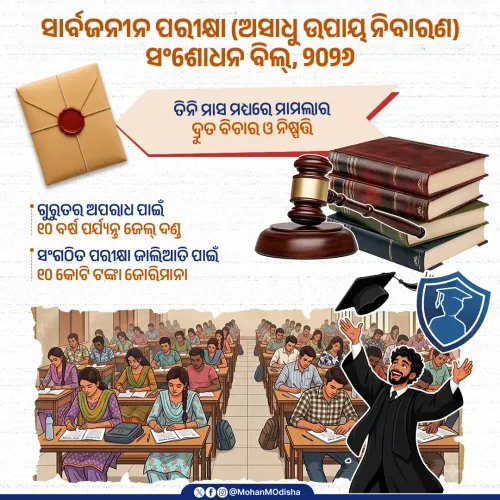
President Droupadi Murmu has granted assent to the Public Examinations (Prevention of Unfair Means) Amendment Bill, 2026. Odisha CM Mohan Charan Majhi welcomed the move, citing stringent penalties and time-bound investigations as key provisions designed to protect India's exam aspirants from malpractice.
Key Takeaways
President Droupadi Murmu gave assent to the Public Examinations (Prevention of Unfair Means) Amendment Bill, 2026 on or before August 1, 2026 .
The amendment builds on the original Public Examinations (Prevention of Unfair Means) Act, 2024 , which was enacted to combat paper leaks and impersonation in national exams.
Key additions include stringent penalties , time-bound investigations , and stronger accountability provisions.
Odisha CM Mohan Charan Majhi hailed the law as a step to protect the 'hard work, aspirations and future of India's youth.' The amendment is framed under Prime Minister Narendra Modi 's governance agenda focused on merit and transparency in public examinations.
India's war on examination fraud just got sharper teeth. Odisha Chief Minister Mohan Charan Majhi on Saturday, August 1, 2026, welcomed the presidential assent granted by President Droupadi Murmu to the Public Examinations (Prevention of Unfair Means) Amendment Bill, 2026 — calling it a historic step to protect the aspirations of India's youth.
From the 2024 Act to the 2026 Amendment
The journey begins with the Public Examinations (Prevention of Unfair Means) Act, 2024, which Parliament passed to tackle a crisis hiding in plain sight: paper leaks, impersonation, and organised malpractice that had repeatedly derailed the futures of lakhs of honest aspirants appearing in national recruitment and entrance examinations. That law established a foundational framework — penalties, structured probes, and accountability mechanisms — that signalled a clear shift in how the state intended to treat examination fraud: not as an administrative hiccup, but as a serious crime. The 2026 Amendment builds on that foundation. CM Majhi described it as introducing 'stringent penalties, time-bound investigations and strict accountability,' tightening the screws further on those who seek to corrupt the system. The presidential assent, he noted, transforms the bill 'from promise to protection.'What the Amendment Means for Crores of Exam Aspirants
For the millions of young Indians who spend years preparing for competitive examinations — UPSC, SSC, state PSC boards, railway recruitment, and more — paper leaks and impersonation are not abstract policy failures. They are life-altering injustices. A single compromised examination can set back a candidate's career by years, sometimes permanently. The amended law's emphasis on time-bound investigations addresses a persistent grievance: that even when malpractice was detected, the legal process dragged on long enough to render justice meaningless. Stricter accountability provisions aim to ensure that responsibility is fixed — on individuals and, where applicable, on officials who enable or ignore fraud.Majhi's Message and the Modi Government's Framing
CM Majhi explicitly anchored his statement in the leadership of Prime Minister Narendra Modi, framing the amendment as part of a broader governance commitment to 'safeguarding merit' and 'strengthening trust in public examinations.' The language is deliberate: trust, once broken by a leaked question paper, is extraordinarily hard to rebuild, and the government is betting that legislative muscle — visible, punitive, and swift — can begin to restore it. The political signal is equally clear. With competitive examinations serving as the primary ladder of social mobility for a vast swathe of India's young population, any credible reform in this space carries significant public resonance. Protecting that ladder is not just policy — it is a promise to a generation. The real test now lies in implementation: whether the amended provisions are operationalised swiftly in both central and state recruitment cycles, and whether the rules notified under the Act translate the law's intent into on-the-ground deterrence.Point of View
Legislating visible, punitive deterrence in this space serves both a governance and an electoral logic: competitive examinations are the primary vehicle of upward mobility for a vast youth demographic that the party courts actively. CM Majhi's statement, which explicitly credits PM Modi's leadership, also reflects the standard BJP state-centre alignment on flagship governance narratives. The real measure of the law's impact, however, will be the speed and consistency of enforcement once the amended rules are operationalised across central and state examination bodies.
NationPress
1 Aug 2026
Frequently Asked Questions
What is the Public Examinations (Prevention of Unfair Means) Amendment Bill 2026?
It is an amendment to the original 2024 Act that combats malpractice in public examinations. The 2026 amendment introduces stricter penalties, time-bound investigations, and stronger accountability provisions to deter paper leaks and impersonation.
Who gave assent to the Public Examinations Amendment Bill 2026?
President Droupadi Murmu granted presidential assent to the bill, converting it into law.
What was the original Public Examinations (Prevention of Unfair Means) Act 2024?
Parliament passed the 2024 Act to address recurring irregularities — including paper leaks and impersonation — in national recruitment and entrance examinations, establishing a framework for penalties and structured investigations.
Why did Odisha CM Mohan Charan Majhi comment on a central government law?
As a BJP Chief Minister, Majhi welcomed the amendment as part of the broader Modi government's governance agenda, framing it as a commitment to protecting the merit and aspirations of India's youth.
How will the exam fraud amendment law affect students in India?
The law aims to make malpractice in competitive examinations a more seriously punishable offence with faster investigations, giving honest aspirants greater assurance that the examination process will be fair and credible.