CM Majhi Highlights Odisha's Multi-Sector Growth Push

Synopsis
Odisha CM Mohan Charan Majhi on June 8, 2026, listed a sweeping set of state initiatives: a new coastal road, ₹195 crore for police infrastructure, expanded reservations for marginalised students, a Pipili handicraft hub, 13 space labs, a model solar village, and revised DMF norms for mining districts.
Key Takeaways
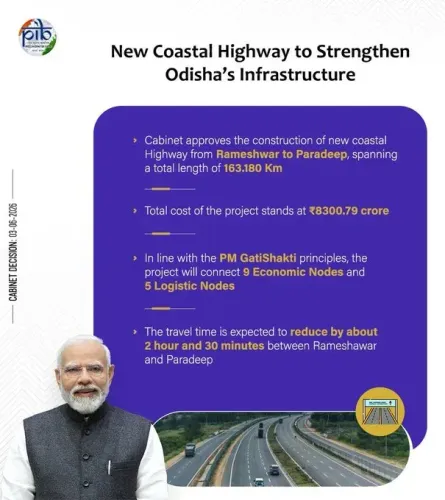
A new coastal highway linking Rameshwar to Paradip has been announced to boost shoreline connectivity.
Fresh reservation provisions for ST, SC, and SEBC students in technical and vocational education have been introduced.
A ₹195 crore project has been sanctioned to strengthen police infrastructure across the state.
A chandua handicraft hub is planned at Pipili in Puri district to support traditional artisans.
13 space laboratories and Odisha's first model solar village have been launched as part of science and clean-energy outreach.
Revised DMF guidelines aim to improve fund utilisation in mining-affected districts.
Odisha Chief Minister Mohan Charan Majhi on Monday, June 8, 2026, outlined a cluster of state government initiatives spanning infrastructure, education, renewable energy, and handicraft development, describing them collectively as building blocks of a 'modern, empowered, and prosperous Odisha.'
Context
Posting in Odia, CM Majhi listed several concurrent policy moves: a new coastal highway from Rameshwar to Paradip, fresh reservation provisions for ST, SC, and SEBC students in technical and vocational education, a ₹195 crore police infrastructure project, and a dedicated chandua (applique handicraft) hub at Pipili in Puri district. He also cited the successful hosting of a BRICS Disaster Risk Reduction Working Group meeting, recognition at the National Panchayat Awards, the launch of 13 space laboratories, Odisha's first model solar village, and revised District Mineral Foundation (DMF) guidelines for mining-affected areas.
The post signals the state government's intent to communicate governance momentum across multiple fronts simultaneously, rather than through piecemeal announcements.
Policy Backdrop
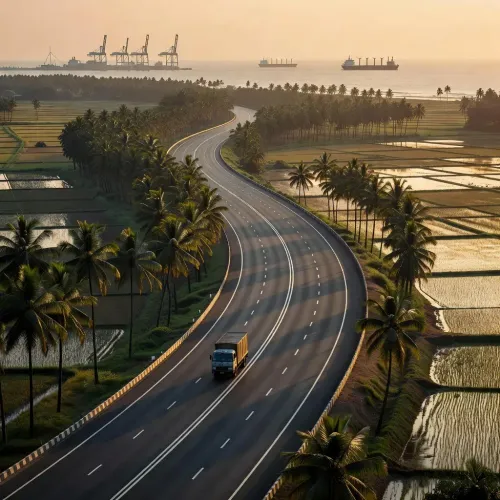
The Rameshwar-Paradip Coastal Road is positioned as a connectivity upgrade along Odisha's extensive shoreline, linking interior regions to Paradip Port, one of India's major cargo hubs. Coastal infrastructure has been a recurring priority for the state given its vulnerability to cyclones and its dependence on maritime trade.
The revised DMF norms draw from the framework established under the Mines and Minerals (Development and Regulation) Amendment Act, 2015, which mandated that a share of mining royalties flow into statutory DMF bodies to fund development in districts bearing the environmental and social costs of extraction. New state-level rules can sharpen how those funds are prioritised and disbursed. The reservation expansion for ST, SC, and SEBC students in technical education aligns with the equity thrust of the National Education Policy 2020, which specifically called for widening access to vocational pathways for marginalised groups.
The BRICS Disaster Risk Reduction Working Group meeting, hosted in Odisha, underscores the state's growing role as a venue for multilateral technical cooperation, building on its established expertise in cyclone preparedness and post-disaster recovery.
Stakeholders and Impact
Coastal communities along the Rameshwar-Paradip corridor stand to gain from improved road access, potentially reducing logistics costs for fishermen and small traders. Artisans in Pipili, whose chandua applique work is a recognised craft tradition, could benefit from the proposed hub through shared infrastructure, market linkages, and export facilitation.
ST, SC, and SEBC students across the state are the direct beneficiaries of the new reservation framework in technical and vocational institutions, a cohort historically underrepresented in professional education streams. Mining-affected districts — where communities have long sought better utilisation of DMF funds — could see more targeted welfare spending if the revised guidelines tighten accountability and expand eligible project categories.
The 13 space labs and the model solar village initiative point to an attempt to embed science education and clean energy demonstration into rural governance, with potential replication value across the state's 314 blocks.
What's Next
Observers will watch for tendering and land-acquisition timelines on the Rameshwar-Paradip Coastal Road, as coastal projects in Odisha have historically faced delays linked to environmental clearances and displacement concerns. The DMF rule revisions will require notification in the state gazette and subsequent district-level implementation orders before funds are redirected.
The rollout of space labs and the solar village pilot will be tested by last-mile delivery capacity; their success could inform the state's pitch for central government co-funding under national science education and renewable energy schemes. The BJP government, which came to power after the 2024 Odisha assembly elections, is likely to use this governance record as a political benchmark ahead of the next electoral cycle.
Point of View
Bundling diverse initiatives into a single narrative of momentum — a strategy common among state governments seeking to project administrative competence between elections. The inclusion of the BRICS Disaster Risk Reduction meeting is notable: it positions Odisha not merely as a recipient of central policy but as an active node in multilateral technical diplomacy, leveraging the state's cyclone-management credentials. The simultaneous push on DMF reform and coastal infrastructure addresses two of Odisha's most persistent structural tensions — equitable distribution of mineral wealth and vulnerability to climate-linked coastal shocks. Whether the breadth of these announcements translates into measurable delivery will be the defining test for the government as it approaches the midpoint of its term.
NationPress
18 Sept 2026
Frequently Asked Questions
What is the Rameshwar to Paradip coastal road project in Odisha?
It is a new coastal highway announced by the Odisha government to improve road connectivity along the state's shoreline, linking Rameshwar to Paradip Port, a major cargo hub on the Bay of Bengal.
What are the new reservation rules for ST, SC, and SEBC students in Odisha?
The Odisha government has introduced new reservation provisions specifically for ST, SC, and SEBC students in technical and vocational education institutions, aiming to improve access to professional training for marginalised communities.
What is the DMF and why are new rules being introduced in Odisha?
The District Mineral Foundation is a statutory body funded by mining levies under the 2015 MMDR Amendment Act. Odisha's revised DMF guidelines are intended to make fund utilisation more targeted and accountable in districts affected by mining activity.
What is the Pipili chandua hub announced by CM Majhi?
The chandua hub at Pipili in Puri district is a dedicated infrastructure facility for artisans practising the traditional applique craft, designed to provide shared workspace, market access, and export support.
What are the 13 space labs launched in Odisha?
The Odisha government has set up 13 space laboratories as part of a science education outreach initiative. Their district-wise rollout and full operational status are subject to ongoing implementation.