CM Majhi marks 2 years of rural infra push in Odisha
Synopsis
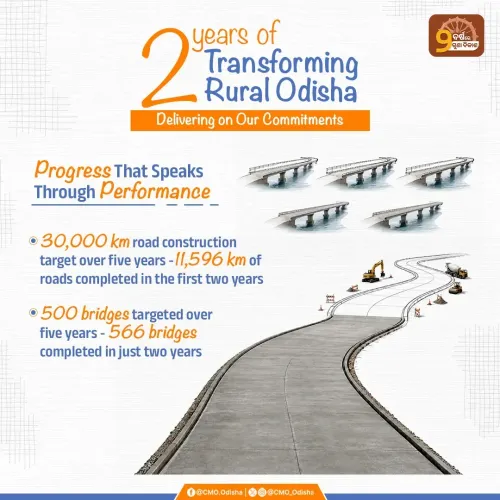
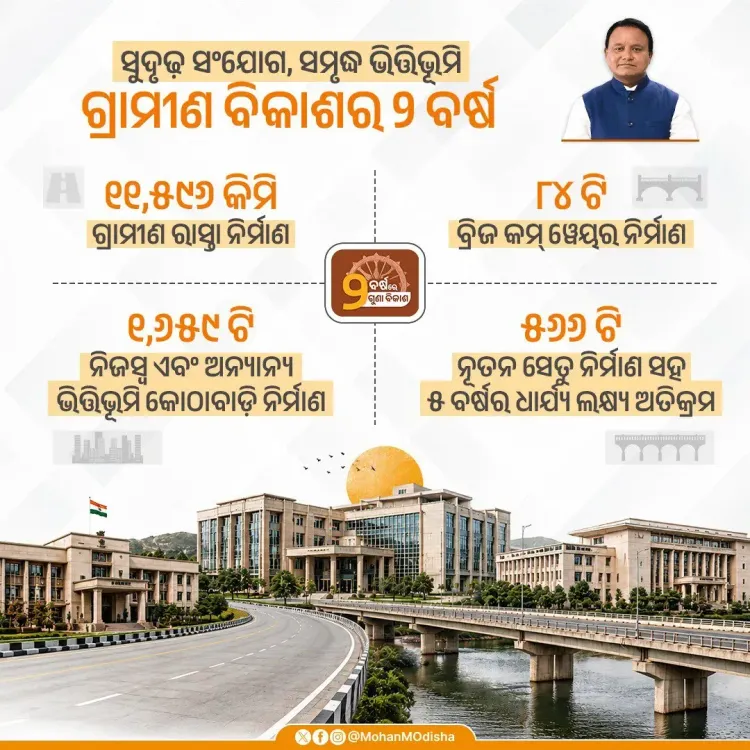
Odisha Chief Minister Mohan Charan Majhi marked two years of his BJP government on 26 June 2026 by crediting his administration with large-scale rural road construction, ahead-of-schedule bridge completion, and bridge-cum-weir projects aimed at connecting every village to the mainstream of development.
Key Takeaways
CM Mohan Charan Majhi posted on 26 June 2026 to mark two years of his government's rural infrastructure drive.
The government claims extensive rural road construction, multiple bridges completed ahead of schedule , and numerous bridge-cum-weirs built in the period.
The BJP government took office in June 2024 , ending 24 years of BJD rule in Odisha.
PMGSY and Bharatmala Pariyojana form the central policy backbone for rural connectivity in the state.
CM Majhi said the efforts will continue toward building 'a strong and prosperous Odisha.'
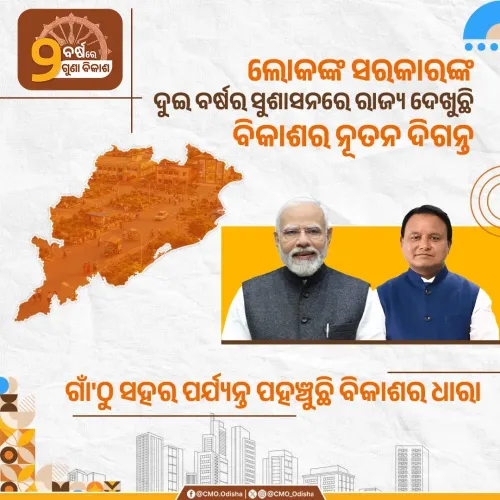
Odisha Chief Minister Mohan Charan Majhi on Friday, 26 June 2026, highlighted his government's rural infrastructure record as it completed two years in office, stating that extensive road construction, bridges, and allied civil works had transformed connectivity across the state's villages.
Posting in Odia on X, CM Majhi wrote: 'ଗ୍ରାମୀଣ ଓଡ଼ିଶାର ସୁଦୃଢ଼ ସଂଯୋଗୀକରଣ' — 'Strong connectivity of rural Odisha has today created a new chapter of development.' He added that his government had pursued 'continuous efforts to connect every village of Odisha to the mainstream of progress,' and that the two-year period had seen 'large-scale rural road construction, several new bridges completed ahead of schedule, various infrastructure buildings, and numerous bridge-cum-weirs.'
Context
The post was tagged with the hashtags #2YearsofLokankaSarakar, #BikasharaDharaOdishaSara, and #2YearsofRuralDevelopment, marking the second anniversary of the BJP government that took power in June 2024 after ending 24 years of Biju Janata Dal (BJD) rule in the state. The ruling party has framed rural connectivity as a signature deliverable of its first two years.
CM Majhi emphasised that the development had 'strengthened rural economy and social life while instilling new hope and confidence in the minds of every villager,' and that these efforts would 'continue uninterrupted' toward building 'a strong and prosperous Odisha.'
Policy Backdrop
Rural road connectivity in Odisha has been driven in large part by the Pradhan Mantri Gram Sadak Yojana (PMGSY), a centrally sponsored scheme launched in 2000 to provide all-weather road access to unconnected rural habitations. Odisha, with its large rural population and geographically dispersed settlements — including tribal and forested areas — has been a significant beneficiary of the programme.
The Bharatmala Pariyojana, approved in 2017, further expanded the highway and bridge network with rural linkage components. The current state government has positioned itself as an accelerator of projects initiated under earlier regimes, emphasising time-bound completion as a distinguishing feature of its approach.
Stakeholders and Impact
The primary beneficiaries of rural road and bridge expansion are Odisha's farming households and village communities, for whom better connectivity translates into faster access to agricultural markets, healthcare, and educational institutions. Bridge-cum-weirs — structures that serve dual purposes of road crossing and water retention — are particularly significant in a state where seasonal rivers can cut off villages for months.
Improved rural infrastructure also supports the broader goal of integrating remote economies with urban supply chains, a pattern seen across multiple Indian states that have prioritised last-mile connectivity in recent years.
What's Next
Analysts and rural development observers will watch the next Odisha state budget for detailed targets and expenditure figures on rural roads and bridges, including any new phases of PMGSY or state-funded schemes. The government's ability to sustain the pace of construction — and to publish auditable project-completion data — will be a key measure of whether the two-year record translates into durable rural transformation.
Point of View
Framing rural connectivity as the BJP government's defining achievement at the two-year mark — a contrast with the outgoing BJD's long incumbency. By invoking ahead-of-schedule bridge completions and bridge-cum-weirs, the administration is signalling execution speed as a differentiator, not just policy intent. The move fits a broader national BJP pattern of using infrastructure milestones as electoral messaging, particularly in states with large rural voter bases. The credibility of these claims will ultimately depend on independently verifiable project-completion data in forthcoming budget documents.
NationPress
26 Jun 2026
Frequently Asked Questions
What did Odisha CM Mohan Majhi say about rural development after two years?
CM Mohan Charan Majhi said his government has achieved large-scale rural road construction, completed several bridges ahead of schedule, and built numerous bridge-cum-weirs in the two years since taking office in June 2024, calling it a 'new chapter of development' for rural Odisha.
How long has the BJP government been in power in Odisha?
The BJP government in Odisha completed two years in office in June 2026, having come to power in June 2024 after ending 24 years of Biju Janata Dal rule in the state.
What is PMGSY and how does it relate to Odisha's rural roads?
Pradhan Mantri Gram Sadak Yojana (PMGSY) is a centrally sponsored scheme launched in 2000 to provide all-weather road connectivity to rural habitations. Odisha, with its large and dispersed rural population, has been a major beneficiary of the programme.
What is a bridge-cum-weir and why is it important in Odisha?
A bridge-cum-weir is a structure that functions both as a road crossing and a water-retention barrier. In Odisha, where seasonal rivers can isolate villages for extended periods, such structures are critical for year-round rural connectivity.
What are the hashtags CM Majhi used for the two-year rural development post?
CM Majhi used the hashtags #2YearsofLokankaSarakar, #BikasharaDharaOdishaSara, and #2YearsofRuralDevelopment to mark the occasion.