CM Majhi: Odisha to make farming market-linked, future-ready
Synopsis
Chief Minister Mohan Charan Majhi on 11 July 2026 set out Odisha's agricultural agenda across six pillars — procurement, irrigation, technology, mandi infrastructure, value addition, and food processing — aimed at making farming market-linked and raising farmer incomes in a state where agriculture employs over half the workforce.
Key Takeaways
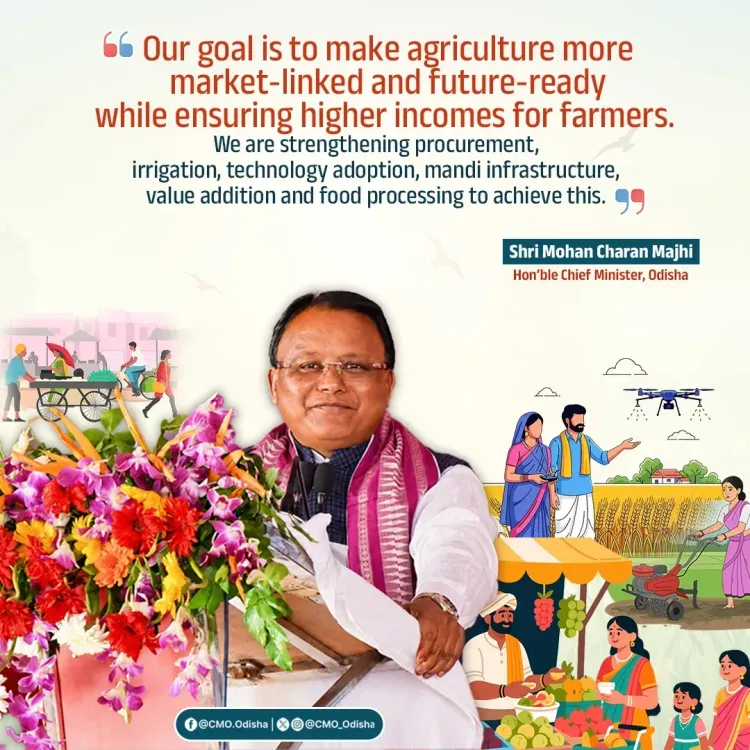
CM Mohan Charan Majhi on 11 July 2026 articulated a six-pillar farm strategy for Odisha : procurement, irrigation, technology adoption, mandi infrastructure, value addition, and food processing.
Agriculture accounts for roughly 20 percent of Odisha's GSDP and employs over 50 percent of its workforce, making farm-sector performance critical to the state economy.
The strategy builds on Odisha's earlier KALIA scheme (2018) , which provided direct income support and crop insurance to small and marginal farmers.
The focus on mandi infrastructure and food processing aligns with the national e-NAM platform launched in 2016 and broader Agricultural Produce and Livestock Marketing reforms.
Small and marginal farmers and the food-processing sector are the primary stakeholders expected to benefit from the announced priorities.
Concrete budget allocations and pilot-project announcements in the upcoming assembly session will be the key test of the policy's seriousness.
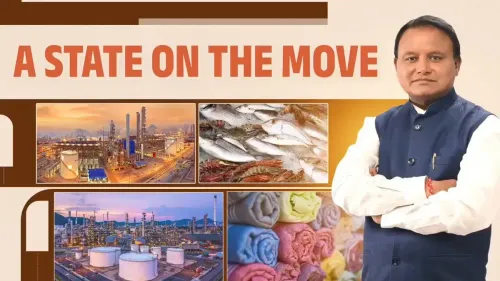
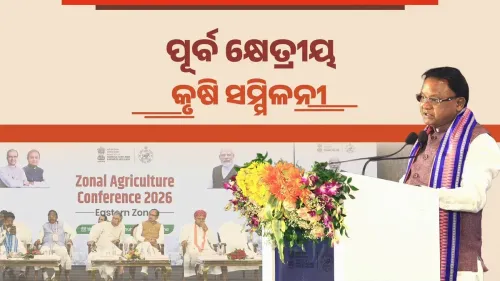
The Chief Minister's Office of Odisha on Saturday, 11 July 2026, shared a statement from Chief Minister Mohan Charan Majhi outlining the state government's agricultural vision — centred on market linkages, higher farmer incomes, and a sweeping upgrade of rural infrastructure across Odisha.
Context
Speaking on the state's farm policy direction, CM Majhi said: 'Our goal is to make agriculture more market-linked and future-ready while ensuring higher incomes for farmers.' He identified six specific pillars the government is pursuing: procurement strengthening, irrigation, technology adoption, mandi infrastructure, value addition, and food processing.
The statement is notable for its breadth — spanning the entire agricultural value chain from field to market — and signals that the Majhi government, which took office in June 2024, is consolidating its farm-sector agenda into a coherent public narrative.
Policy Backdrop
Odisha is one of India's significant agrarian states, with agriculture contributing roughly 20 percent of the state's gross domestic product and employing over 50 percent of its workforce. The stakes of farm-sector performance are therefore high for both the state economy and the livelihoods of its rural majority.
The state has prior form in farm welfare: the KALIA (Krushak Assistance for Livelihood and Income Augmentation) scheme, launched in 2018, delivered direct income support and crop insurance to small and marginal farmers and drew national attention as a precursor to similar central and state-level direct-benefit programmes. CM Majhi's current emphasis on market linkages and post-harvest infrastructure builds on that foundation while pivoting toward income enhancement through commercialisation rather than subsidy alone.
At the national level, the push to connect farmers to organised markets gained momentum with the launch of the e-NAM (electronic National Agriculture Market) platform in 2016 and subsequent Agricultural Produce and Livestock Marketing reforms that multiple states have pursued in parallel. Odisha's articulated focus on mandi infrastructure and food-processing clusters fits squarely within this pan-Indian policy arc.
Stakeholders and Impact
Small and marginal farmers — who make up the bulk of Odisha's agricultural community — stand to be the primary beneficiaries if the government's six-pillar strategy translates into on-ground investment. Improved irrigation coverage would reduce dependence on monsoon rainfall, while stronger procurement mechanisms could shield growers from distress sales at below-minimum-support-price rates.
The food-processing sector is the other key stakeholder. Expanded processing capacity creates demand for raw agricultural output at stable prices, generates rural non-farm employment, and reduces post-harvest losses — a persistent drag on farmer incomes across eastern India. Private food-processing investors will be watching state budget allocations and any announced cluster or incentive schemes closely.
What's Next
Observers will look to the Odisha state assembly's upcoming session for concrete budget lines: allocations for mandi upgrades, irrigation projects, and any new technology-adoption or food-processing pilot programmes that give substance to the Chief Minister's statement. The translation of this policy vision into measurable targets and funding commitments will determine whether the six pillars remain an aspiration or become a structural shift in how Odisha supports its farming community.
If the state follows through with coordinated investment across all six areas, it could position Odisha as a model for other eastern Indian states seeking to move their farm economies from subsistence-oriented to market-integrated — a transition that the broader national policy environment has been encouraging for over a decade.
Point of View
The government is signalling to investors and multilateral agencies that Odisha is open for agri-business, not just agrarian relief. The statement's breadth, however, also carries political risk: committing to six simultaneous fronts invites scrutiny if budget allocations prove thin. The real test will come in the assembly session, where the gap between vision and fiscal commitment will become visible.
NationPress
11 Jul 2026
Frequently Asked Questions
What is Odisha CM Mohan Majhi's agriculture policy?
CM Mohan Charan Majhi has outlined a six-pillar agriculture strategy for Odisha focused on strengthening procurement, expanding irrigation, promoting technology adoption, upgrading mandi infrastructure, enabling value addition, and boosting food processing — all aimed at making farming more market-linked and raising farmer incomes.
What is the KALIA scheme in Odisha?
The KALIA (Krushak Assistance for Livelihood and Income Augmentation) scheme was launched by Odisha in 2018 to provide direct income support and crop insurance to small and marginal farmers, and is considered a precursor to similar direct-benefit farm programmes across India.
How important is agriculture to Odisha's economy?
Agriculture contributes roughly 20 percent of Odisha's gross state domestic product and employs over 50 percent of the state's workforce, making it the single most important sector for rural livelihoods in the state.
What is e-NAM and how does it relate to Odisha's farm policy?
e-NAM, the electronic National Agriculture Market, is a national platform launched in 2016 to connect farmers to organised markets across state borders. Odisha's current emphasis on mandi infrastructure and market linkages aligns with the broader national push that e-NAM represents.
What should I watch for next on Odisha's farm policy?
Watch the Odisha state assembly's upcoming session for budget allocations to mandi upgrades, irrigation projects, and any new food-processing or technology-adoption pilot schemes that will indicate whether CM Majhi's six-pillar vision is backed by concrete funding.