CM Majhi Hails Dharmendra Pradhan's Tenure, Cites NEP 2020
Synopsis
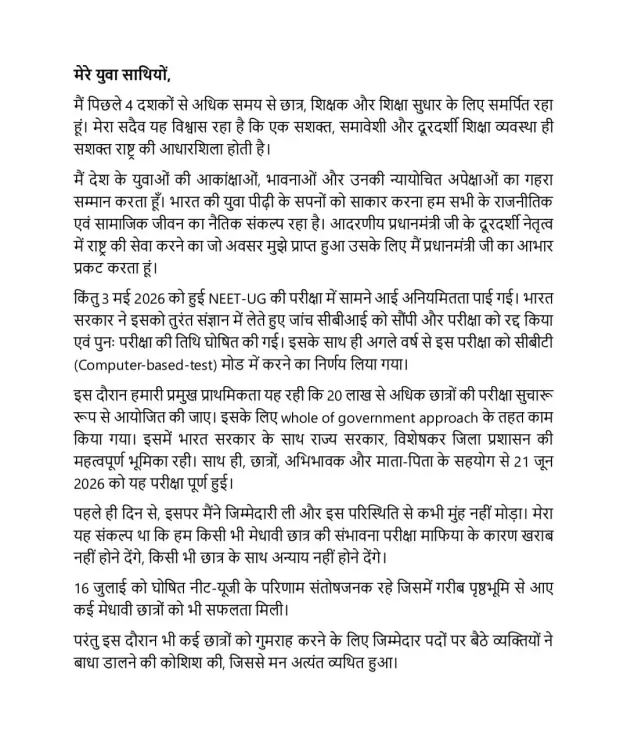
Odisha Chief Minister Mohan Charan Majhi praised Dharmendra Pradhan on 25 July 2026 following his resignation as Union Education Minister, hailing his stewardship of NEP 2020 and calling the decision to step down a mark of high moral principle.
Key Takeaways
CM Mohan Charan Majhi publicly praised Dharmendra Pradhan on 25 July 2026 after Pradhan's resignation as Union Minister of Education.
Majhi credited Pradhan with implementing the National Education Policy (NEP) 2020 , calling it a 'historic' reform benefiting millions of students.
The Chief Minister described the resignation as reflecting 'high moral values' and 'unwavering dedication to public service.' NEP 2020 , approved by the Union Cabinet in July 2020 , replaced the 1986 National Policy on Education and introduced a 5+3+3+4 curricular structure .
Majhi invoked Mahaprabhu Shri Jagannath , a central cultural symbol in Odisha, to bless Pradhan's future journey.
Both leaders are senior BJP figures from Odisha, reflecting the party's centre-state alignment on education reform.
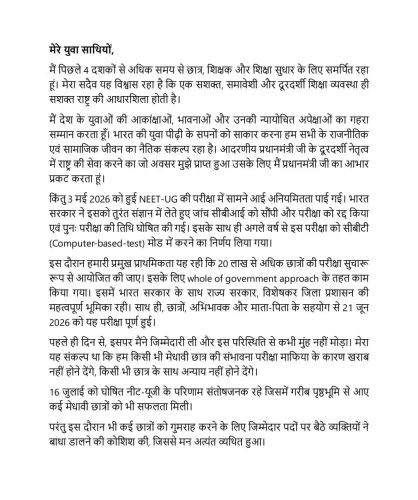
Odisha Chief Minister Mohan Charan Majhi on Saturday, 25 July 2026, paid tribute to Dharmendra Pradhan following his resignation as Union Minister of Education, praising his role in implementing the landmark National Education Policy (NEP) 2020 and describing the decision to step down as an act of deep principle.
Context
In his post, CM Majhi wrote that Pradhan, as Union Minister of Education, 'led transformative reforms, including the historic National Education Policy (NEP 2020), laying a strong foundation for the future of millions of students across the nation.' The Chief Minister framed Pradhan's resignation as a reflection of 'high moral values' and 'unwavering dedication to public service,' adding a blessing in Odia: 'Mahaprabhu Shri Jagannathanka ashirbadaru agami dinare tankar ei karmamaya yatra ahuri adhika safalata o pratishtha anideba' ['May Mahaprabhu Shri Jagannath's blessings bring even greater success and honour to his journey in the days ahead'].
Dharmendra Pradhan is a senior Bharatiya Janata Party (BJP) leader from Odisha who served as Union Minister of Education and previously held the petroleum and natural gas portfolio. His political career has been closely tied to Odisha, and his relationship with CM Majhi reflects the broader alignment between the BJP-led state and central governments.
Policy Backdrop
The National Education Policy 2020, approved by the Union Cabinet in July 2020, was the most sweeping overhaul of India's education framework since the 1986 National Policy on Education. It introduced a new 5+3+3+4 curricular structure, replacing the long-standing 10+2 model, and emphasised mother-tongue instruction at the foundational level, multidisciplinary higher education, and vocational integration from an early age.
Pradhan was the minister who oversaw much of the NEP's implementation phase, coordinating with state governments — including Odisha — on curriculum alignment, teacher training, and institutional restructuring. The Right to Education Act 2009 had earlier established free and compulsory education as a fundamental right for children aged 6 to 14, providing the legislative floor on which NEP 2020 built its ambitions.
Stakeholders and Impact
The NEP 2020 affects a vast constituency: students from pre-primary through higher education, state education departments, universities, and millions of families. Odisha, like other states, has been in the process of aligning its curricula and governance mechanisms with NEP provisions, a process that will continue regardless of ministerial changes at the centre.
CM Majhi's public statement signals that Odisha's BJP government views Pradhan's tenure as a net positive for the state's education trajectory. The invocation of Mahaprabhu Shri Jagannath — the presiding deity of Puri and a deeply resonant cultural symbol in Odisha — underscores the personal and regional significance of Pradhan's standing within the state.
What's Next
Attention will now turn to the appointment of a new Union Minister of Education and the continuity of ongoing NEP rollout programmes. At the state level, Odisha will be watched for how it advances NEP provisions such as mother-tongue-based instruction in foundational classes and multidisciplinary reforms in higher education institutions. Any formal announcement regarding Dharmendra Pradhan's subsequent role — whether in party organisation or another public office — is expected to follow in the coming days.
Point of View
Framing Pradhan's exit not as a political setback but as a principled act — a narrative that protects party morale and Pradhan's future utility. The emphasis on NEP 2020 also serves a dual purpose: it reinforces the BJP's education reform credentials at a moment of ministerial transition. The Jagannath invocation is not incidental; it roots a national political moment in Odishan cultural identity, signalling Pradhan's continued relevance to the state. Taken together, the post reads less as a farewell and more as a positioning statement ahead of Pradhan's next chapter.
NationPress
24 Oct 2026
Frequently Asked Questions
Why did Dharmendra Pradhan resign as Education Minister?
CM Mohan Majhi's post states that Pradhan's resignation reflects his prioritisation of 'high moral values' and 'unwavering dedication to public service,' though the specific reasons for the resignation have not been detailed in the post.
What is NEP 2020 and what did Dharmendra Pradhan do for it?
The National Education Policy 2020 is India's most comprehensive education reform since 1986, introducing a 5+3+3+4 curricular structure and emphasising mother-tongue instruction. Dharmendra Pradhan, as Union Minister of Education, oversaw its implementation across states including Odisha.
Who is Mohan Charan Majhi?
Mohan Charan Majhi is the Chief Minister of Odisha and a senior BJP leader who assumed office in June 2024 after the BJP's victory in the Odisha assembly elections.
Who is Dharmendra Pradhan?
Dharmendra Pradhan is a senior BJP leader from Odisha who served as Union Minister of Education and previously held the petroleum and natural gas portfolio at the Centre.
What happens to NEP 2020 rollout in Odisha after Pradhan's resignation?
The NEP 2020 rollout in Odisha — including mother-tongue-based instruction and higher education restructuring — is expected to continue under state education department oversight, with a new Union Minister of Education likely to be appointed to guide the central implementation.