CM Majhi Sets Up 6 Special SC/ST Courts Across Odisha
Synopsis
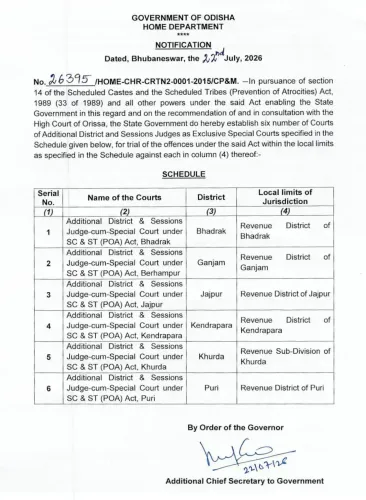
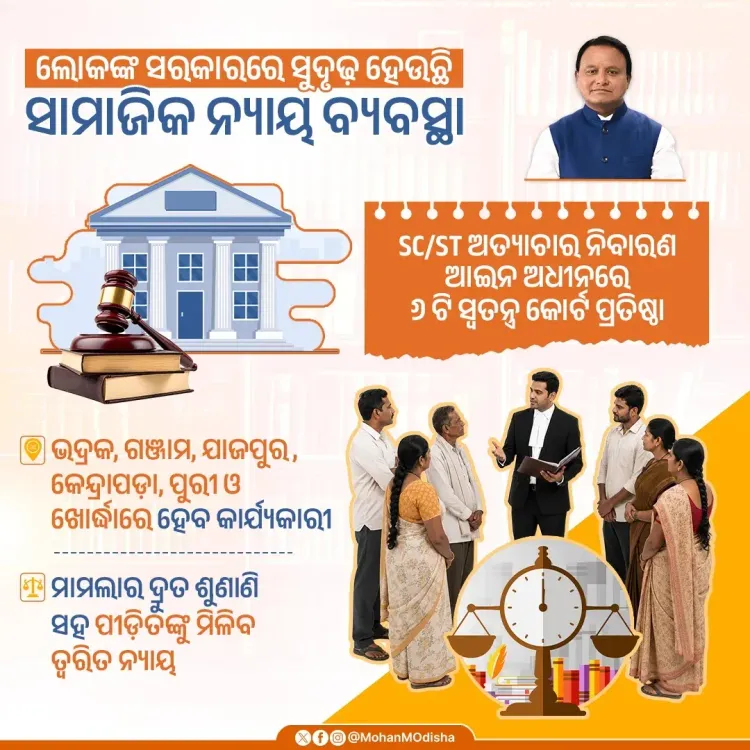
Odisha Chief Minister Mohan Charan Majhi has announced six exclusive special courts under the SC/ST (Prevention of Atrocities) Act in Bhadrak, Ganjam, Jajapur, Kendrapara, Puri and Khordha, aiming to ensure faster trials and stronger rights protection for atrocity victims across these six districts.
Key Takeaways
Six exclusive special courts have been established under the SC/ST (Prevention of Atrocities) Act in Odisha.
The courts are located in Bhadrak, Ganjam, Jajapur, Kendrapara, Puri and Khordha districts.
The courts are mandated to hear only POA Act cases, reducing backlog and ensuring faster disposal.
The 2015 amendment to the POA Act made exclusive special courts mandatory for all states.
CM Mohan Charan Majhi framed the move as the 'core commitment' of his 'people's government' to social justice.
Performance of these courts in terms of disposal rates and conviction statistics will be subject to central government review.
Odisha Chief Minister Mohan Charan Majhi announced on Friday, 25 July 2026 that his government has established six dedicated special courts under the Scheduled Castes and Scheduled Tribes (Prevention of Atrocities) Act across six districts of Odisha, promising faster trials and stronger rights protection for atrocity victims.
Context
Posting in Odia on X, CM Majhi wrote: 'ଲୋକଙ୍କ ସରକାରରେ ସାମାଜିକ ନ୍ୟାୟକୁ ମିଳୁଛି ସର୍ବାଧିକ ପ୍ରାଥମିକତା' — 'Social justice receives the highest priority in the people's government.' He stated that the six exclusive courts have been set up in Bhadrak, Ganjam, Jajapur, Kendrapara, Puri and Khordha districts, and that they will ensure 'swift hearings, speedy justice for victims, and stronger protection of their rights.' He concluded: 'Justice for all, protection for everyone — this is the core commitment of the people's government.'
The announcement marks a concrete step in the BJP-led Odisha government's social justice agenda, less than two years after Majhi took office in June 2024 following the party's first-ever majority in the state assembly.
Policy Backdrop
The Scheduled Castes and the Scheduled Tribes (Prevention of Atrocities) Act, 1989 — commonly called the POA Act — mandates that state governments establish special courts to ensure expeditious trial of caste-based atrocity cases. The 2015 amendment to the Act made the creation of exclusive special courts — courts that handle only POA cases — mandatory, and added provisions for victim relief and time-bound investigation.
Before the 2015 amendment, many states designated existing sessions courts as 'special courts' on a shared basis, leading to high case pendency and prolonged trials for victims from SC/ST communities. Exclusive courts, by contrast, are required to hear only atrocity cases, significantly reducing the backlog burden.
State governments across India have progressively moved to notify such exclusive courts, particularly after central government reviews flagged low conviction rates and high pendency in shared-court arrangements. Odisha's move to cover six districts simultaneously fits this national pattern of strengthening legal infrastructure for marginalised communities.
Stakeholders and Impact
The primary beneficiaries are members of Scheduled Caste and Scheduled Tribe communities in Bhadrak, Ganjam, Jajapur, Kendrapara, Puri and Khordha — six of Odisha's most populous districts. Victims of caste atrocities in these areas will no longer need to wait in long queues behind general criminal cases for their matters to be heard.
Legal aid organisations and civil society groups working with Dalit and Adivasi communities have long argued that delays in trial are themselves a form of denial of justice, often forcing victims to withdraw complaints. Dedicated courts directly address this structural barrier.
For the Majhi government, the move also carries political significance: Odisha has a substantial SC/ST population, and delivering on social justice commitments is central to the BJP's consolidation of its electoral base in the state.
What's Next
The effectiveness of the six new courts will ultimately be measured by their case disposal rates and conviction statistics over the next 12 to 18 months, metrics that the central government periodically reviews. Advocacy groups are likely to watch whether adequate public prosecutors and support infrastructure are put in place alongside the court notifications.
There will also be pressure on the state government to extend similar exclusive courts to the remaining districts of Odisha, particularly those with high reported incidences of caste atrocities. How swiftly the government moves on that expansion could define the long-term legacy of this announcement.
Point of View
Visible delivery on social justice infrastructure strengthens the party's post-2024 narrative of inclusive governance. The real test, however, lies in implementation: exclusive courts without adequate prosecutors, witness protection, and support services have historically underperformed in other states. Whether Odisha bucks that trend will determine if this is a structural reform or a headline measure.
NationPress
24 Jul 2026
Frequently Asked Questions
What are the six districts where Odisha has set up new SC/ST special courts?
The six districts are Bhadrak, Ganjam, Jajapur, Kendrapara, Puri and Khordha. Each will have one exclusive special court to hear cases under the SC/ST (Prevention of Atrocities) Act.
What is the SC/ST Prevention of Atrocities Act?
The Scheduled Castes and the Scheduled Tribes (Prevention of Atrocities) Act, 1989 is a central law that criminalises caste-based atrocities and mandates special courts for their expeditious trial. A 2015 amendment made exclusive special courts compulsory for all states.
Why are exclusive special courts better than shared courts for SC/ST cases?
Exclusive special courts handle only POA Act cases, which prevents atrocity cases from being pushed back behind a large general criminal docket. This reduces pendency and ensures victims receive faster justice.
Who is Mohan Charan Majhi?
Mohan Charan Majhi is the Chief Minister of Odisha and a senior BJP leader. He assumed office in June 2024 after the BJP won its first outright majority in the Odisha Legislative Assembly.
Will more SC/ST special courts be set up in other Odisha districts?
CM Majhi's announcement covers six districts. Advocacy groups and legal observers expect pressure on the government to extend exclusive courts to remaining Odisha districts, though no official timeline has been announced.