Odisha notifies 6 new Special Courts for SC/ST atrocity cases
Synopsis
Odisha has notified six new Exclusive Special Courts for SC/ST atrocity cases — a move driven by pendency audits from the State Human Rights Protection Cell. The courts cover five districts and one sub-division identified as high-caseload zones, with the government signalling more such courts may follow in other districts.
Key Takeaways
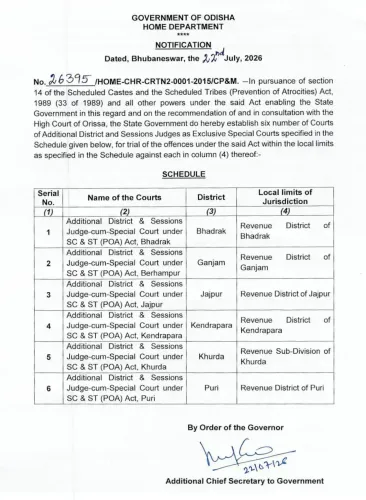
The Odisha government notified six new Exclusive Special Courts on 22 July under the SC/ST (Prevention of Atrocities) Act, 1989 .
The courts will cover Bhadrak , Ganjam (Berhampur) , Jajpur , Kendrapara , Puri , and the Khurda revenue sub-division .
The notification followed recommendations from the Orissa High Court and pendency audits by the State Human Rights Protection Cell (SHRPC) .
ADGP Yatindra Koyal led the coordination that identified high-caseload districts and drafted the proposal.
The Home Department has requested the Orissa High Court to appoint Additional District and Sessions Judges as Presiding Officers.
The government is evaluating proposals for further Special Courts and Special Public Prosecutors in additional high-pendency districts.
The Odisha government on Wednesday, 22 July officially notified the establishment of six new Exclusive Special Courts across key districts to ensure speedy trial and effective prosecution of offences under the Scheduled Castes and Scheduled Tribes (Prevention of Atrocities) Act, 1989. The decision marks a significant institutional reinforcement of legal protections for marginalised communities in the state.
Key Developments
The notification was issued by the Home Department under Notification No. 26395/HOME-CHR-CRTN2-0001-2015/CP&M, following statutory consultations and formal recommendations from the Orissa High Court. The newly constituted courts will function as Courts of Additional District and Sessions Judges-cum-Special Courts, holding exclusive jurisdiction over designated revenue districts.
The courts will cover the revenue districts of Bhadrak, Ganjam (Berhampur), Jajpur, Kendrapara, and Puri, along with the Khurda revenue sub-division — areas identified as high-caseload regions under the Act.
How the Proposal Came Together
The initiative is the direct outcome of sustained administrative work by the State Human Rights Protection Cell (SHRPC), based at the Odisha Police Headquarters in Cuttack. Following rigorous pendency audits and persistent coordination led by Additional Director General of Police (ADGP) Yatindra Koyal, the SHRPC identified districts with disproportionately high caseloads and prepared the comprehensive proposal that secured judicial concurrence from the High Court.
This comes amid longstanding concerns across several Indian states about the pace of justice delivery in SC/ST atrocity cases, where pendency in special courts has remained a persistent challenge. Notably, the SC/ST (Prevention of Atrocities) Act itself mandates the establishment of Special Courts for expeditious trials — yet implementation has historically lagged in many jurisdictions.
What the Government Said
The state government, in an official statement, said that under the leadership of Chief Minister Mohan Charan Majhi, it has reaffirmed its commitment to victim-centric justice, social equity, and the protection of rights of vulnerable communities. Officials stated the move is aimed at expediting case disposal and reducing pendency in districts with relatively high caseloads under the Act.
What Happens Next
Following the statutory notification, the Home Department has formally requested the High Court of Orissa to appoint Additional District and Sessions Judges as Presiding Officers for the six courts. In parallel, the government is actively evaluating proposals for additional Exclusive Special Courts and Special Public Prosecutors in other high-pendency districts across the state, signalling that this round of notifications may not be the last.
Point of View
But the real measure of success will be the pace of judicial appointments and the availability of Special Public Prosecutors — two bottlenecks that have historically neutralised similar efforts in other states. The SHRPC-driven pendency audit model is worth watching: if it produces measurable case-disposal improvements in these districts, it could serve as a replicable template nationally. The broader question is whether this institutional push is matched by adequate witness protection and legal aid, without which faster trials alone may not translate into better outcomes for SC/ST victims.
NationPress
21 Oct 2026
Frequently Asked Questions
What are the six new Exclusive Special Courts notified by Odisha?
The Odisha government has notified six new Exclusive Special Courts to try offences under the SC/ST (Prevention of Atrocities) Act, 1989. They will function as Courts of Additional District and Sessions Judges-cum-Special Courts and cover the districts of Bhadrak, Ganjam (Berhampur), Jajpur, Kendrapara, Puri, and the Khurda revenue sub-division.
Why did Odisha establish these new Special Courts?
The courts were established to reduce case pendency and ensure speedier trials in districts identified as high-caseload zones under the SC/ST (Prevention of Atrocities) Act. The move followed rigorous pendency audits conducted by the State Human Rights Protection Cell (SHRPC) and recommendations from the Orissa High Court.
Who led the effort to create these courts?
Additional Director General of Police (ADGP) Yatindra Koyal spearheaded the coordination through the State Human Rights Protection Cell (SHRPC) at Odisha Police Headquarters in Cuttack. The SHRPC identified high-caseload regions and prepared the proposal that secured judicial concurrence from the Orissa High Court.
What happens after the notification is issued?
The Home Department has formally requested the Orissa High Court to appoint Additional District and Sessions Judges as Presiding Officers for the six courts. The government is also evaluating proposals for more Exclusive Special Courts and Special Public Prosecutors in other high-pendency districts.
Which districts will the new Special Courts serve?
The six courts will hold exclusive jurisdiction over the revenue districts of Bhadrak, Ganjam (Berhampur), Jajpur, Kendrapara, and Puri, as well as the Khurda revenue sub-division — all identified as areas with relatively high caseloads under the SC/ST (Prevention of Atrocities) Act.