CM Bhajanlal: SC/ST atrocity cases down, 60-day disposal faster in Rajasthan
Synopsis
The Rajasthan Chief Minister's Office announced on 22 July 2026 that atrocity cases against SC/ST communities have declined in the state while disposal of registered cases within the 60-day statutory window under the Prevention of Atrocities Act has improved significantly under CM Bhajanlal Sharma's government.
Key Takeaways
The Chief Minister's Office of Rajasthan announced on 22 July 2026 a fall in atrocity cases against SC/ST communities.
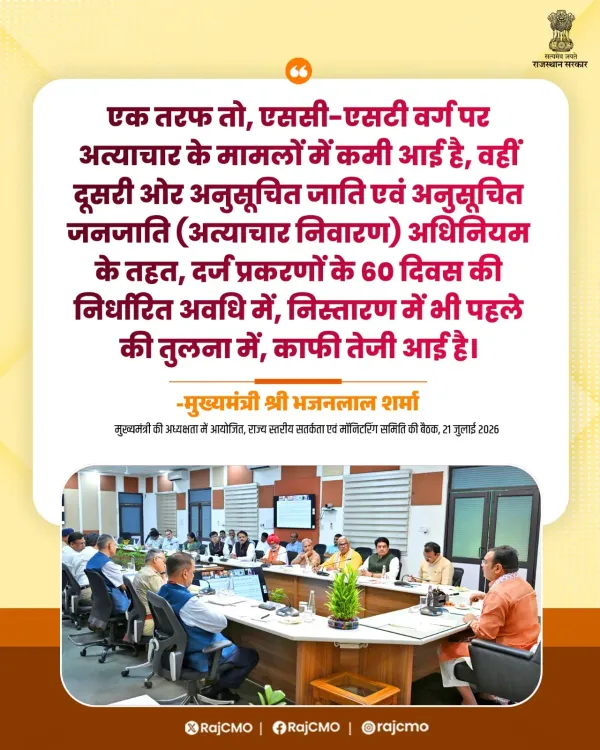
Disposal of cases within the statutory 60-day period under the SC/ST (Prevention of Atrocities) Act has accelerated compared to previous periods.
The post was tagged to Chief Minister Bhajanlal Sharma under the hashtag #आपणो_अग्रणी_राजस्थान ('Our Leading Rajasthan').
The Prevention of Atrocities Act, 1989 , amended in 2015 , mandates a 60-day timeline for investigation and trial at certain stages.
Independent verification of the state's claims is expected through forthcoming NCRB annual crime statistics .
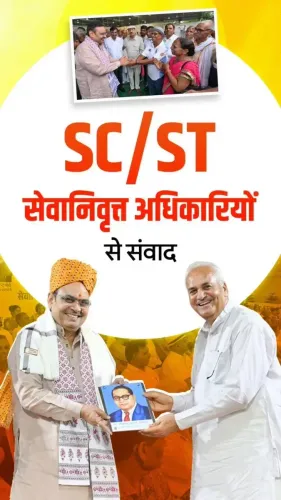
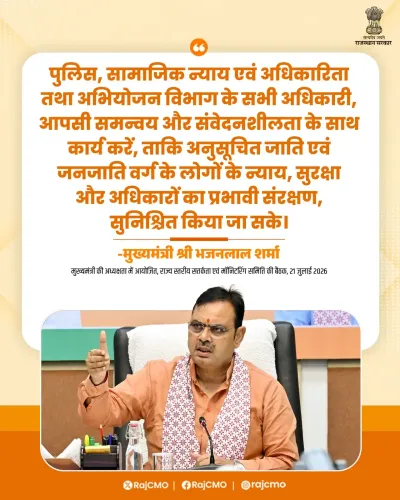
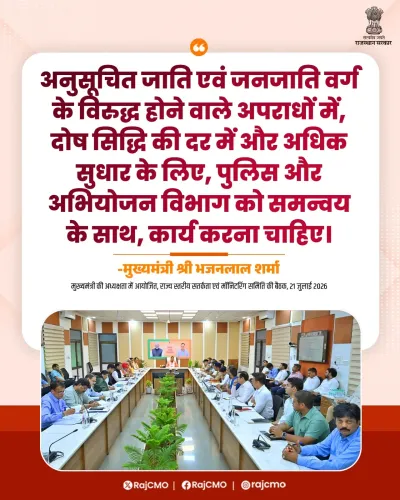
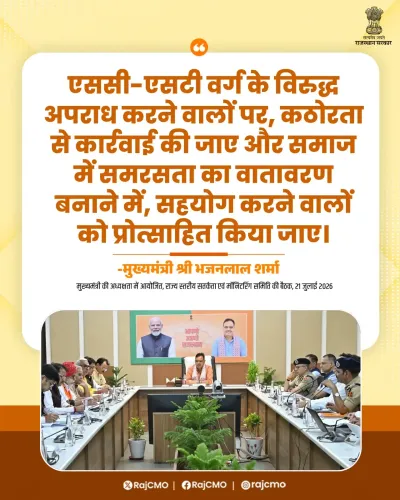
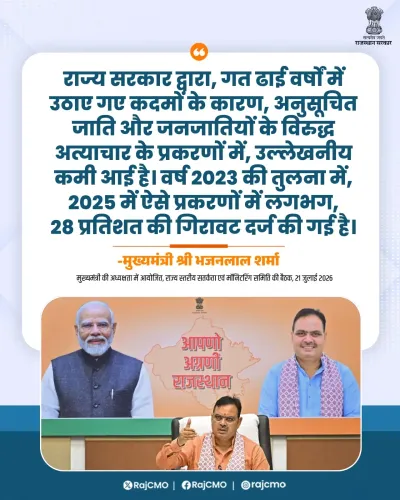
The Chief Minister's Office of Rajasthan on Wednesday, 22 July 2026, highlighted a dual achievement under the state government led by Chief Minister Bhajanlal Sharma — a decline in atrocity cases against Scheduled Caste and Scheduled Tribe communities alongside faster resolution of registered cases within the mandated 60-day window under the Scheduled Castes and Scheduled Tribes (Prevention of Atrocities) Act.
Context
The post, tagged to @BhajanlalBjp and carrying the hashtag #आपणो_अग्रणी_राजस्थान ('Our Leading Rajasthan'), stated: 'On one hand, cases of atrocities against SC-ST communities have declined; on the other, the disposal of registered cases within the stipulated 60-day period under the Scheduled Castes and Scheduled Tribes (Prevention of Atrocities) Act has also become considerably faster compared to before.' The announcement positions the state as both reducing incidence and improving institutional response speed.
Policy Backdrop
The Scheduled Castes and Scheduled Tribes (Prevention of Atrocities) Act, 1989 is a central law enacted to deter and punish violence and discrimination against marginalised communities. A landmark 2015 amendment strengthened the Act by introducing mandatory timelines — including the requirement that investigations and certain trial stages be completed within 60 days — to prevent cases from languishing in the system.
Rajasthan has historically featured among states with significant caseloads under the Act, given its large SC and ST populations spread across districts including Barmer, Jalore, Dungarpur, and Banswara. State governments across party lines have periodically reported on disposal rates and incidence trends as part of routine governance accountability under the Act.
Stakeholders and Impact
SC and ST communities in Rajasthan stand as the primary beneficiaries if the trend holds. Faster 60-day disposal means victims receive quicker legal redress, reducing the prolonged uncertainty that has long been a criticism of atrocity-case handling across states. State police and special courts designated under the Act are the implementing agencies whose performance is directly reflected in these figures.
The announcement also carries political weight for the BJP government led by Chief Minister Bhajanlal Sharma, which took office in December 2023. Demonstrating welfare outcomes for constitutionally protected communities is a recurring governance benchmark, particularly ahead of local body elections and amid broader national scrutiny of SC/ST protections.
What's Next
The state's claims are expected to be tested against forthcoming data from the National Crime Records Bureau (NCRB), which publishes annual crime statistics including state-wise breakdowns of POA Act cases. Independent verification through NCRB reports or Rajasthan Police's annual crime statistics will determine whether the downward incidence trend and improved disposal rates are reflected in official public records.
If sustained, the dual improvement — fewer cases registered and faster closure of those that are — could serve as a model for other states grappling with implementation gaps in the Prevention of Atrocities Act, and may inform future amendments or administrative guidelines at the central level.
Point of View
Combining a law-and-order metric (fewer atrocity cases) with a judicial-efficiency metric (faster 60-day disposal) to project administrative competence on a politically sensitive issue. For the Bhajanlal Sharma government, welfare outcomes for SC/ST communities carry both constitutional weight and electoral salience in a state where these communities form a substantial vote bloc. The framing aligns with a broader BJP pattern of using institutional performance data — rather than new scheme launches — to demonstrate delivery on existing central legislation. The real test will come when NCRB publishes its next annual report, which will either corroborate or complicate the state's narrative.
NationPress
20 Oct 2026
Frequently Asked Questions
What did the Rajasthan CMO announce about SC/ST atrocity cases?
The Chief Minister's Office of Rajasthan announced on 22 July 2026 that cases of atrocities against SC and ST communities have declined in the state, and that disposal of registered cases within the 60-day statutory period under the Prevention of Atrocities Act has become considerably faster than before.
What is the 60-day rule under the SC/ST Prevention of Atrocities Act?
The 2015 amendment to the Scheduled Castes and Scheduled Tribes (Prevention of Atrocities) Act introduced mandatory timelines requiring that investigations and certain trial stages be completed within 60 days to prevent cases from being delayed indefinitely.
Who is the Chief Minister of Rajasthan in 2026?
Bhajanlal Sharma of the BJP has been the Chief Minister of Rajasthan since December 2023.
How can I verify Rajasthan's SC/ST case disposal claims?
The National Crime Records Bureau publishes annual state-wise crime statistics including data on POA Act cases. The next NCRB report will be the primary public source to independently verify the state's claims on incidence and disposal rates.
What is the SC/ST Prevention of Atrocities Act?
The Scheduled Castes and Scheduled Tribes (Prevention of Atrocities) Act, 1989, is a central law designed to prevent violence and discrimination against SC and ST communities, with a significant amendment in 2015 that added investigation and trial timelines and strengthened punishments.