CM Bhajanlal Directs Police, Social Justice Depts to Protect SC/ST Rights
Synopsis
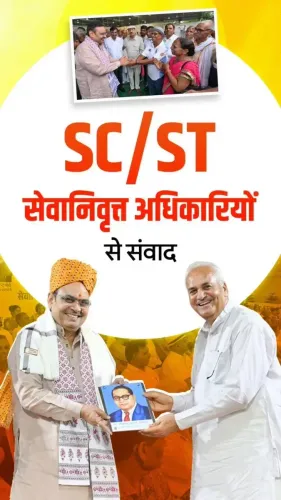
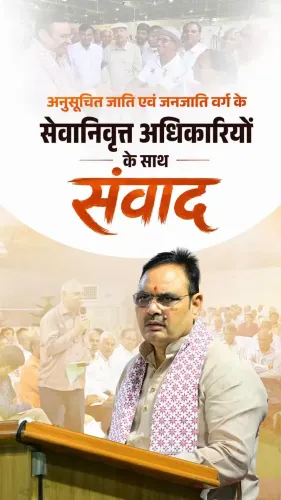
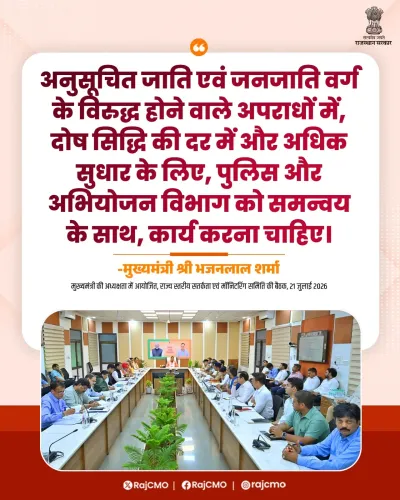
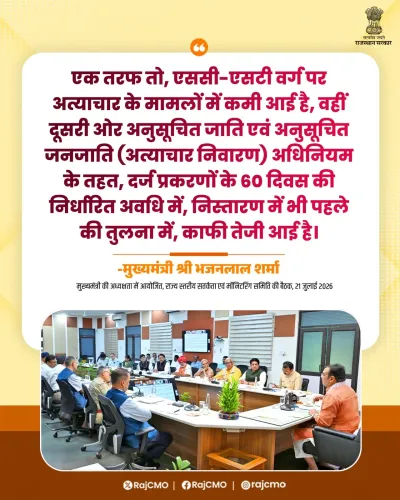
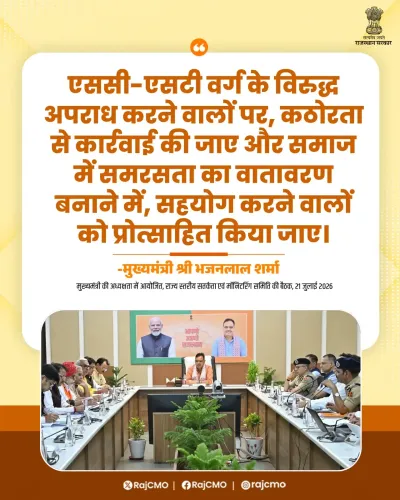
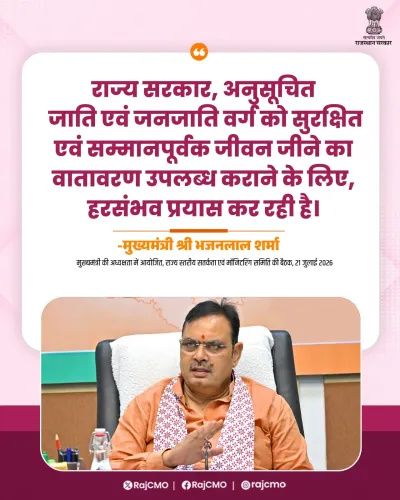
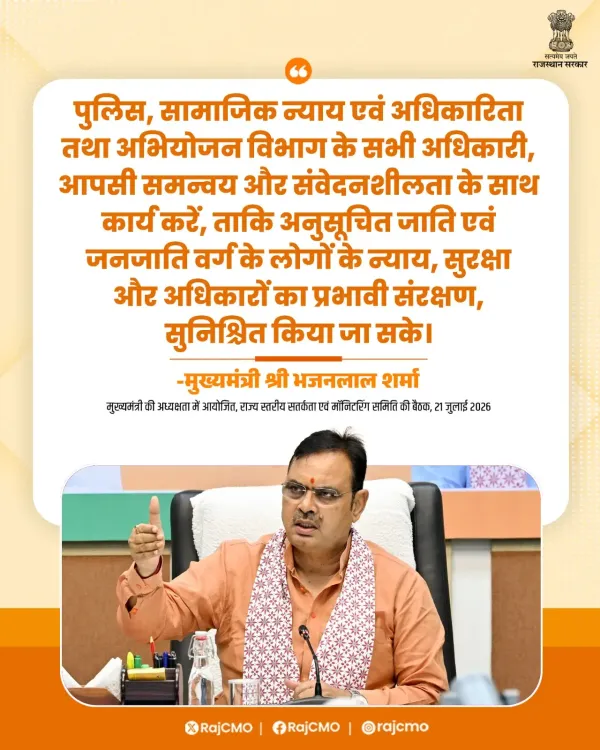
The Rajasthan Chief Minister's Office has directed police, social justice, and prosecution officials to work with coordination and sensitivity to effectively protect the rights and security of Scheduled Caste and Scheduled Tribe communities across the state.
Key Takeaways
The Chief Minister's Office of Rajasthan issued a directive on 22 July 2026 calling for inter-departmental coordination to protect SC/ST rights.
The directive covers three departments: police, social justice and empowerment, and prosecution .
It invokes the mandate of the Scheduled Castes and Scheduled Tribes (Prevention of Atrocities) Act, 1989 , amended in 2015 and 2018 .
Chief Minister Bhajanlal Sharma is directly tagged, underlining the directive's political priority under his government.
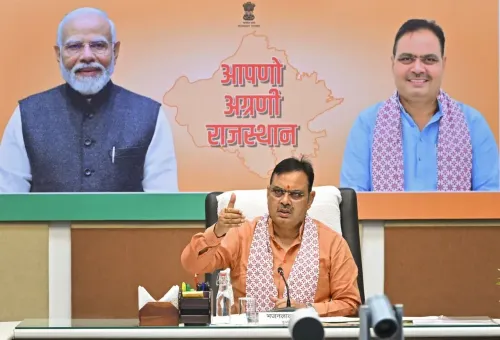
The post is part of the state's #आपणो_अग्रणी_राजस्थान ('Our Leading Rajasthan') campaign.
Follow-up action is expected in the form of departmental circulars and training modules for front-line officials.
The Chief Minister's Office of Rajasthan on Wednesday, 22 July 2026 issued a directive calling on officials across the police, social justice and empowerment, and prosecution departments to work in coordinated and sensitive manner to ensure effective protection of the rights, security, and access to justice of Scheduled Caste and Scheduled Tribe communities in the state.
Context
The post, attributed to the office of Chief Minister Bhajanlal Sharma, states in Hindi: 'पुलिस, सामाजिक न्याय एवं अधिकारिता तथा अभियोजन विभाग के सभी अधिकारी, आपसी समन्वय और संवेदनशीलता के साथ कार्य करें' — ('All officers of the police, social justice and empowerment, and prosecution departments must work with mutual coordination and sensitivity') — so that the justice, security, and rights of SC and ST communities can be effectively safeguarded. The directive is tagged with the hashtag #आपणो_अग्रणी_राजस्थान ('Our Leading Rajasthan'), a campaign identifier used by the Rajasthan government.
The message is addressed directly to @BhajanlalBjp, the personal account of the Chief Minister, signalling that the communication carries the weight of his office and is intended for wide public visibility.
Policy Backdrop
The directive draws its administrative authority from the Scheduled Castes and the Scheduled Tribes (Prevention of Atrocities) Act, 1989, a central legislation that mandates special courts and enhanced penalties for crimes against SC/ST populations. The Act was significantly strengthened through amendments in 2015 and 2018, expanding the definition of atrocities and tightening bail conditions for accused persons.
Rajasthan also operates under the Rajasthan Scheduled Castes, Scheduled Tribes and Other Backward Classes (Reservation of Posts and Services) Rules, 2001, which reinforces representation and institutional safeguards for these communities. The Department of Social Justice and Empowerment, Rajasthan is the nodal state body for overseeing welfare schemes and rights enforcement for marginalised groups.
Indian state governments routinely issue inter-departmental coordination directives to bridge implementation gaps in the Prevention of Atrocities Act — particularly around case registration, timely investigation, and conviction rates — and Rajasthan, with a sizeable SC/ST population, has been a focus of such administrative attention.
Stakeholders and Impact
Scheduled Caste and Scheduled Tribe communities across Rajasthan stand as the primary beneficiaries of this directive. Improved coordination between the Rajasthan Police, the prosecution wing, and the social justice department is intended to reduce delays in registering and prosecuting atrocity cases, which have historically been a concern in the state.
For front-line police and prosecution officials, the directive sets an expectation of sensitivity alongside procedural rigour — a dual mandate that reflects the administrative challenge of handling cases involving deep-rooted social dynamics. Civil society groups working on Dalit and Adivasi rights have consistently called for exactly this kind of top-down institutional push.
What's Next
The directive is likely to be followed by departmental circulars, training modules, or review meetings involving senior officials from the Home Department and the Department of Social Justice and Empowerment. Quarterly crime statistics on atrocities published by the state will serve as a key metric to assess whether the coordination push translates into measurable improvements in case registration and disposal. The broader success of this directive will depend on sustained follow-through at the district and sub-divisional levels, where most SC/ST atrocity cases originate.
Point of View
The BJP government in Rajasthan has sought to project a governance-first image, and publicly tagging the CM's personal handle amplifies the political visibility of what is otherwise a routine inter-departmental instruction. The timing and framing suggest the government is aware of persistent criticism around SC/ST atrocity case handling and is using the social media directive as both an administrative nudge and a political message. Whether this translates into improved conviction rates and faster case disposal will be the real test of intent.
NationPress
20 Oct 2026
Frequently Asked Questions
What did the Rajasthan Chief Minister's Office direct regarding SC/ST protection?
The Rajasthan CMO directed all officers of the police, social justice and empowerment, and prosecution departments to work with mutual coordination and sensitivity to ensure effective protection of the rights, security, and access to justice of Scheduled Caste and Scheduled Tribe communities.
Which law protects SC/ST communities from atrocities in India?
The Scheduled Castes and the Scheduled Tribes (Prevention of Atrocities) Act, 1989, is the primary central legislation. It was amended in 2015 and 2018 to expand the definition of atrocities and strengthen legal protections for SC/ST communities.
Who is the Chief Minister of Rajasthan in 2026?
Bhajanlal Sharma of the Bharatiya Janata Party (BJP) is the Chief Minister of Rajasthan, having assumed office in December 2023.
What is the role of the Department of Social Justice and Empowerment in Rajasthan?
The Department of Social Justice and Empowerment, Rajasthan, is the nodal state body responsible for overseeing welfare schemes, rights enforcement, and institutional safeguards for Scheduled Castes, Scheduled Tribes, and other marginalised communities.
What does #आपणो_अग्रणी_राजस्थान mean?
The hashtag translates from Rajasthani/Hindi as 'Our Leading Rajasthan' and is a campaign identifier used by the Rajasthan state government to brand its governance and development initiatives.