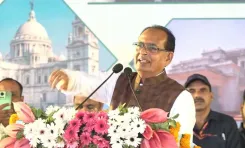
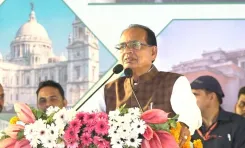
CM Mohan Yadav Announces Ujjain-Indore Metropolitan Region

Synopsis
Madhya Pradesh's Chief Minister's Office announced the Ujjain-Indore Metropolitan Region on 20 June 2026, promising better infrastructure, an investment-friendly climate, youth employment, and a startup ecosystem to accelerate the state's development.
Key Takeaways
The Chief Minister's Office of Madhya Pradesh announced the Ujjain-Indore Metropolitan Region on 20 June 2026 .
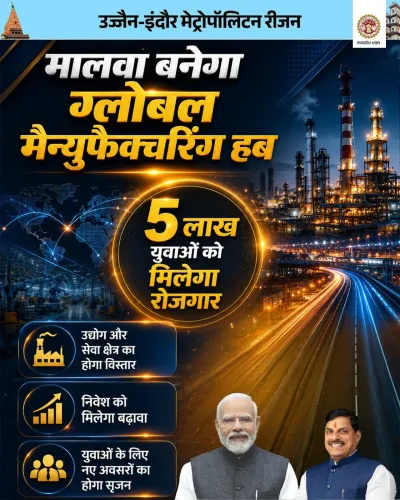
The initiative targets four pillars: better infrastructure, investment-friendly environment, youth employment, and a startup ecosystem.
Indore and Ujjain , located roughly 55 km apart, are being merged into a single metropolitan planning zone.
Indore has been part of the Smart Cities Mission since 2015 , providing a policy foundation for the new region.
The Madhya Pradesh Urban Development Department is the nodal agency overseeing the initiative.
Formal notification of a metropolitan authority and a regional development plan are the critical next steps.
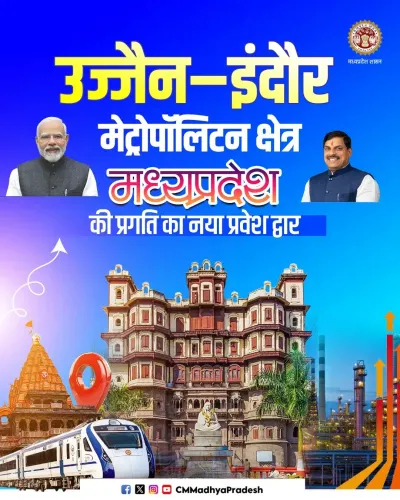
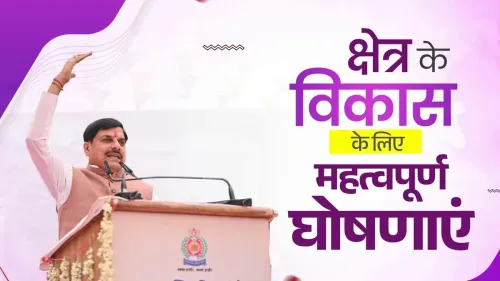
The Chief Minister's Office of Madhya Pradesh announced on Saturday, 20 June 2026, the formation of the Ujjain-Indore Metropolitan Region, positioning it as a catalyst for infrastructure upgrades, investment, youth employment, and a stronger startup ecosystem across the state.
Context
The post, shared by the official handle of the Chief Minister's Office and directed at Chief Minister Dr. Mohan Yadav and the Madhya Pradesh Urban Development Department, declares that the new metropolitan region will give 'Madhya Pradesh ke vikas ko nayi raftaar' ('a new speed to Madhya Pradesh's development'). The announcement frames the initiative around four pillars: better infrastructure, an investment-friendly environment, new employment opportunities for youth, and a robust startup ecosystem.
Indore, the state's largest city and commercial nerve centre, and Ujjain, an ancient religious and educational hub located roughly 55 kilometres away, are being clubbed into a single metropolitan planning zone. The pairing brings together two cities with complementary economic and cultural identities.
Policy Backdrop
The concept of metropolitan-region frameworks has deep roots in Indian urban governance. Models such as the Mumbai Metropolitan Region and the Hyderabad Metropolitan Development Authority have demonstrated how unified planning across adjacent cities can attract large-scale investment and rationalise land use. Madhya Pradesh is now extending this approach to its own second-tier urban cluster.
Indore was selected under the national Smart Cities Mission in 2015, which seeded integrated urban planning and technology-driven infrastructure upgrades. A proposal for the Indore Metro Rail project was also advanced around 2018 to strengthen intra-city connectivity. The new metropolitan region builds on that policy lineage, aligning with national programmes such as AMRUT 2.0, which encourages states to improve urban services and ease of living.
Dr. Mohan Yadav, who assumed office as Chief Minister in December 2023, has consistently emphasised urban infrastructure and investment attraction as cornerstones of his administration's economic agenda. The Ujjain-Indore Metropolitan Region reflects that broader orientation.
Stakeholders and Impact
Urban youth stand to benefit most directly if the metropolitan framework succeeds in generating employment through planned industrial and commercial expansion. The announcement's explicit reference to startups signals an intent to create incubation-friendly policy conditions — potentially including land allocation, regulatory ease, and connectivity investments — within the new regional boundary.
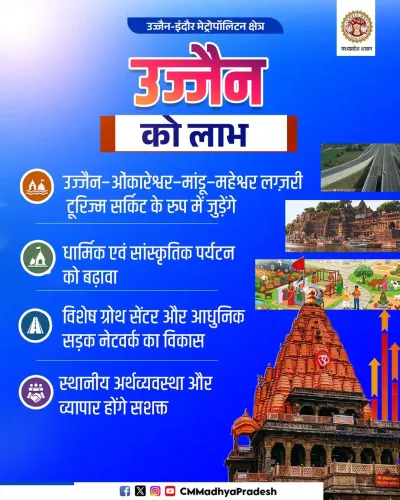
Local businesses in both cities could gain from a unified investment clearance mechanism and shared infrastructure such as roads, logistics corridors, and utilities. Ujjain, which hosts the Simhastha Kumbh Mela every 12 years, also carries significant tourism and pilgrimage traffic that a metropolitan framework could help channel into sustained economic activity beyond the event cycle.
Investors looking at Madhya Pradesh will watch whether the metropolitan authority is formally notified and backed by a regional development plan, as these steps determine whether the announcement translates into bankable projects.
What's Next
The immediate next steps, as indicated by the policy research context, include the formal notification of a metropolitan development authority, the release of a regional development plan, and potential budget allocations in the state assembly. None of these timelines have been specified in the current announcement.
The Madhya Pradesh Urban Development Department, tagged in the original post, is the nodal agency expected to drive these processes. How quickly the state moves from announcement to gazette notification will be the key indicator of political and administrative commitment to the project. A well-executed metropolitan framework could also improve the state's ease-of-doing-business rankings, a metric that directly influences future investment inflows.
Point of View
The Madhya Pradesh government is attempting to create an economic zone with year-round relevance rather than one tied to periodic events like the Kumbh Mela. For Chief Minister Dr. Mohan Yadav, the move also reinforces a pattern of high-visibility urban policy announcements that align with national programmes and investor-facing metrics. The real test, however, lies in the speed and rigour of formal notification — without a gazette order and a funded regional plan, metropolitan-region declarations risk remaining aspirational rather than transformative.
NationPress
20 Jun 2026
Frequently Asked Questions
What is the Ujjain-Indore Metropolitan Region?
The Ujjain-Indore Metropolitan Region is a proposed unified urban planning zone combining the cities of Indore and Ujjain in Madhya Pradesh, announced by the Chief Minister's Office on 20 June 2026 to drive infrastructure, investment, and employment.
Why are Indore and Ujjain being merged into one metropolitan region?
The two cities are roughly 55 kilometres apart and have complementary economic profiles — Indore is the state's commercial hub while Ujjain is a religious and educational centre. A joint metropolitan framework is intended to create a larger economic cluster and attract unified investment.
What benefits will the Ujjain-Indore Metropolitan Region bring?
The announcement promises better infrastructure, an investment-friendly environment, new employment opportunities for youth, and a stronger ecosystem for startups operating in Madhya Pradesh.
Who is responsible for implementing the Ujjain-Indore Metropolitan Region?
The Madhya Pradesh Urban Development Department, tagged in the official announcement, is the nodal state agency overseeing urban planning and metropolitan-region formation.
What are the next steps after the Ujjain-Indore Metropolitan Region announcement?
Key next steps include formal gazette notification of a metropolitan development authority, the release of a regional development plan, and potential budget allocations in the Madhya Pradesh state assembly.