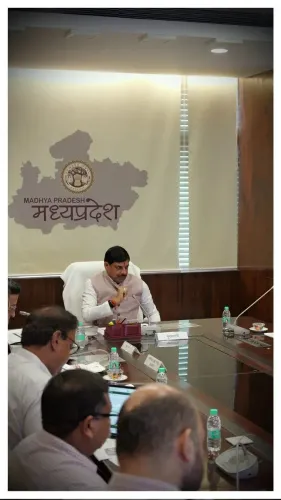
CM Mohan Yadav declares 2026 'Kisan Kalyan Varsh' for MP farmers

Synopsis
Chief Minister Dr. Mohan Yadav has declared 2026 as 'Kisan Kalyan Varsh' in Madhya Pradesh, dedicated to Lord Balaram, crediting 65 lakh hectares of irrigation expansion over two-and-a-half years and spotlighting prosperity gains for farmers in the Nimar region through modern agricultural technologies.
Key Takeaways
2026 has been officially declared Kisan Kalyan Varsh (Farmer Welfare Year) by the Madhya Pradesh government.
The year-long observance is dedicated to Lord Balaram , the deity associated with agriculture and farming communities.
The state claims an irrigation capacity expansion of 65 lakh hectares over the past two-and-a-half years .
Farmers of the Nimar region — covering districts including Khargone , Barwani , and Khandwa — are cited as direct beneficiaries of modern farming initiatives.
The initiative involves coordination with the Union Ministry of Agriculture and Farmers Welfare and the MP Agriculture Department .
Detailed event calendars and budget allocations for the Kisan Kalyan Varsh are awaited.
The Chief Minister's Office of Madhya Pradesh announced on Monday, 27 July 2026 that the year 2026 has been declared 'Kisan Kalyan Varsh' (Farmer Welfare Year), dedicated to Lord Balaram, with Chief Minister Dr. Mohan Yadav highlighting that the state has expanded irrigation capacity by 65 lakh hectares over the past two-and-a-half years.
Context
Posting on X, CM Dr. Mohan Yadav stated: 'वर्ष 2026 को भगवान बलराम को समर्पित करते हुए किसान कल्याण वर्ष के रूप में मनाने का निर्णय लिया गया है' — 'The decision has been taken to observe the year 2026 as Kisan Kalyan Varsh, dedicated to Lord Balaram.' The post specifically credited continuous efforts, the spread of modern agricultural technologies, and innovative farming initiatives for making farmers of the Nimar region more prosperous, self-reliant, and economically empowered.
Dedicating the observance to Lord Balaram — widely revered as the deity of agriculture and farming communities — carries deliberate cultural symbolism, anchoring a policy push within a religious and social framework that resonates strongly with rural Madhya Pradesh.
Policy Backdrop
The irrigation expansion claim of 65 lakh hectares over the past two-and-a-half years forms a central pillar of the announcement. Madhya Pradesh has historically pursued large-scale irrigation augmentation through canal networks, check dams, and micro-irrigation systems, efforts that align with the Pradhan Mantri Krishi Sinchayee Yojana, launched in 2015, which channelled central funds to states for exactly this purpose.
The state government has consistently positioned modern agricultural technology — including precision irrigation, soil health management, and high-yield variety seeds — as levers for raising cropping intensity and rural incomes. The declaration of a full Kisan Kalyan Varsh signals an intent to consolidate and publicise these gains through a year-long institutional focus.
Stakeholders and Impact
The Nimar region — covering western Madhya Pradesh districts such as Khargone, Barwani, and Khandwa — is a significant agricultural belt known for soybean, cotton, and maize cultivation. Farmers here have historically been vulnerable to rain-fed agriculture and water stress, making irrigation expansion particularly consequential for their livelihoods.
The post tagged the Union Ministry of Agriculture and Farmers Welfare (@AgriGoI) and the Madhya Pradesh Agriculture Department (@minmpkrishi), indicating that the Kisan Kalyan Varsh is expected to involve coordination between state and central agencies. Agricultural communities across Madhya Pradesh stand as the primary stakeholders of the year-long initiative.
What's Next
The formal declaration raises expectations for a detailed calendar of events, dedicated budget allocations, and measurable targets under the Kisan Kalyan Varsh framework. Observers will watch for official data releases tracking irrigation utilisation rates and income changes in Nimar and other agricultural districts.
How the state government translates the year-long observance into tangible farmer-welfare outcomes — and whether central schemes are specifically expanded or modified in coordination — will determine the initiative's lasting impact beyond its symbolic framing.
Point of View
But its invocation here carries specific electoral and administrative weight as Madhya Pradesh seeks to consolidate its reputation as a model agricultural state. Anchoring the observance to Lord Balaram is a calculated cultural move that blends religious identity with agrarian policy — a combination that has historically resonated with rural voter bases in central India. Tagging the Union agriculture ministry signals an intent to leverage central scheme funding and co-branding, a standard but strategically important play for state governments. The spotlight on the Nimar region, a historically rain-fed and water-stressed belt, also suggests the government is keen to demonstrate that irrigation investments are translating into on-ground prosperity ahead of any future electoral cycle.
NationPress
27 Jul 2026
Frequently Asked Questions
What is Kisan Kalyan Varsh in Madhya Pradesh?
Kisan Kalyan Varsh is a year-long farmer welfare observance declared by the Madhya Pradesh government for 2026, dedicated to Lord Balaram, aimed at highlighting and accelerating agricultural development across the state.
Why is 2026 dedicated to Lord Balaram in Madhya Pradesh?
Lord Balaram is traditionally revered as the deity of agriculture and farming communities. The Madhya Pradesh government has chosen to dedicate the 2026 Kisan Kalyan Varsh to him to integrate cultural symbolism with its ongoing farmer welfare policy focus.
How much has Madhya Pradesh expanded its irrigation capacity?
According to Chief Minister Dr. Mohan Yadav, Madhya Pradesh expanded its irrigation capacity by 65 lakh hectares over the past two-and-a-half years through sustained efforts and modern agricultural technologies.
Which region does the Kisan Kalyan Varsh focus on?
The announcement specifically highlighted the Nimar region in western Madhya Pradesh — covering districts such as Khargone, Barwani, and Khandwa — as an area where farmers are becoming more prosperous and self-reliant due to irrigation and technology initiatives.
What schemes support Madhya Pradesh's irrigation expansion?
The state's irrigation push aligns with the Pradhan Mantri Krishi Sinchayee Yojana, a central scheme launched in 2015 to expand irrigation coverage, alongside state-level micro-irrigation and canal network programmes.