CM Mohan Yadav Drives 16-Dept Convergence for MP Farmers
Synopsis
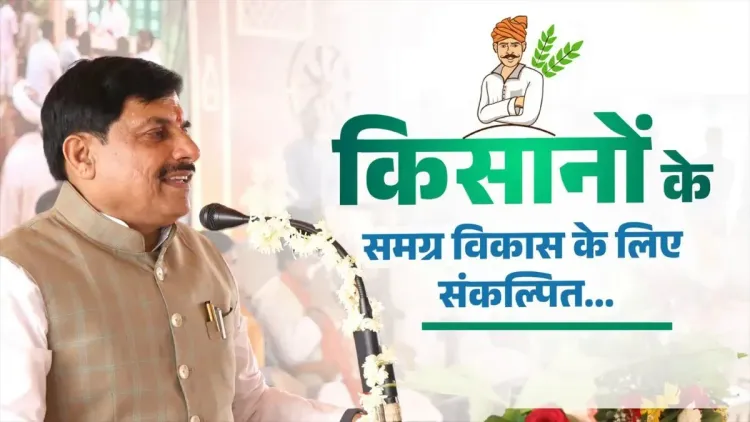
Madhya Pradesh CM Dr. Mohan Yadav announced on 15 July 2026 that his government is converging 16 departments under the Kisan Kalyan Varsh initiative to drive holistic farmer development and income growth across the state.
Key Takeaways
Madhya Pradesh CM Dr.
Mohan Yadav announced the convergence of 16 departments under the Kisan Kalyan Varsh initiative on 15 July 2026 .
The initiative aims at the holistic development and income growth of farmers in Madhya Pradesh .
The state has prior experience with farmer-support mechanisms, including the Bhavantar Bhugtan Yojana launched in 2017 .
The convergence model aligns with the national goal of doubling farmers' income, first announced in 2016 .
Madhya Pradesh is one of India's largest agrarian states and a major beneficiary of the central PM-KISAN scheme.
Progress reports and budget allocations for the 16 departments under Kisan Kalyan Varsh are awaited.
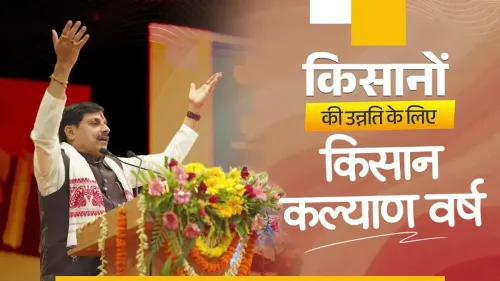
Madhya Pradesh Chief Minister Dr. Mohan Yadav on Wednesday, 15 July 2026 announced that his government is uniting 16 departments under the Kisan Kalyan Varsh (Farmer Welfare Year) initiative to pursue the holistic development and income growth of farmers across the state.
Posting on X, Dr. Yadav stated — 'किसान कल्याण वर्ष के अंतर्गत हमारी सरकार 16 विभागों को एक साथ जोड़कर किसानों के समग्र विकास और आय में वृद्धि की दिशा में निरंतर कार्य कर रही है' — meaning: 'Under the Kisan Kalyan Varsh, our government is continuously working to bring 16 departments together to drive the holistic development and income growth of farmers.'
Context
Kisan Kalyan Varsh is a state-level initiative declared by the Madhya Pradesh government to place farmer welfare at the centre of its annual policy calendar. The announcement underscores the state administration's effort to move beyond single-department interventions and instead coordinate agriculture-linked services under one convergent framework. Dr. Yadav, who has served as Chief Minister since December 2023, has made agricultural outreach a signature theme of his tenure.
Policy Backdrop
Madhya Pradesh has a long record of experimenting with farmer-support mechanisms. The state introduced the Bhavantar Bhugtan Yojana in 2017, a price-deficiency payment scheme designed to compensate farmers when market prices fall below the minimum support price. That programme signalled the state's willingness to use fiscal instruments to cushion agricultural income volatility.
The broader national goal of doubling farmers' income, announced in 2016, pushed states including Madhya Pradesh to explore convergence models that stitch together irrigation, credit, marketing, extension services and allied departments rather than operating in silos. The current 16-department model appears to build on that legacy. Madhya Pradesh is also a major beneficiary state under the central PM-KISAN scheme, making inter-departmental coordination especially consequential for its large farming population.
Stakeholders and Impact
The farming community of Madhya Pradesh — one of India's largest agrarian states and a leading contributor to national grain output — stands to be the primary beneficiary if the convergence model delivers improved service delivery. Fragmented governance across agriculture-related departments has historically been a barrier to timely credit disbursal, irrigation access and market linkages for smallholder farmers.
By bringing 16 departments under a single coordination umbrella, the state government aims to reduce duplication, accelerate implementation of welfare schemes and create measurable income outcomes for farm households. Agriculture department officials, district collectors and panchayat-level functionaries are among the institutional actors whose coordination will determine the initiative's on-ground effectiveness.
What's Next
Observers will watch for the release of formal progress reports tied to the Kisan Kalyan Varsh and any new state budget allocations or convergence guidelines specifying the roles of the 16 departments. The initiative's credibility will ultimately rest on verifiable income data for farm households and transparent reporting on scheme saturation across Madhya Pradesh's districts. Any follow-up announcements from the Chief Minister's office on implementation timelines or district-level targets will be closely tracked by farmer organisations and policy analysts alike.
Point of View
Whole-of-government action rather than isolated schemes. For a state like Madhya Pradesh — where agrarian distress has historically shaped electoral outcomes — framing the Kisan Kalyan Varsh around structural coordination rather than just cash transfers signals an attempt to address systemic service-delivery gaps. The move also positions the state government as an active implementer of the national income-doubling agenda, lending it political credibility ahead of any future electoral cycle. Whether the convergence translates into measurable income gains will depend on the quality of district-level execution and the robustness of monitoring mechanisms.
NationPress
15 Jul 2026
Frequently Asked Questions
What is Kisan Kalyan Varsh in Madhya Pradesh?
Kisan Kalyan Varsh is a state-level initiative declared by the Madhya Pradesh government to prioritise farmer welfare measures throughout the year, with the current focus on converging 16 departments for holistic agricultural development.
What does the 16-department convergence mean for MP farmers?
The convergence of 16 departments under Kisan Kalyan Varsh means that services such as irrigation, credit, marketing and extension will be coordinated under a single framework, aiming to reduce fragmentation and improve income outcomes for farmers.
What is Bhavantar Bhugtan Yojana in Madhya Pradesh?
Bhavantar Bhugtan Yojana is a price-deficiency payment scheme introduced by Madhya Pradesh in 2017 that compensates farmers when market prices fall below the minimum support price, representing an earlier effort to protect agricultural income.
What is Dr. Mohan Yadav's focus on agriculture in Madhya Pradesh?
Since becoming Chief Minister in December 2023, Dr. Mohan Yadav has made agricultural outreach a priority, aligning state schemes with central programmes like PM-KISAN and now launching the Kisan Kalyan Varsh convergence model.
How does Madhya Pradesh contribute to India's farm sector?
Madhya Pradesh is one of India's largest agrarian states with a significant farming population and a major contribution to national grain production, making effective farmer welfare policies particularly impactful at the national level.