CM Mohan Yadav: Ken-Betwa Link to Transform Bundelkhand
Synopsis
Chief Minister Dr. Mohan Yadav says the Ken-Betwa Link Project will transform Bundelkhand by channelling Ken river water to the Betwa basin, benefiting hundreds of villages in Niwari district and extending irrigation to every farm in the drought-prone region.
Key Takeaways
Mohan Yadav stated on 26 July 2026 that the Ken-Betwa Link Project will give new direction to Bundelkhand's development.
Hundreds of villages in Niwari district , Madhya Pradesh, are targeted for irrigation benefits under the project.
The project is India's first river-interlinking scheme under the National Perspective Plan , approved finally by the Union Cabinet in 2021 .
A tripartite agreement between the Union Government , Madhya Pradesh , and Uttar Pradesh governs execution and cost-sharing.
The core infrastructure includes a 221-km link canal and associated dams to transfer surplus Ken river water to the Betwa basin.
Successful implementation could serve as a model for future inter-basin water transfer projects across peninsular India.
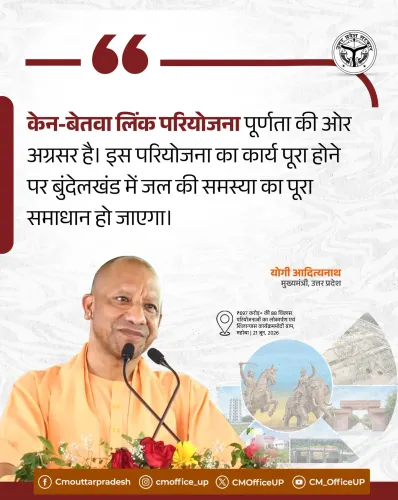
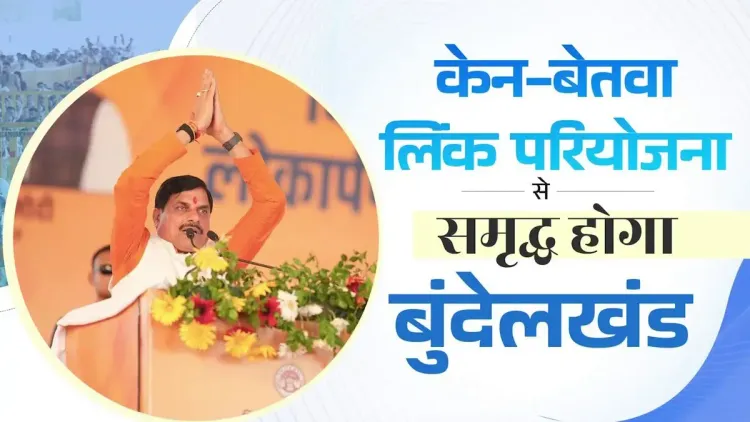
The Chief Minister's Office of Madhya Pradesh, on Sunday, 26 July 2026, quoted Chief Minister Dr. Mohan Yadav stating that the Ken-Betwa Link Project will give new direction to the development of Bundelkhand, with hundreds of villages in Niwari district set to benefit and irrigation facilities expanding to every farm in the region.
Context
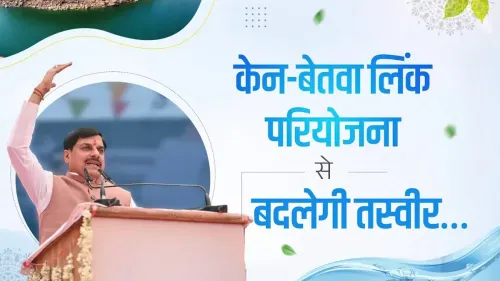
Posting in Hindi, CM Dr. Mohan Yadav said: 'केन-बेतवा लिंक परियोजना बुंदेलखंड के विकास को नई दिशा देगी' ('The Ken-Betwa Link Project will give new direction to Bundelkhand's development'). He added that through this project, hundreds of villages in Niwari district will be benefited and irrigation facilities will be extended to every farm. The statement underscores the state government's emphasis on the project as a transformative infrastructure intervention for one of central India's most drought-affected regions.
Policy Backdrop
The Ken-Betwa Link Project is the first river-interlinking project under India's National Perspective Plan and the flagship component of the broader National River Linking Programme. It is designed to transfer surplus water from the Ken river to the Betwa river basin, addressing chronic irrigation deficits in Bundelkhand. The Union Cabinet granted in-principle approval in 2018 and final approval in 2021, followed by a tripartite agreement between the Union Government, Madhya Pradesh, and Uttar Pradesh for project execution and cost-sharing.
Bundelkhand spans parts of both Madhya Pradesh and Uttar Pradesh and has historically suffered from low irrigation intensity and recurring agrarian distress linked to erratic monsoons. The Madhya Pradesh Water Resources Department is the state-level agency coordinating implementation with central authorities. A 221-km link canal along with associated dams forms the core infrastructure of the project.
Stakeholders and Impact
The primary beneficiaries are Bundelkhand farmers and residents of villages in Niwari district, a relatively newly carved administrative unit within Madhya Pradesh's Bundelkhand region. Expanded canal networks are expected to bring previously rain-dependent farmland under assured irrigation, directly affecting agricultural productivity and rural livelihoods. The project also aligns with the national goal of moving water from surplus to deficit river basins across central India, with comparable inter-basin transfer proposals being advanced for other peninsular river systems under the same framework.
What's Next
Key milestones to watch include progress on land acquisition, forest clearances, and tendering for the 221-km link canal and associated dam infrastructure. Central and state budget allocations in the coming fiscal cycles will determine the pace of construction and the timeline for water reaching farms in Niwari district and surrounding areas. The project's successful execution could serve as a template for subsequent river-linking initiatives under the national programme.
Point of View
Likely to consolidate support among Bundelkhand's agrarian communities ahead of future electoral cycles. The specific mention of Niwari district is notable — it is a small, newly created district, and singling it out suggests a deliberate effort to communicate localised benefits to a constituency that has historically felt underserved. The project's status as the first operational element of the larger National River Linking Programme means its progress is watched closely as a proof-of-concept for India's most ambitious water-management vision. Any acceleration in land acquisition or forest clearances in the coming months will be the real test of whether this political messaging translates into implementation momentum.
NationPress
26 Jul 2026
Frequently Asked Questions
What is the Ken-Betwa Link Project?
The Ken-Betwa Link Project is India's first river-interlinking project under the National Perspective Plan, designed to transfer surplus water from the Ken river to the Betwa river basin to address irrigation deficits in the Bundelkhand region of Madhya Pradesh and Uttar Pradesh.
Which districts in Madhya Pradesh will benefit from the Ken-Betwa Link Project?
Niwari district is specifically highlighted by CM Dr. Mohan Yadav as a key beneficiary, with hundreds of villages in the district expected to receive expanded irrigation coverage under the project.
When was the Ken-Betwa Link Project approved?
The Union Cabinet granted in-principle approval in 2018 and final approval in 2021. A tripartite agreement between the Union Government, Madhya Pradesh, and Uttar Pradesh was also signed in 2021 for execution and cost-sharing.
What infrastructure does the Ken-Betwa Link Project involve?
The project's core infrastructure includes a 221-km link canal along with associated dams to channel water from the Ken river to the Betwa basin, enabling large-scale canal irrigation across Bundelkhand.
Why is Bundelkhand in need of irrigation projects like Ken-Betwa?
Bundelkhand is a historically drought-prone region spanning Madhya Pradesh and Uttar Pradesh that has faced chronic low irrigation intensity and recurring agrarian distress due to erratic monsoons and limited water infrastructure.