CM Mohan Yadav: Ken-Betwa Project to Transform Bundelkhand
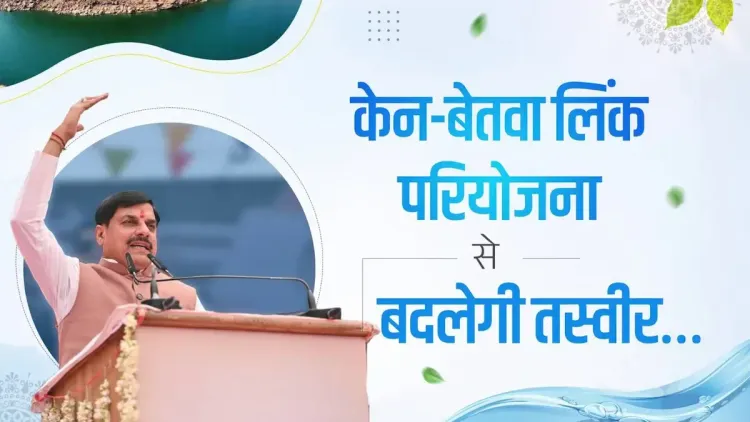
Synopsis
Chief Minister Dr. Mohan Yadav says the Ken-Betwa Link Project, being built at approximately ₹1 lakh crore, will historically transform irrigation in drought-hit Bundelkhand and position the region on par with Punjab and Haryana in agricultural output.
Key Takeaways
The Ken-Betwa Link Project is being executed at an estimated cost of approximately ₹1 lakh crore , according to CM Dr.
The project aims to provide permanent relief from water scarcity to farmers in the semi-arid Bundelkhand region spanning Madhya Pradesh and Uttar Pradesh .
The Union Cabinet had approved the project in December 2021 at an original estimated cost of ₹44,605 crore .
A tripartite MoU between the Centre , Madhya Pradesh , and Uttar Pradesh was signed in 2014 to advance the project.
CM Yadav expressed a resolve to make Bundelkhand more empowered than Punjab and Haryana in agricultural production and prosperity.
The project is part of India's broader National River Linking Project aimed at mitigating regional water deficits.
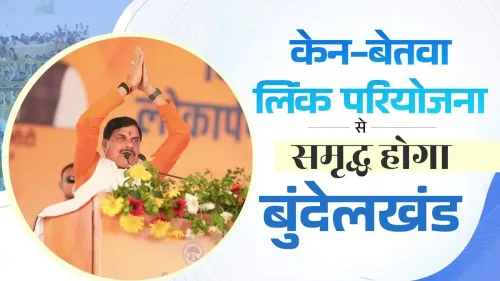
The Chief Minister's Office of Madhya Pradesh on Friday, 24 July 2026, shared remarks by Chief Minister Dr. Mohan Yadav asserting that the Ken-Betwa Link Project, being executed at an estimated cost of approximately ₹1 lakh crore, will bring historic change to irrigation in the Bundelkhand region and permanently relieve farmers of water scarcity.
Context
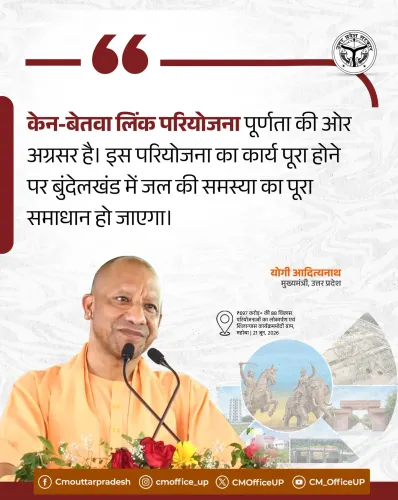
Posting in Hindi, CM Dr. Mohan Yadav stated: 'बुंदेलखंड के किसानों के बेहतर भविष्य के लिए लगभग ₹1 लाख करोड़ की लागत से केन-बेतवा लिंक परियोजना को साकार किया जा रहा है' ('The Ken-Betwa Link Project is being realised at a cost of approximately ₹1 lakh crore for the better future of Bundelkhand's farmers'). He added that the project will write 'a new chapter of agricultural prosperity' for the region. The Chief Minister expressed a resolve to make Bundelkhand more empowered than leading states like Punjab and Haryana in terms of agricultural production, prosperity, and development.
Policy Backdrop
The Ken-Betwa Link Project is part of India's broader National River Linking Project, conceptualised to connect river systems for balanced water distribution. The Union Cabinet granted it national project status and approved it in December 2021 at an estimated cost of ₹44,605 crore at that time. A tripartite memorandum of understanding between the Centre, Madhya Pradesh, and Uttar Pradesh had been signed as far back as 2014 to advance the project.
The project proposes to transfer surplus water from the Ken river to the Betwa river basin, augmenting irrigation and drinking water supply across the semi-arid Bundelkhand belt. Bundelkhand straddles districts in both Madhya Pradesh and Uttar Pradesh, and has historically suffered from drought and erratic monsoon patterns that severely constrain agricultural output.
Stakeholders and Impact
Farmers across Bundelkhand's drought-prone districts stand to be the primary beneficiaries if the project delivers on its irrigation targets. Expanded canal networks and assured water supply are expected to enable year-round cultivation and shift the region away from rain-fed dependence. The project also carries significance for Uttar Pradesh, whose districts in the Bundelkhand belt are covered under the same water-sharing framework.
State governments and the Centre have consistently cited the project as a model for resolving inter-state water-sharing disputes through cooperative agreements. Successful implementation would also validate the broader river-interlinking strategy as a drought-mitigation tool for central India.
What's Next
Key milestones to watch include timelines for land acquisition, dam construction, and canal-network phases, as well as the status of environmental and wildlife clearances — particularly those relating to the Panna Tiger Reserve, which falls within the project's footprint. Coordination between Madhya Pradesh and Uttar Pradesh on water-sharing protocols will also be critical. Further central funding disbursements and progress reviews will determine whether the project's ambitious agricultural transformation goals translate into ground-level outcomes for Bundelkhand's farming communities.
Point of View
Invoking the Punjab-Haryana agricultural benchmark — a politically resonant aspiration in a state where farming communities form a decisive electoral constituency. The updated cost figure of approximately ₹1 lakh crore, significantly higher than the Cabinet-approved ₹44,605 crore of 2021, signals either substantial project expansion or cost escalation, a detail that will invite scrutiny from opposition and fiscal watchdogs alike. The statement fits a wider pattern of the BJP-led state government using infrastructure announcements to consolidate support in historically neglected regions like Bundelkhand ahead of electoral cycles. Whether ground-level progress on land acquisition and environmental clearances matches the rhetorical ambition will be the real test of this commitment.
NationPress
22 Oct 2026
Frequently Asked Questions
What is the Ken-Betwa Link Project?
The Ken-Betwa Link Project is a river interlinking scheme that proposes to transfer surplus water from the Ken river to the Betwa river basin to improve irrigation and drinking water supply, primarily in the drought-prone Bundelkhand region of Madhya Pradesh and Uttar Pradesh.
What is the cost of the Ken-Betwa Link Project?
CM Dr. Mohan Yadav has cited an approximate cost of ₹1 lakh crore for the project. The Union Cabinet had originally approved the project in December 2021 at an estimated cost of ₹44,605 crore.
Who will benefit from the Ken-Betwa Link Project?
Farmers in the Bundelkhand region — spread across districts of Madhya Pradesh and Uttar Pradesh — are the primary intended beneficiaries, as the project aims to provide assured irrigation water and reduce dependence on erratic monsoon rainfall.
When was the Ken-Betwa Link Project approved?
The Union Cabinet granted the Ken-Betwa Link Project national project status and approved it in December 2021. A tripartite MoU between the Centre, Madhya Pradesh, and Uttar Pradesh had been signed earlier in 2014.
Why is Bundelkhand considered a drought-prone region?
Bundelkhand is a semi-arid belt straddling Madhya Pradesh and Uttar Pradesh that historically receives erratic and below-average rainfall, making agriculture highly vulnerable to drought and limiting farmers to largely rain-fed cultivation.