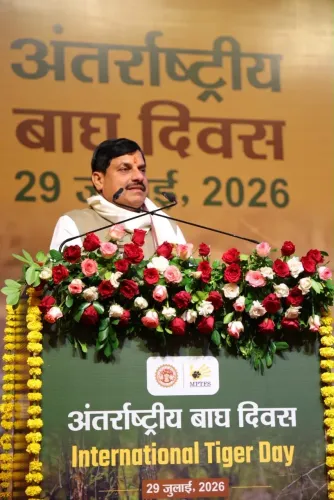
CM Mohan Yadav Launches AI Tiger Alert System PAWS in MP

Synopsis
On International Tiger Day 2026, Madhya Pradesh CM Dr. Mohan Yadav launched PAWS, an AI-based early-warning system for forest security, at a Bhopal event. He projected the state's tiger population will surpass 1,000 in the next census and honoured Padmashri Dr. Narayan Vyas for conservation work.
Key Takeaways
PAWS (Pench Advance Warning System) — an AI-based early-warning tool for forest and wildlife security — was launched in Bhopal on 29 July 2026 .
Mohan Yadav flagged off new vehicles for forest protection staff at the same event.
Narayan Vyas and conservationist Mohan Ji Nagar were honoured for outstanding wildlife conservation work.
Village forest committees, eco-development groups, and frontline forest workers also received awards.
The state government projects Madhya Pradesh's tiger population will cross 1,000 in the next All-India Tiger Estimation.
Pench Tiger Reserve , where PAWS is deployed, was notified in 1975 and is one of MP's flagship protected areas.
On International Tiger Day, 29 July 2026, Madhya Pradesh Chief Minister Dr. Mohan Yadav launched a first-of-its-kind AI-powered forest security tool — the Pench Advance Warning System (PAWS) — at a state-level event in Bhopal, signalling that India's self-styled 'Tiger State' is betting on technology to push its big-cat count past an extraordinary milestone.
Addressing the gathering, Dr. Yadav declared that Madhya Pradesh expects its tiger population to cross 1,000 individuals in the next census — a figure that, if confirmed, would be a landmark in India's five-decade conservation story. 'The tiger family in Madhya Pradesh,' he said, 'is continuously growing through sustained efforts to protect tigers and other wildlife in the Tiger State.'
What PAWS does — and why Pench
PAWS is an AI-based early-warning system designed to protect both forests and the communities that border them. Deployed in and around the Pench Tiger Reserve — notified in 1975 as one of the state's core protected areas — the system is intended to flag threats such as poaching activity and human-wildlife conflict before they escalate. At the launch, Dr. Yadav also flagged off a fresh fleet of vehicles for forest protection duties, giving field staff a visible operational upgrade.
Pench is part of a network of reserves — alongside Kanha and Bandhavgarh — that have collectively made Madhya Pradesh the dominant contributor to India's tiger numbers in successive All-India Tiger Estimations. The state has repeatedly paired reserve expansion with community engagement and surveillance technology; PAWS represents the sharpest edge of that strategy yet.
Padmashri Dr. Narayan Vyas and the people behind the count
The ceremony was not only about machines. Padmashri Dr. Narayan Vyas, honoured for decades of wildlife conservation work in Madhya Pradesh, was felicitated alongside conservationist Mohan Ji Nagar. Awards also went to village forest committees, eco-development groups, and frontline forest workers — the human infrastructure without which no technology delivers.
That dual recognition — algorithm and on-the-ground ranger — captures something important about how Madhya Pradesh has held its position. Project Tiger, launched nationally in 1973, created the protected-reserve backbone. What has kept the numbers climbing is the layering of community ownership and, now, real-time AI surveillance on top of that foundation.
The 1,000-tiger horizon
The projection of crossing 1,000 tigers in the upcoming census is striking — and deliberate. India's periodic tiger estimations are the global benchmark for population monitoring, and Madhya Pradesh's share of that count has defined its political and conservation identity for years. Whether the next census confirms four digits will be watched closely by conservationists and policymakers alike.
One number, one system, one ceremony — but the signal is unmistakable: Madhya Pradesh is not content to hold its title. It is building the infrastructure to extend it.
Point of View
000-tiger milestone on International Tiger Day maximises visibility and ties state policy to a globally resonant conservation narrative. The dual recognition of technology and community workers reflects the broader lesson from Project Tiger: hardware alone does not hold a population. Whether PAWS delivers measurable poaching deterrence — and whether the census confirms four digits — will determine if this launch is a genuine inflection point or a well-timed headline.
NationPress
29 Jul 2026
Frequently Asked Questions
What is PAWS — the Pench Advance Warning System?
PAWS (Pench Advance Warning System) is an AI-based early-warning system launched by the Madhya Pradesh government to protect forests and communities from threats such as poaching and human-wildlife conflict, deployed in and around the Pench Tiger Reserve.
How many tigers does Madhya Pradesh have in 2026?
The exact current count has not been officially confirmed, but CM Dr. Mohan Yadav projected on International Tiger Day 2026 that the state's tiger population is likely to exceed 1,000 in the upcoming national census.
Who is Padmashri Dr. Narayan Vyas?
Dr. Narayan Vyas is a Padmashri awardee recognised for long-standing contributions to wildlife conservation in Madhya Pradesh; he was felicitated at the International Tiger Day event in Bhopal on 29 July 2026.
Why is Madhya Pradesh called the Tiger State?
Madhya Pradesh has consistently reported the highest tiger numbers in India's periodic All-India Tiger Estimations, backed by a network of major reserves including Pench, Kanha, and Bandhavgarh, earning it the informal title of 'Tiger State'.
When was Pench Tiger Reserve established?
Pench Tiger Reserve was notified in 1975 as one of Madhya Pradesh's core protected areas under the national Project Tiger programme, which was launched in 1973.