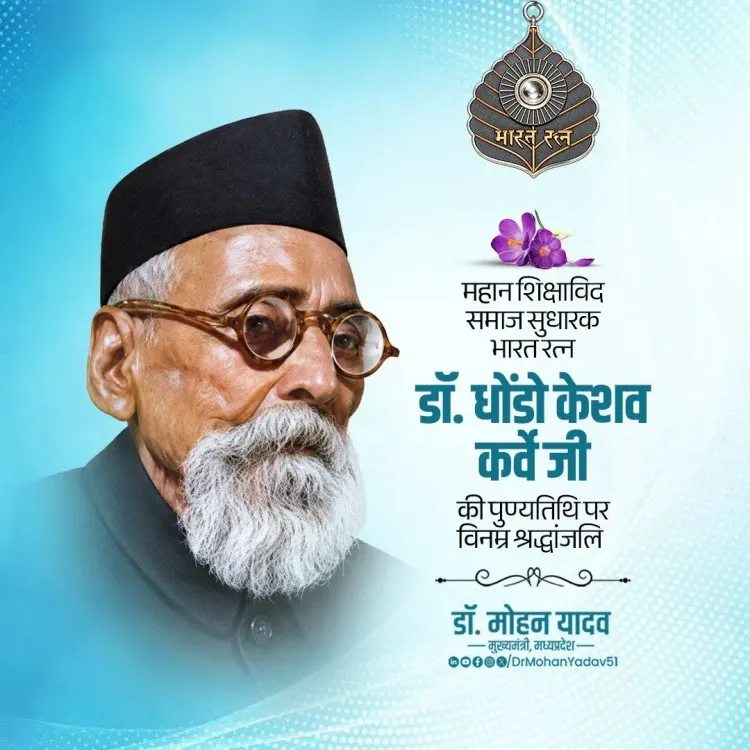
CM Mohan Yadav pays tribute to Bharat Ratna Dr. D.K. Karve
Synopsis
Madhya Pradesh Chief Minister Dr. Mohan Yadav on 9 November 2026 honoured Bharat Ratna Dr. Dhondo Keshav Karve on his death anniversary, calling women's education the foundation of social transformation and praising Karve's century-long crusade for gender equality.
Key Takeaways
Mohan Yadav , Chief Minister of Madhya Pradesh, posted a tribute to Dr.
Karve on his death anniversary on 9 November 2026 .
Dhondo Keshav Karve (1858–1962) was a social reformer and educationist who championed widow remarriage and women's higher education.
He founded SNDT Women's University in 1916 , one of India's first universities exclusively for women.
Karve was awarded the Bharat Ratna in 1958 , coinciding with his hundredth birthday .
CM Yadav described Karve's life and ideas as a permanent source of inspiration for women's empowerment and social equality.
A life that spanned 104 years and rewrote the rules for half of India's population deserves more than a footnote — and Madhya Pradesh Chief Minister Dr. Mohan Yadav paused on Monday, 9 November 2026 to mark the death anniversary of Bharat Ratna Dr. Dhondo Keshav Karve, the visionary who staked his reputation on the radical idea that educating women was the surest path to a just society.
Posting on X in Hindi, Dr. Yadav wrote: 'महान समाज सुधारक, शिक्षाविद एवं भारत रत्न, डॉ. धोंडो केशव कर्वे जी की पुण्यतिथि पर विनम्र श्रद्धांजलि अर्पित करता हूं।' ('I offer humble homage on the death anniversary of the great social reformer, educationist and Bharat Ratna, Dr. Dhondo Keshav Karve.') He added that Karve treated women's education as 'the foundation of social transformation' and dedicated his entire life to strengthening women's empowerment and the spirit of equality — and that his inspiring life and ideas 'will continue to guide us forever.'
The reformer who built a university for widows
Dr. Dhondo Keshav Karve was born in 1858 in Maharashtra and lived until 1962 — a century of witness to India's transformation from colonial rule to independent republic. At a time when widow remarriage was socially taboo, he championed it, and in 1916 he founded what became SNDT Women's University, one of the country's first universities dedicated entirely to women's higher education. The Indian state recognised his life's work with the Bharat Ratna in 1958, awarded on his hundredth birthday.
Women's education as the axis of his legacy
Karve's core conviction — that no society can claim progress while its women are denied learning — resonates as sharply today as it did in the late nineteenth century. He ran ashrams for widows, established schools, and mobilised resources at a time when such activism invited fierce social resistance. His institutions outlived him and continue to shape women's education policy across India.
A tradition of remembering India's reform giants
Tributes like this one are a fixture of Indian political culture — leaders across the spectrum mark the birth and death anniversaries of pre-independence reformers to signal continuity with a broader civilisational project. For Madhya Pradesh, where girls' education metrics have historically lagged national averages, invoking Karve's legacy carries a pointed policy undertone: the unfinished work of gender parity in classrooms remains live.
Karve showed that one person with a clear moral purpose and a stubborn institutional vision could bend history. The question his anniversary always leaves on the table is how far the current generation has carried that bend.
Point of View
But invoking Karve specifically ties a BJP leader to a Maharashtra-born liberal reformist tradition — a pointed act of cross-regional, cross-ideological claim-staking. For Madhya Pradesh, where female literacy and enrolment gaps persist, the tribute also functions as a soft signal toward ongoing state commitments on girls' education. Karve's core thesis — that institutions, not just rhetoric, drive gender equity — remains the most demanding test of any government's sincerity on the subject.
NationPress
9 Nov 2026
Frequently Asked Questions
Who was Dr. Dhondo Keshav Karve?
Dr. Dhondo Keshav Karve (1858–1962) was a Maharashtra-born social reformer and educationist who advocated widow remarriage and founded SNDT Women's University in 1916 . He received the Bharat Ratna in 1958 on his hundredth birthday for his lifelong work in women's education.
Why is Dr. Karve's death anniversary observed?
Dr. Karve's death anniversary is observed to commemorate his transformative contributions to women's empowerment, widow rehabilitation, and the institutionalisation of women's higher education in India — work that continues to influence education policy.
What did CM Mohan Yadav say about Dr. Karve?
CM Dr. Mohan Yadav said Karve treated women's education as 'the foundation of social transformation' and dedicated his entire life to women's empowerment and equality. He described Karve's life and ideas as a source of perpetual inspiration.
Which university did Dr. Karve found?
Dr. Karve founded SNDT Women's University in 1916 , one of India's first universities established exclusively for women's higher education.
When did Dr. Karve receive the Bharat Ratna?
Dr. Dhondo Keshav Karve received the Bharat Ratna in 1958 , awarded on the occasion of his hundredth birthday , in recognition of his decades-long service to women's education and social reform.