CM Mohan Yadav Pays Tribute to Dr. Ram Manohar Lohia
Synopsis
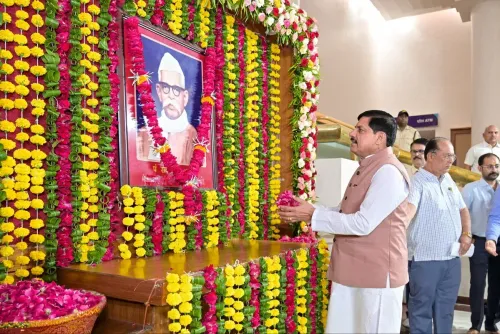
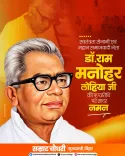
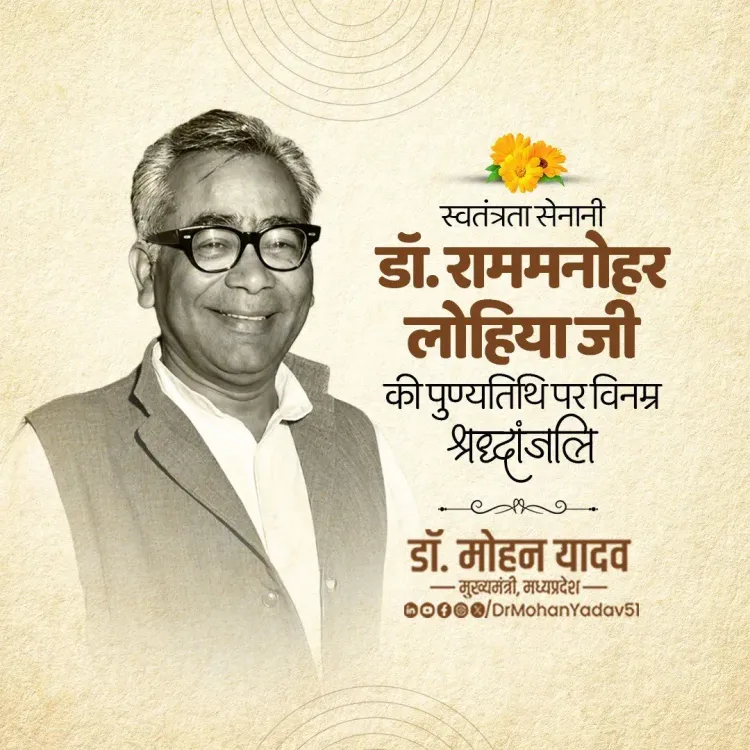
Madhya Pradesh Chief Minister Dr. Mohan Yadav honoured socialist freedom fighter Dr. Ram Manohar Lohia on his 59th death anniversary, recalling his vision of making every citizen a partner in India's post-independence development.
Key Takeaways
October 12 marks the death anniversary of freedom fighter and socialist thinker Dr.
Ram Manohar Lohia , who passed away in 1967 .
Madhya Pradesh CM Dr.
Mohan Yadav offered tribute, highlighting Lohia's mission to make every citizen a partner in national development.
Lohia was born on 23 March 1910 and was a close associate of Mahatma Gandhi during the independence movement.
He championed the rights of Dalits, women, and OBCs and is widely regarded as the founding voice of democratic socialism in India.
His concept of chaukhamba raj — distributed governance across four pillars — anticipated modern decentralisation debates.
Tributes from across party lines underscore Lohia's status as a shared democratic inheritance, not the legacy of a single political tradition.
On the death anniversary of freedom fighter and socialist thinker Dr. Ram Manohar Lohia, Madhya Pradesh Chief Minister Dr. Mohan Yadav offered his humble tribute, honouring a man whose ideas on participatory development continue to resonate across India's political landscape.
In his post on Monday, October 12, 2026, CM Yadav wrote: 'स्वतंत्रता के बाद देश के विकास में जन-जन को भागीदार बनाने के लिए उन्होंने देश को जागृत किया' — 'After independence, he awakened the nation so that every citizen could become a partner in the country's development.' He added that Lohia's ideas continue to inspire patriotism.
Lohia's Legacy: Socialism, Civil Defiance, and Grassroots India
Dr. Ram Manohar Lohia was born on 23 March 1910 and passed away on 12 October 1967 — making this his 59th death anniversary. A towering figure of India's independence movement, he was a close associate of Mahatma Gandhi and later emerged as the foremost voice of democratic socialism in post-independence India.
Lohia was uncompromising in his belief that independence meant little without economic and social equity for India's poorest citizens. He championed the cause of Dalits, women, and Other Backward Classes at a time when such advocacy was politically inconvenient, and his concept of 'chaukhamba raj' — a four-pillar model of distributed governance — anticipated modern debates about decentralisation by decades.
A BJP Chief Minister Honouring a Socialist Icon
The tribute from a BJP leader carries a particular resonance. Lohia spent much of his political life in fierce opposition to the Congress — a legacy that parties across the ideological spectrum, including the BJP, have at times invoked to frame their own anti-establishment credentials. His insistence on caste-based equity and social justice, however, remains most directly carried forward by parties in the socialist tradition.
That leaders from different political corners pause to honour Lohia on his death anniversary is itself a measure of how foundational his thinking has become to Indian democratic discourse — not the property of any single party, but a shared inheritance of the republic.
Point of View
People-first voice. For the BJP, invoking Lohia's anti-Congress legacy has long served a strategic purpose, even as the socialist redistributive policies he championed sit uneasily with the party's economic orientation. The tribute also signals how Lohia's emphasis on grassroots participation and OBC representation has become politically indispensable in states like Madhya Pradesh, where backward-class mobilisation shapes electoral outcomes. His death anniversary, observed year after year across the spectrum, is less a political act than a reminder that some legacies outlast the parties that claim them.
NationPress
12 Oct 2026
Frequently Asked Questions
When did Dr. Ram Manohar Lohia die?
Dr. Ram Manohar Lohia passed away on 12 October 1967 . His death anniversary, known as punyatithi , is observed every year on this date.
Who was Dr. Ram Manohar Lohia?
Dr. Ram Manohar Lohia was an Indian freedom fighter, philosopher, and democratic socialist, born on 23 March 1910 . He was a key figure in the independence movement and later founded the socialist political tradition in post-independence India.
Why did CM Mohan Yadav pay tribute to Lohia?
Madhya Pradesh Chief Minister Dr. Mohan Yadav offered tribute on Lohia's death anniversary, honouring his vision of inclusive national development and his inspiration for patriotism across generations.
What were Dr. Lohia's main political ideas?
Lohia championed democratic socialism, rights of Dalits, women, and OBCs, and proposed the concept of chaukhamba raj — a distributed, four-pillar model of governance. He was a fierce critic of economic inequality in post-independence India.
What is the significance of Lohia's death anniversary in Indian politics?
Lohia's death anniversary is observed across party lines in India, reflecting his enduring stature as a voice for social justice and participatory democracy. Leaders from the BJP, socialist parties, and regional outfits all regularly pay tribute to him.