CM Mohan Yadav Pays Tribute to Swami Vivekananda on Death Anniversary
Synopsis
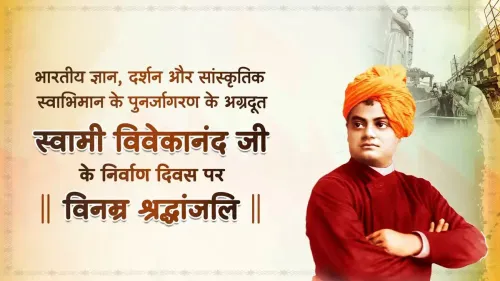
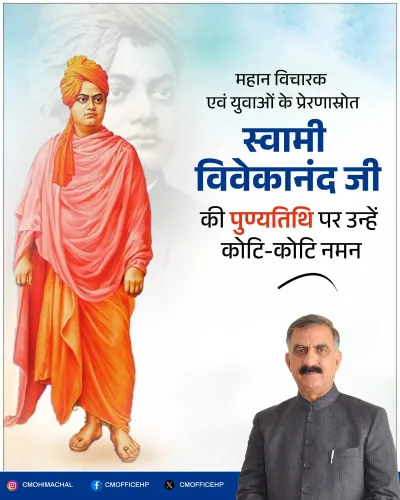
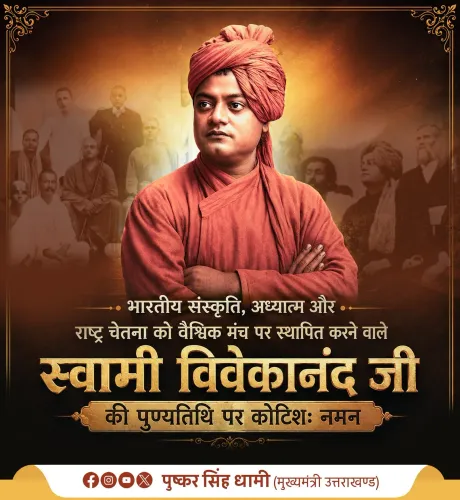
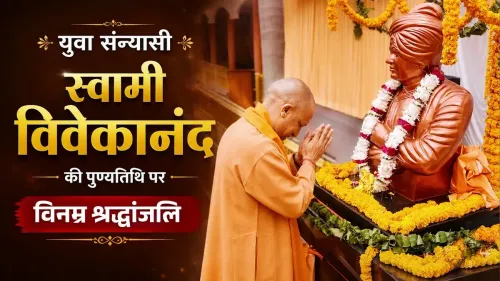
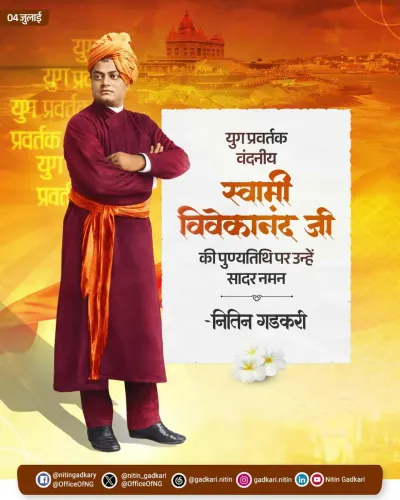
Madhya Pradesh Chief Minister Dr. Mohan Yadav paid tribute to Swami Vivekananda on his death anniversary on 4 July 2026, calling the philosopher-monk's ideas on youth awakening and self-reliance the motivating foundation for building a developed and empowered India.
Key Takeaways
Mohan Yadav , Chief Minister of Madhya Pradesh , paid tribute to Swami Vivekananda on his death anniversary on 4 July 2026 .
He described Vivekananda as an immortal inspiration for nation-building, youth awakening, and spiritual consciousness.
The Chief Minister linked Vivekananda's teachings directly to the goals of a developed ( Viksit ), self-reliant ( Atmanirbhar ), and empowered India.
12 January , Vivekananda's birth anniversary, has been observed as National Youth Day in India since 1984 .
The BJP has consistently cited Vivekananda's philosophy of inner strength and self-reliance in its public and policy messaging since 2014 .
Vivekananda's landmark address at the Parliament of the World's Religions in Chicago in 1893 remains a touchstone in India's cultural diplomacy narrative.
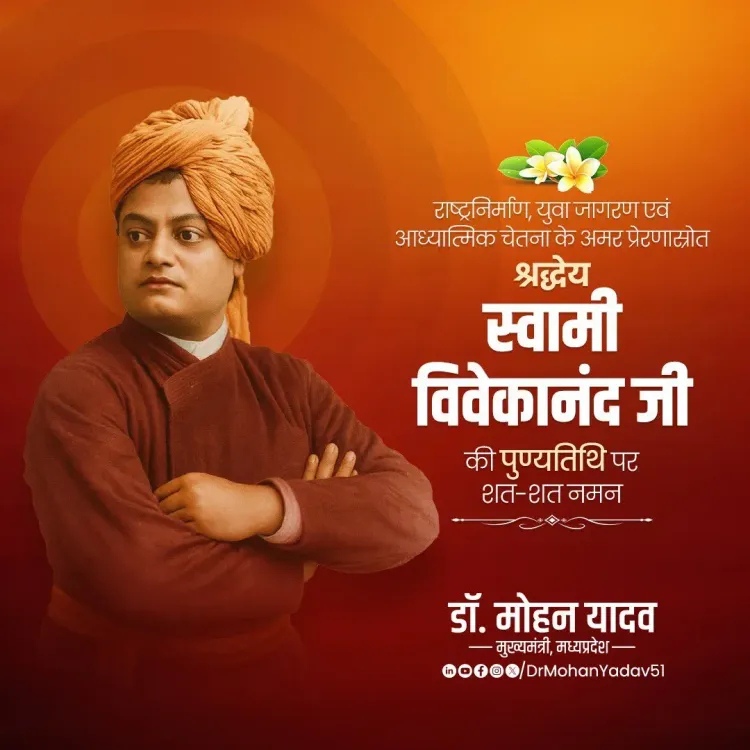
Madhya Pradesh Chief Minister Dr. Mohan Yadav on Saturday, 4 July 2026 paid tribute to Swami Vivekananda on the philosopher-monk's death anniversary, invoking his legacy of nation-building, youth awakening, and spiritual consciousness as a guiding force for a self-reliant and developed India.
Context
In his post, Dr. Yadav offered 'koti-koti naman' (countless salutations) to Vivekananda, describing him as an immortal source of inspiration for 'rashtra nirman, yuva jagran evam adhyatmik chetna' — nation-building, youth awakening, and spiritual consciousness. He credited Vivekananda's 'powerful ideas, extraordinary inner strength, and nation-dedicated vision' with bringing glory to India's Sanatan cultural consciousness on the world stage. The Chief Minister also underlined that Vivekananda's messages for youth remain a motivating foundation for building a developed, self-reliant, and empowered India.
Policy Backdrop
Swami Vivekananda's death anniversary falls on 4 July, while his birth anniversary on 12 January has been observed as National Youth Day since 1984, when the Government of India formally recognised his ideas on character-building and national service as a model for Indian youth. Since 2014, the central government has repeatedly cited Vivekananda's teachings while articulating the Atmanirbhar Bharat and Viksit Bharat campaigns, drawing a deliberate line between his spiritual philosophy of inner strength and the policy goal of economic self-reliance. BJP-ruled states, including Madhya Pradesh, have institutionalised such tributes as part of a wider cultural policy that positions historical spiritual leaders as sources of ideological motivation for governance and youth outreach.
Stakeholders and Impact
The tribute is directed most visibly at Indian youth, who form both a key electoral and policy constituency for the BJP government in Madhya Pradesh. Vivekananda's 1893 address at the Parliament of the World's Religions in Chicago remains one of the most cited moments in modern Indian cultural diplomacy, and references to it carry resonance in state messaging around soft power and civilisational pride. State cultural bodies and youth organisations in Madhya Pradesh are the institutional stakeholders most directly engaged by such commemorative communications.
What's Next
Observers will watch whether the tribute translates into concrete state-level initiatives — such as curriculum modules, cultural festivals, or youth empowerment programmes — that link Vivekananda's philosophy to the government's development agenda in the months ahead. The alignment of his death anniversary tribute with the language of Viksit Bharat and Atmanirbhar Bharat signals that Dr. Yadav's administration is likely to continue weaving this ideological thread into its public communications and policy framing through the rest of 2026.
Point of View
Particularly youth mobilisation and economic self-reliance. By explicitly connecting Vivekananda's legacy to the language of 'Viksit Bharat' and 'Atmanirbhar Bharat', the Chief Minister is reinforcing a cultural-nationalist policy framework that gives historical spiritual authority to present-day development campaigns. This approach has deepened since 2014, with BJP-ruled states institutionalising such tributes as a soft-power instrument that simultaneously addresses cultural, electoral, and policy audiences. The real test will be whether Madhya Pradesh follows the tribute with tangible youth programmes or curriculum initiatives that give Vivekananda's philosophy an institutional footprint beyond commemorative messaging.
NationPress
4 Jul 2026
Frequently Asked Questions
When is Swami Vivekananda's death anniversary?
Swami Vivekananda's death anniversary falls on 4 July each year. He passed away on 4 July 1902 at Belur Math, West Bengal.
Why is 12 January celebrated as National Youth Day in India?
12 January is celebrated as National Youth Day because it is Swami Vivekananda's birth anniversary. The Government of India declared it so in 1984 to honour his ideas on character-building and national service as a model for Indian youth.
What did CM Mohan Yadav say about Swami Vivekananda?
Dr. Mohan Yadav called Swami Vivekananda an immortal source of inspiration for nation-building, youth awakening, and spiritual consciousness, and said his messages for youth are the motivating foundation for building a developed, self-reliant, and empowered India.
What is the connection between Swami Vivekananda and Atmanirbhar Bharat?
The central government and BJP-ruled states have repeatedly cited Vivekananda's philosophy of inner strength and self-reliance as a spiritual precursor to the Atmanirbhar Bharat campaign, drawing a parallel between his call for individual empowerment and the policy goal of national economic self-sufficiency.
What did Swami Vivekananda do at the Parliament of the World's Religions?
Swami Vivekananda delivered a landmark address at the Parliament of the World's Religions in Chicago in 1893 , presenting Vedanta and yoga to a Western audience and articulating a message of universal tolerance and India's spiritual heritage that brought him global recognition.