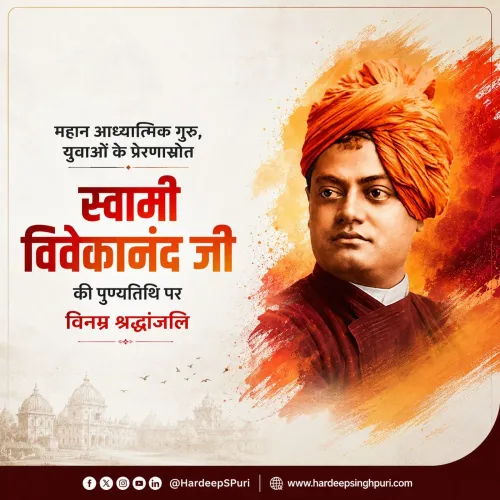
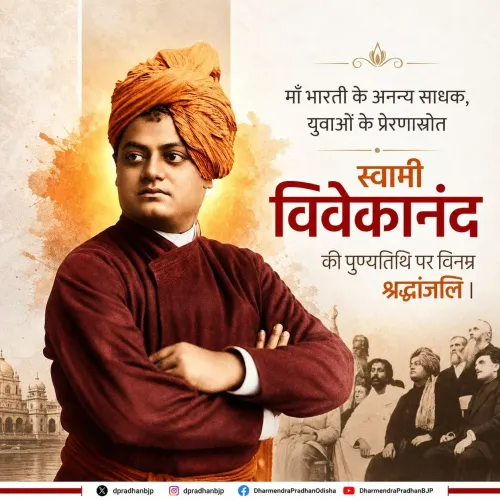
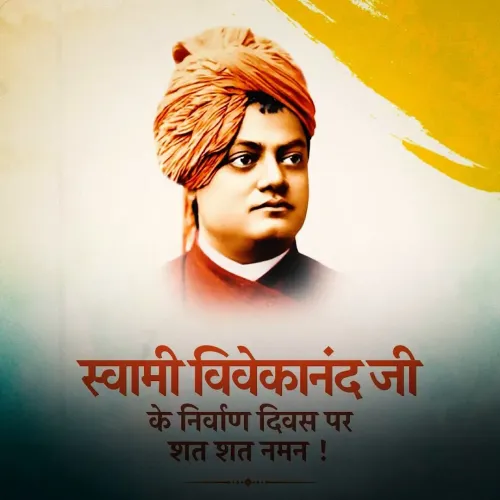
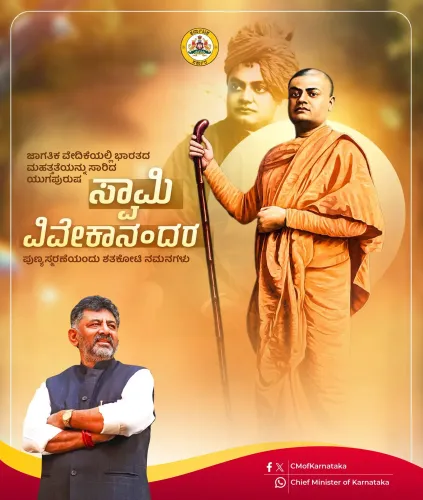
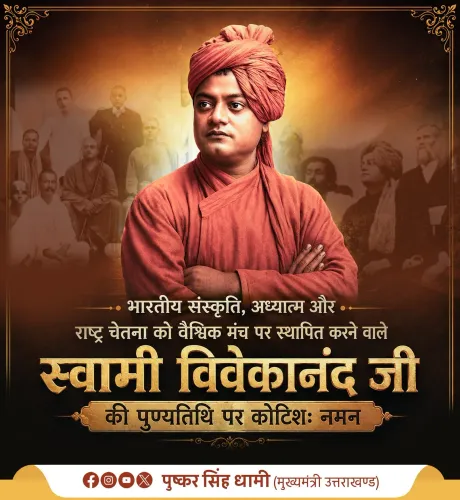
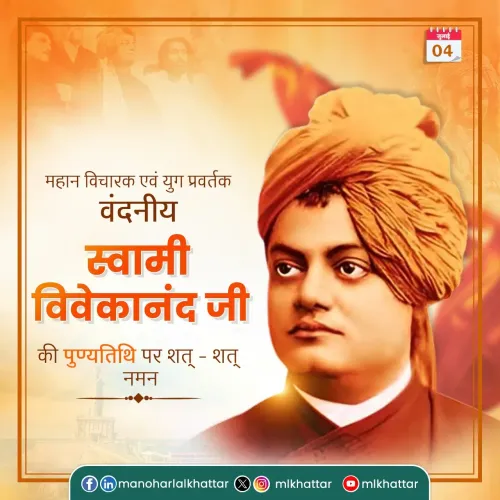
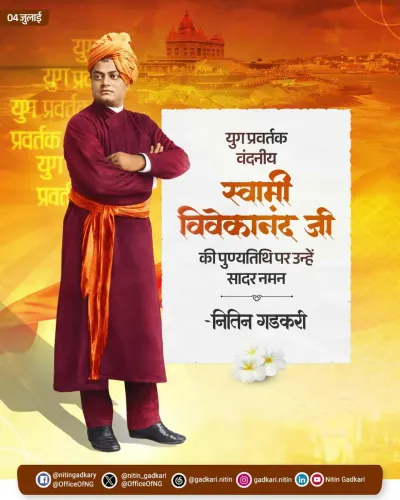
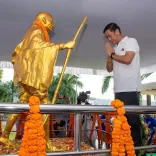
Shekhawat pays tribute to Swami Vivekananda on death anniversary
Synopsis
Union Culture and Tourism Minister Gajendra Singh Shekhawat on 4 July 2026 paid homage to Swami Vivekananda on his death anniversary, saluting the 19th-century philosopher-monk as an epoch-maker who carried the banner of Indian culture and spirituality to the world.
Key Takeaways
Gajendra Singh Shekhawat , Union Culture and Tourism Minister, paid tribute to Swami Vivekananda on his death anniversary, 4 July 2026 .
Shekhawat described Vivekananda as an 'epoch-maker' who spread Indian culture and spirituality globally.
Vivekananda passed away on 4 July 1902 at Belur Math , near Kolkata, aged 39.
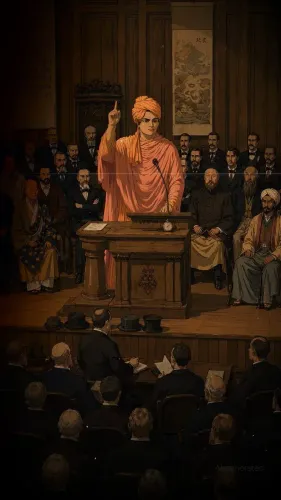
His landmark address at the 1893 Parliament of the World's Religions in Chicago introduced Vedanta and Yoga to the West.
The Government of India declared 12 January , Vivekananda's birth anniversary, as National Youth Day in 1984 .
The Ramakrishna Mission , founded by Vivekananda in 1897 , continues to operate schools, hospitals, and relief programmes worldwide.
Union Culture and Tourism Minister Gajendra Singh Shekhawat on Saturday, 4 July 2026 paid homage to Swami Vivekananda on the philosopher-monk's death anniversary, hailing him as a epoch-making thinker who carried the banner of Indian culture and spirituality across the world.
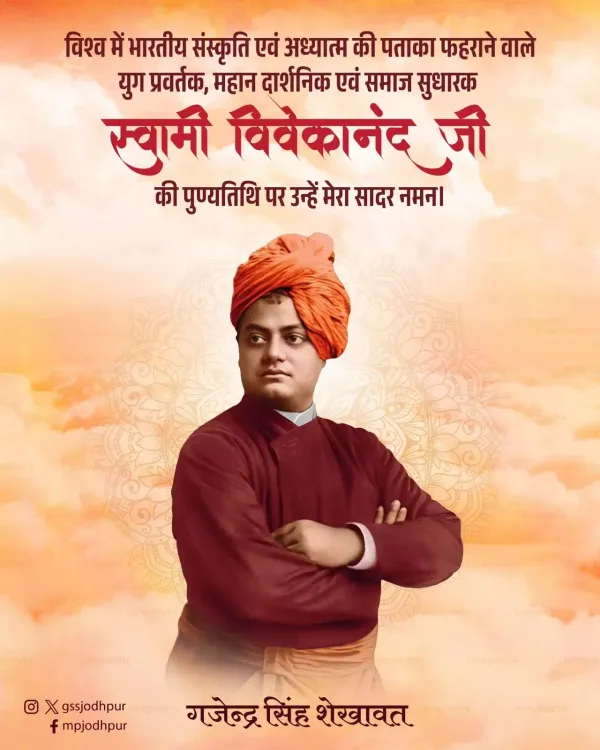
Posting in Hindi on X, Shekhawat wrote: 'Vishwa mein Bharatiya sanskriti evam adhyatm ki pataka fehraaney waley yug pravartak, mahaan darshnik evam samaaj sudharak Swami Vivekananda ji ki punyatithi par unhe mera saadar naman' — ('My respectful salute to Swami Vivekananda, the epoch-maker who unfurled the flag of Indian culture and spirituality across the world, the great philosopher and social reformer, on his death anniversary.')
Context
Swami Vivekananda was born on 12 January 1863 in Calcutta and passed away on 4 July 1902 at Belur Math, near Kolkata, at the age of 39. His death anniversary, observed annually on 4 July, draws tributes from political leaders, cultural organisations, and citizens across India. Shekhawat's post is part of a long-standing tradition of official commemoration that underlines Vivekananda's enduring place in India's national consciousness.
Vivekananda is best known for his landmark address at the 1893 Parliament of the World's Religions in Chicago, where he introduced Vedanta and Yoga to a Western audience and opened his speech with the celebrated salutation to 'sisters and brothers of America.' That address is widely regarded as a turning point in the global reception of Indian philosophy.
Policy Backdrop
The Government of India declared 12 January — Vivekananda's birth anniversary — as National Youth Day in 1984, recognising his transformative influence on young Indians. In 1897, Vivekananda himself founded the Ramakrishna Mission, a spiritual and philanthropic organisation that continues to run schools, hospitals, and relief operations across India and abroad.
As Union Minister of Culture and Tourism, Shekhawat oversees a portfolio that directly engages with Vivekananda's legacy — from heritage site preservation to cultural diplomacy initiatives that project India's civilisational contributions on the world stage. Commemorations of reformers such as Vivekananda fit within a broader government emphasis on soft-power projection rooted in India's philosophical traditions.
Stakeholders and Impact
The tribute resonates with a wide cross-section of stakeholders: youth organisations inspired by Vivekananda's call to action, the Ramakrishna Mission and its global network of centres, and cultural bodies that draw on his writings to promote national identity. For the Tourism Ministry, sites associated with Vivekananda — including Belur Math, the Vivekananda Rock Memorial in Kanyakumari, and his birthplace in Kolkata — represent significant pilgrimage and heritage tourism destinations.
Indian governments across administrations have consistently invoked Vivekananda to reinforce narratives of civilisational pride and to position India as a historic contributor to global thought, making such tributes a point of broad political consensus.
What's Next
Observers will watch for any ministry-level announcements around Vivekananda-associated heritage circuits, memorial upgrades, or cultural exchange programmes timed to significant anniversaries. With 2027 marking 125 years since Vivekananda's passing, the Culture and Tourism Ministry may use the milestone to launch commemorative initiatives that combine heritage tourism with India's ongoing cultural diplomacy agenda.
Point of View
Consistent with the BJP government's sustained effort to foreground India's civilisational heritage as a pillar of both domestic identity and foreign soft power. As Culture and Tourism Minister, his invocation of Vivekananda carries institutional weight beyond a personal gesture, implicitly linking the ministry's agenda to the monk's legacy of spiritual nationalism. The commemoration also keeps Vivekananda's memory alive as a non-partisan icon — one whose appeal cuts across ideological lines — making such tributes a low-risk, high-resonance form of public communication. With the 125th death anniversary approaching in 2027, the ministry is likely to build on this foundation with more substantive programmatic announcements.
NationPress
2 Oct 2026
Frequently Asked Questions
When did Swami Vivekananda die?
Swami Vivekananda died on 4 July 1902 at Belur Math, near Kolkata, at the age of 39.
Why is 12 January celebrated as National Youth Day in India?
The Government of India declared 12 January as National Youth Day in 1984 to mark Swami Vivekananda's birth anniversary, honouring his inspirational influence on Indian youth.
What did Swami Vivekananda do at the 1893 Parliament of the World's Religions?
Vivekananda delivered a landmark address at the Parliament of the World's Religions in Chicago in 1893 , introducing Vedanta and Yoga to a Western audience and earning global recognition for Indian philosophy.
Who is Gajendra Singh Shekhawat?
Gajendra Singh Shekhawat is the Union Minister of Culture and Tourism, a senior BJP leader, and Lok Sabha MP from Jodhpur, Rajasthan .
What is the Ramakrishna Mission?
The Ramakrishna Mission is a spiritual and philanthropic organisation founded by Swami Vivekananda in 1897 to propagate his teachings on service and Vedanta; it runs schools, hospitals, and relief operations across India and internationally.