CM Mohan Yadav to Attend Adirang Shilpkar Mahotsav 2026 Closing Ceremony
Synopsis
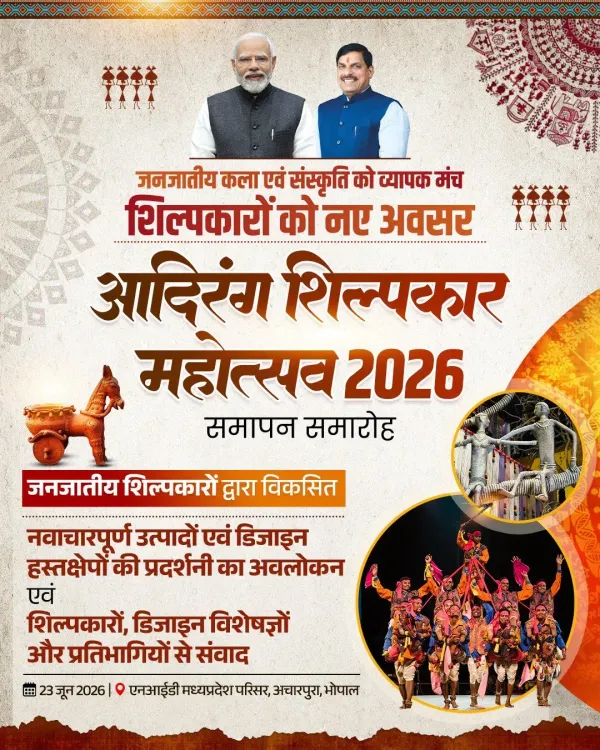
Madhya Pradesh Chief Minister Dr. Mohan Yadav announced he will attend the closing ceremony of Adirang Shilpkar Mahotsav 2026 in Bhopal on 23 June, engaging with participants in tribal crafts, art and traditions — reflecting the state's sustained focus on tribal cultural economy.
Key Takeaways
Mohan Yadav will participate in the closing ceremony of Adirang Shilpkar Mahotsav 2026 in Bhopal on 23 June 2026 .
The festival is dedicated to tribal crafts, art, traditions and indigenous products from across Madhya Pradesh .
The CM will hold direct conversations with artisan participants at the event.
Madhya Pradesh has a long-standing policy of supporting tribal craft exhibitions as tools of cultural preservation and economic empowerment.
Tribal artisans and rural craft clusters are the primary stakeholders, with potential follow-up announcements on state procurement or marketing support.
The event reflects the BJP -led state government's broader emphasis on cultural economy and tribal heritage.
Madhya Pradesh Chief Minister Dr. Mohan Yadav announced on Tuesday, 23 June 2026 that he will participate in the closing ceremony of Adirang Shilpkar Mahotsav 2026 in Bhopal, where he will also engage directly with participants showcasing tribal crafts, art, traditions and other products.
Context
In his post, Dr. Yadav stated — 'जहां जनजातीय शिल्प, कला, परंपराओं व अन्य उत्पादों के प्रतिभागियों से संवाद भी करूंगा' — ('I will also hold conversations with participants in tribal crafts, art, traditions and other products') — signalling a hands-on engagement rather than a ceremonial appearance. The festival, titled Adirang Shilpkar Mahotsav, appears to be a state-level platform dedicated to celebrating and showcasing the rich indigenous craft heritage of Madhya Pradesh.
Bhopal, the state capital, has served as a recurring venue for cultural and governance events under the Madhya Pradesh government, making it a natural host for a flagship tribal arts festival of this scale.
Policy Backdrop
Madhya Pradesh governments have organised tribal art and craft exhibitions for well over a decade, treating such events as instruments of both cultural preservation and economic empowerment for artisan communities. The broader approach links indigenous producers to markets, reduces dependence on middlemen, and creates visibility for craft clusters that might otherwise remain confined to rural corridors.
These festivals operate in alignment with central government schemes that emphasise documentation, skill upgradation and market access for Scheduled Tribe producers. Under the BJP-led state government, the cultural economy has received sustained attention as a policy pillar, with tribal heritage positioned as both a source of identity and a livelihood asset.
Stakeholders and Impact
The primary beneficiaries of events like Adirang Shilpkar Mahotsav are tribal artisans and rural craft clusters spread across Madhya Pradesh — a state with one of the largest Scheduled Tribe populations in India. Direct dialogue between the Chief Minister and participating artisans can carry practical significance, as such interactions have historically preceded announcements on state procurement, branding support or marketing tie-ups.
For the broader cultural ecosystem, the festival provides a platform for intangible heritage — songs, weaving techniques, pottery traditions, and ritual crafts — that risk gradual erosion without institutional backing. The closing ceremony, in particular, often sets the tone for policy commitments that carry through to the next edition.
What's Next
Observers and artisan groups will watch closely for any follow-up announcements on state procurement targets, expanded marketing support, or digital marketplace integration for participating craftspersons emerging from the closing ceremony. Any reference to the next edition of the festival or a permanent institutional structure for tribal craft promotion would mark a significant step beyond the event itself.
Dr. Yadav's participation underscores the Madhya Pradesh government's intent to keep tribal cultural economy at the centre of its public engagement calendar heading into the second half of 2026.
Point of View
Where craft festivals double as political engagement exercises with Scheduled Tribe communities. With Madhya Pradesh holding one of the country's largest tribal populations, such events carry both cultural and electoral weight. The real test will be whether the ceremony yields concrete policy commitments on market linkages and procurement that outlast the festival itself.
NationPress
23 Jun 2026
Frequently Asked Questions
What is Adirang Shilpkar Mahotsav 2026?
Adirang Shilpkar Mahotsav 2026 is a state-level festival held in Bhopal, Madhya Pradesh, dedicated to showcasing tribal crafts, art, traditions and indigenous products, with artisans from across the state participating.
Why is CM Mohan Yadav attending the tribal craft festival?
Dr. Mohan Yadav announced he will participate in the closing ceremony to engage directly with tribal artisan participants, consistent with the Madhya Pradesh government's policy of promoting tribal cultural economy.
Where is Adirang Shilpkar Mahotsav 2026 being held?
The festival is being held in Bhopal, the capital of Madhya Pradesh, which regularly hosts state-level cultural and governance events.
What is the significance of tribal craft festivals in Madhya Pradesh?
Madhya Pradesh has one of India's largest Scheduled Tribe populations, and tribal craft festivals serve as platforms for cultural preservation, artisan market linkages, and economic empowerment for rural craft clusters.
What follow-up actions are expected after the festival's closing ceremony?
Observers will watch for announcements on state procurement support, marketing tie-ups, or digital marketplace integration for tribal artisans, as well as any plans for the next edition of the festival.