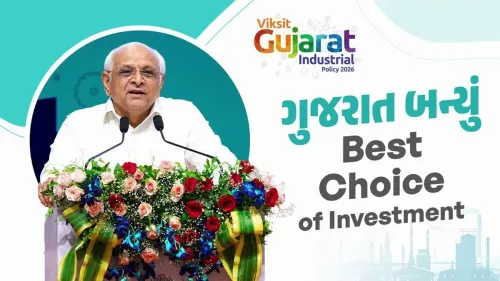
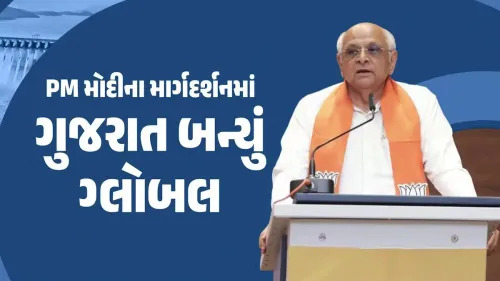
CM Bhupendra Patel Credits PM Modi for Gujarat's Industrial Rise
Synopsis
Gujarat Chief Minister Bhupendra Patel has penned a special article crediting PM Narendra Modi's 12-year leadership for transforming Gujarat from a traditional industrial base into a global hub in semiconductors, innovation, and green energy, linking the state's growth to the national Viksit Bharat vision.
Key Takeaways
The Chief Minister's Office of Gujarat shared a special article by CM Bhupendra Patel on 17 June 2026 crediting PM Modi 's leadership for Gujarat's industrial evolution.
Gujarat has expanded from a traditional manufacturing base into sectors including semiconductors, innovation, and green energy .
The Vibrant Gujarat Global Summit , launched in 2003 , is cited as a foundational step in attracting global investment to the state.
The India Semiconductor Mission and National Policy on Electronics (2021–22) have positioned Gujarat as a key destination for chip manufacturing investment.
CM Patel links Gujarat's growth directly to the national Viksit Bharat goal of a developed, self-reliant India by 2047 .
Semiconductor capacity milestones and renewable-energy auction results in 2026–27 will be key indicators of the transformation's progress.
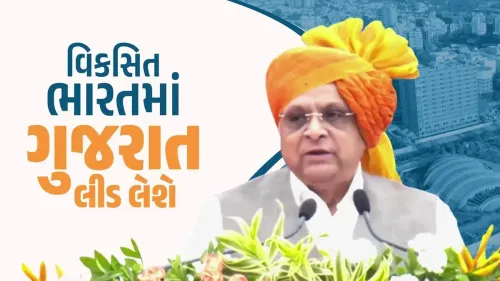
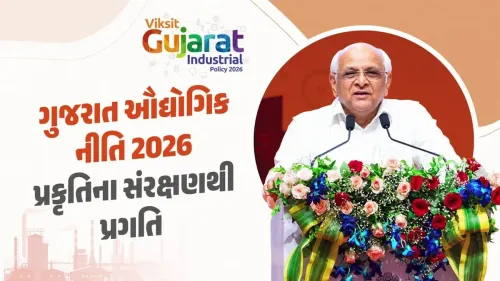
The Chief Minister's Office of Gujarat on Wednesday, 17 June 2026 shared a special opinion article authored by Chief Minister Shri Bhupendra Patel, tracing the state's evolution from a traditional industrial base to a global hub in semiconductors, innovation, and green energy — crediting Prime Minister Narendra Modi's 'unprecedented statesmanship' over the past 12 years as the driving force behind this transformation.
Context
In the article, CM Bhupendra Patel argues that Gujarat's growth journey is 'a reflection of the architectural vision' of PM Modi, who served as the state's Chief Minister from 2001 to 2014 before assuming national office. The piece situates Gujarat's industrial milestones within the broader national goal of Viksit Bharat (Developed India), the Prime Minister's vision for a self-reliant, high-technology economy by 2047.
The Chief Minister's Office described the article as highlighting how PM Modi's 'visionary leadership' over the last 12 years 'laid the foundation for a modern-progressive Gujarat, while steering the nation towards a Viksit Bharat.'
Policy Backdrop
Gujarat's industrial identity was shaped significantly by the Vibrant Gujarat Global Summit, first organised in 2003 under then-Chief Minister Modi to attract foreign direct investment and position the state as a manufacturing hub. That summit model became a template replicated across several Indian states.
On the technology front, the India Semiconductor Mission and the National Policy on Electronics, launched in 2021–22, gave fresh momentum to Gujarat's ambitions in chip design and fabrication. The state has since emerged as one of the primary destinations for semiconductor investment under the Atmanirbhar Bharat framework, which prioritises high-tech manufacturing and energy transition at the national level.
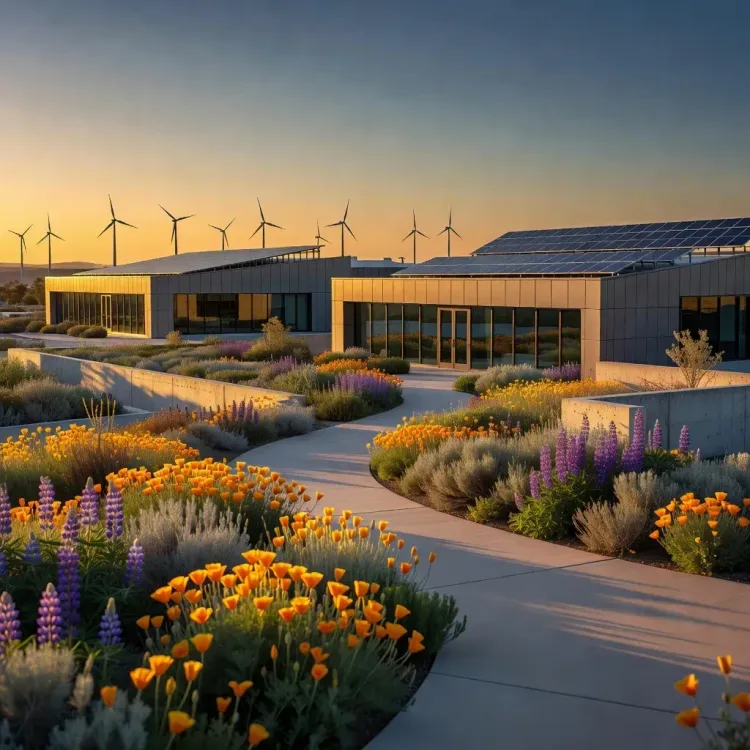
Renewable energy has been another pillar of this growth arc. Gujarat has long led India in wind and solar capacity, and the state's push into green hydrogen aligns directly with central government targets for clean-energy exports and domestic decarbonisation.
Stakeholders and Impact
The article's central audience is the industrial and investor community — particularly semiconductor manufacturers, electronics firms, and renewable-energy developers who have committed capital to Gujarat. For these stakeholders, a high-profile endorsement from the Chief Minister's office reinforces policy continuity and state-level commitment to ease of doing business.
For the broader political landscape, the piece reinforces the Bharatiya Janata Party's established narrative linking Gujarat's pre-2014 industrial model directly to post-2014 national missions. It is part of a pattern of state governments articulating local development outcomes as evidence of the national government's governance philosophy.
What's Next
Analysts and industry observers will watch for ground-breaking ceremonies and capacity milestones at approved semiconductor units in Gujarat, as well as the results of the state's renewable-energy auctions expected in 2026–27. These concrete outcomes will determine whether the transformation narrative outlined in CM Patel's article translates into measurable economic indicators.
If semiconductor fabrication capacity comes online on schedule, Gujarat could cement its position as India's first significant chip-manufacturing state — a milestone that would lend considerable weight to the Viksit Bharat agenda ahead of its 2047 horizon.
Point of View
The article draws a continuous thread from pre-2014 state policy to post-2014 national missions — a framing that is central to the party's development messaging. The explicit reference to Viksit Bharat signals that state governments are being positioned as visible proof-points of the 2047 vision, elevating routine governance milestones into a larger ideological arc. Whether semiconductor and green-energy targets materialise on schedule will ultimately determine how durable this narrative proves to be.
NationPress
16 Sept 2026
Frequently Asked Questions
What did Gujarat CM Bhupendra Patel write about PM Modi?
CM Bhupendra Patel authored a special article crediting PM Narendra Modi's 12-year leadership for Gujarat's transformation from a traditional industrial base into a global hub in semiconductors, innovation, and green energy, linking the state's journey to the national Viksit Bharat vision.
What is Viksit Bharat and how does it relate to Gujarat?
Viksit Bharat is PM Modi's vision for a developed, self-reliant India by 2047. CM Patel's article positions Gujarat's industrial and technology growth — particularly in semiconductors and renewables — as a concrete example of progress toward this national goal.
How has Gujarat transformed under PM Modi's influence?
Gujarat evolved from a traditional manufacturing base into a destination for semiconductor investment, electronics manufacturing, and green energy under policies shaped during PM Modi's tenure as Chief Minister (2001–2014) and continued through national missions after 2014.
What is the India Semiconductor Mission and its role in Gujarat?
The India Semiconductor Mission, launched in 2021–22, is a national programme to build domestic chip design and fabrication capacity. Gujarat has emerged as one of its primary investment destinations, with approved semiconductor units expected to reach capacity milestones in 2026–27.
What was the Vibrant Gujarat Global Summit?
The Vibrant Gujarat Global Summit was first organised in 2003 under then-Chief Minister Narendra Modi to attract foreign direct investment and position Gujarat as a manufacturing hub. It became a widely replicated model for state-level investor outreach across India.